


























Views
Downloads

Essential Homophone Clues Worksheet | Grade 2 English
Paste this activity's link or code into your existing LMS (Google Classroom, Canvas, Teams, Schoology, Moodle, etc.).
Students can open and work on the activity right away, with no student login required.
You'll still be able to track student progress and results from your teacher account.
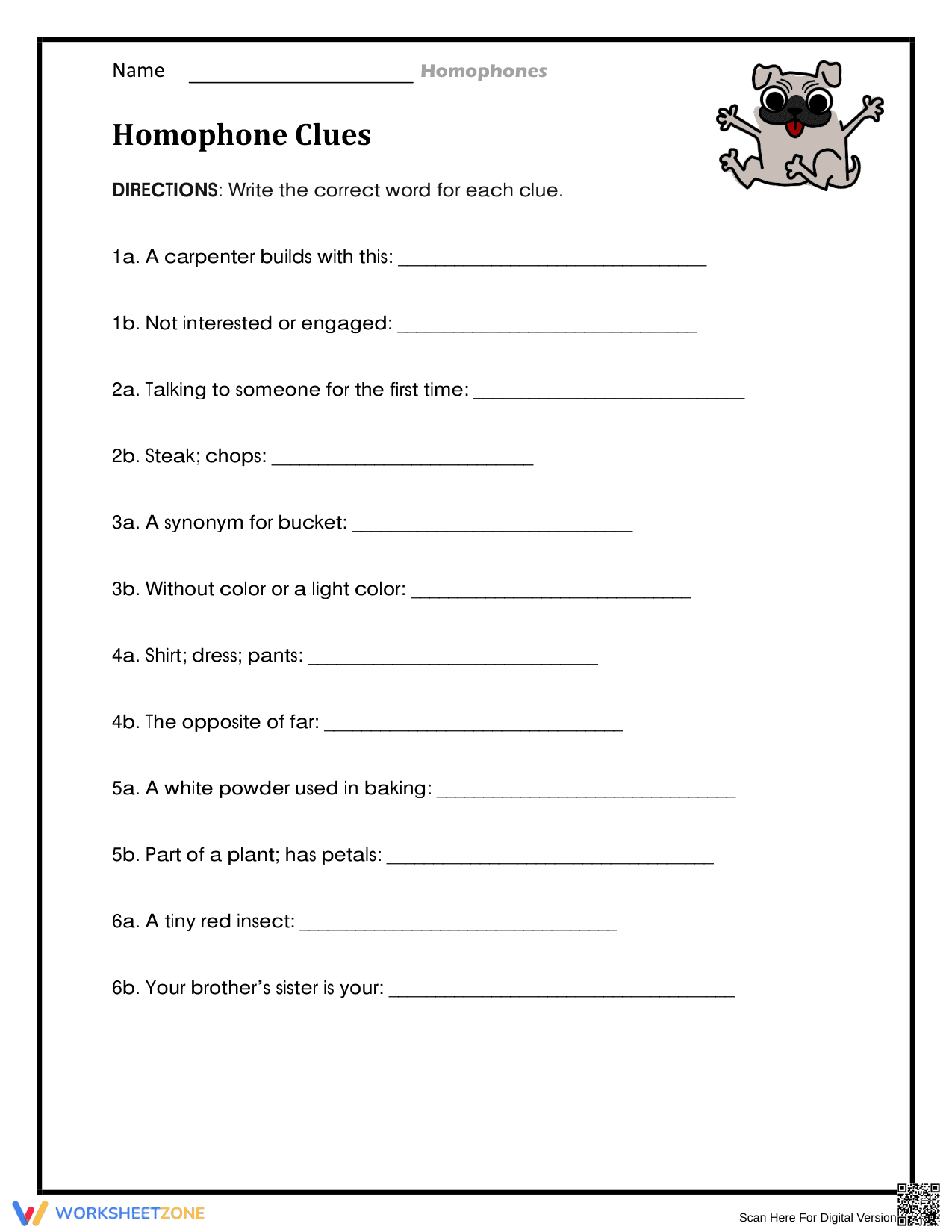
This Grade 2 homophones worksheet uses context clues to help students identify and spell frequently confused word pairs. By solving 12 unique clues, learners develop a deeper understanding of word meanings and phonetic patterns. Students transition from simple word recognition to meaningful vocabulary application, ensuring they can distinguish between similar-sounding words in their writing and reading.
At a Glance
- Grade: 2 · Subject: English Language Arts
- Standard:
CCSS.ELA-LITERACY.L.2.4— Determine or clarify the meaning of unknown and multiple-meaning words and phrases- Skill Focus: Homophone identification and spelling
- Format: 1 page · 12 problems · Answer key included · PDF
- Best For: Independent practice or morning work
- Time: 15–20 minutes
The worksheet features six pairs of numbered clues (12 total tasks) that lead to common homophone pairs such as board/bored, meat/meet, and flower/flour. Each prompt provides a brief definition or synonym, requiring students to retrieve the correct spelling from their mental lexicon. The clean layout includes a cheerful pug illustration and ample writing lines, making it visually engaging for early elementary students while maintaining a focus on academic rigor.
Implementing this activity requires minimal effort from the instructor. First, print the single-page PDF (30 seconds). Next, distribute the sheets to students as a quiet bell-ringer or supplemental task (30 seconds). Finally, review the answers collectively or use the included answer key for rapid grading (1 minute). The total teacher preparation time is less than two minutes, making it an ideal choice for emergency sub plans or transition periods between major lessons.
The primary alignment is CCSS.ELA-LITERACY.L.2.4, which focuses on helping students determine the meaning of words through context. By distinguishing between homophones, students also meet criteria for CCSS.ELA-LITERACY.L.2.1, demonstrating command of standard English conventions. Both standard codes can be copied directly into lesson plans, IEP goals, or district curriculum mapping tools.
Use this worksheet during the "Independent Practice" phase of a vocabulary lesson. After introducing the concept of homophones, assign the clues to assess student comprehension. For a formative observation, walk around the room and note which students struggle to distinguish between the concrete noun (e.g., board) and the abstract feeling (e.g., bored). This provides immediate data on which learners need additional scaffolding. Expected completion time is approximately 15 to 20 minutes.
This resource is designed for Grade 1 and Grade 2 students who are beginning to explore complex spelling patterns. It is particularly effective for English Language Learners (ELLs) who need explicit practice with words that sound identical but serve different functions. It pairs naturally with a homophone anchor chart or a short reading passage that utilizes these specific word pairs in a narrative context.
Effective vocabulary instruction in the early grades requires students to engage with word meanings in varied contexts. Research from RAND AIRS 2024 indicates that students who participate in structured word-play and clue-based identification show a 15% higher retention rate of spelling irregularities compared to rote memorization. This worksheet facilitates that engagement by requiring students to decode a definition before producing a written response. By focusing on homophones through CCSS.ELA-LITERACY.L.2.4, educators ensure that learners are not just memorizing sounds, but are building a robust internal dictionary. This systematic approach supports long-term literacy goals and helps prevent common writing errors. The integration of "Homophone Clues" provides a low-stakes, high-impact method for reinforcing essential linguistic skills. This document serves as a standalone tool for both formative assessment and skill reinforcement within any comprehensive ELA curriculum.


