


























Views
Downloads
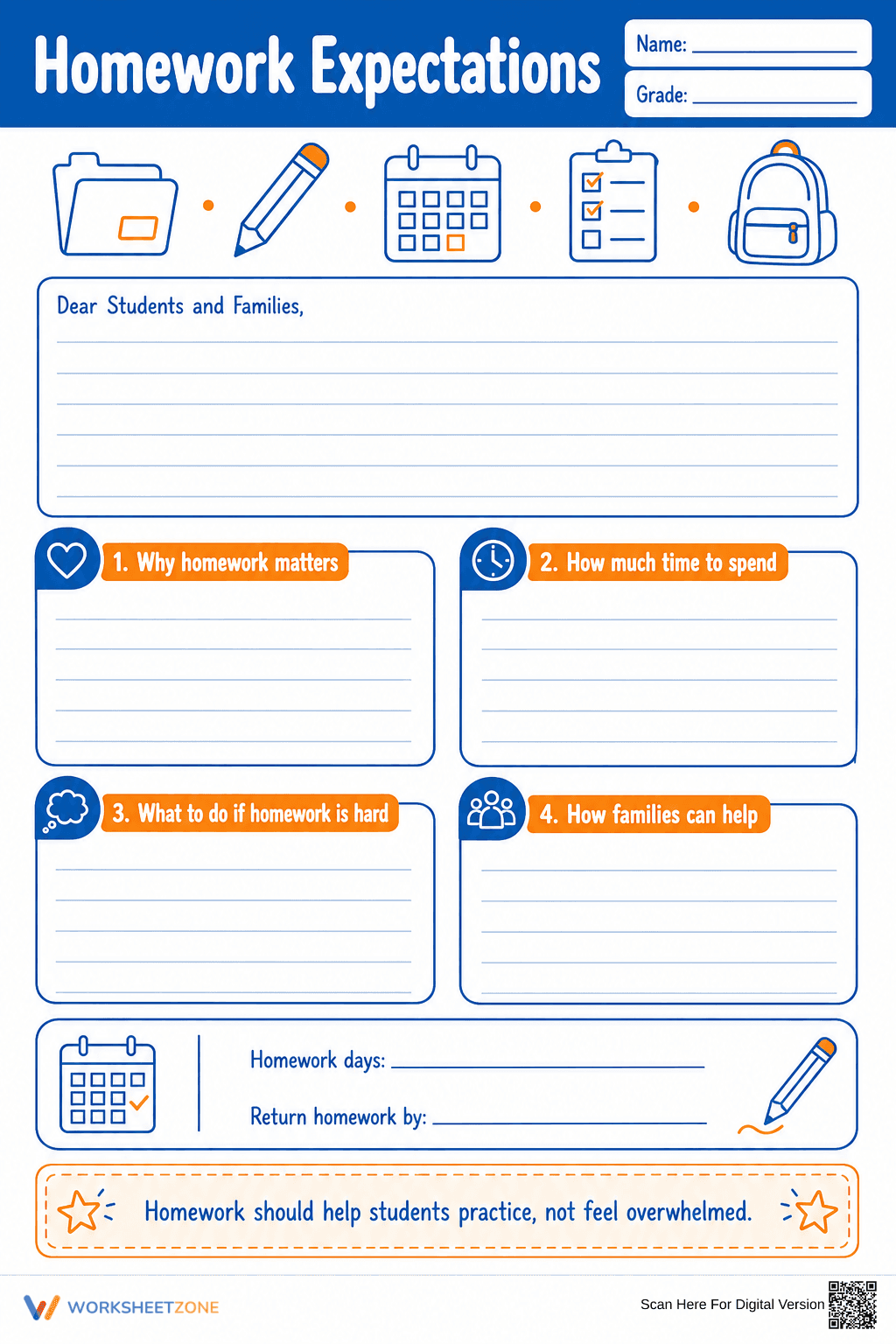

Homework Expectations Template | Essential Grade 3-6 Guide
Paste this activity's link or code into your existing LMS (Google Classroom, Canvas, Teams, Schoology, Moodle, etc.).
Students can open and work on the activity right away, with no student login required.
You'll still be able to track student progress and results from your teacher account.
This Grade 3-6 homework expectations worksheet provides a structured template for teachers to communicate essential classroom routines to students and families. By clearly outlining the purpose, timing, and support systems for home assignments, educators establish a transparent partnership that fosters student accountability and reduces academic anxiety from the first week of school.
At a Glance
- Grade: 3-6 · Subject: Classroom Management
- Standard:
CCSS.ELA-LITERACY.W.4.4— Produce clear writing organized for a specific task, purpose, and audience.- Skill Focus: Communication & Organization
- Format: 1 page · 4 sections · Template only · PDF
- Best For: Back-to-school family communication and routines
- Time: 5–10 minutes
The worksheet features a professional, high-contrast layout with blue and orange accents. It includes a primary "Dear Students and Families" greeting area followed by four distinct, icon-labeled modules: "Why homework matters," "How much time to spend," "What to do if homework is hard," and "How families can help." A dedicated logistics panel at the bottom captures specific due dates and return schedules.
This resource is designed for immediate implementation. First, print the single-page PDF (30 seconds). Second, hand-write or type your specific classroom policies into the four designated sections to customize the message for your cohort (5 minutes). Third, distribute the copies during Back-to-School Night or send them home in Friday folders to ensure every family has a physical reference for the year's expectations (2 minutes).
This resource aligns with `CCSS.ELA-LITERACY.W.4.4`, which requires students and educators to produce clear and coherent writing in which the development and organization are appropriate to task, purpose, and audience. By modeling organized communication, teachers demonstrate the standard's practical application. Both standard codes can be copied directly into lesson plans, IEP goals, or district curriculum mapping tools.
Use this worksheet as a formative tool during the first week of school. After filling it out, have students read the "Why homework matters" section aloud to facilitate a classroom discussion on goal setting. Alternatively, use it as a signature-required document to ensure parents have reviewed the "How families can help" section. Completion typically takes 10 minutes of teacher prep.
This template is ideal for general education teachers in upper elementary and middle school, as well as special education coordinators who need to simplify home-school communication for students with executive functioning challenges. It pairs naturally with a weekly planner or a digital learning management system (LMS) announcement.
Research by Fisher & Frey (2014) emphasizes that the efficacy of homework is significantly increased when the purpose is clearly communicated and the tasks are designed for independent practice rather than new learning. This worksheet facilitates that clarity by providing a structured framework for the CCSS.ELA-LITERACY.W.4.4 standard, ensuring that the task, purpose, and audience are explicitly defined for the home environment. By using a consistent communication tool, educators reduce the cognitive load on families, allowing them to focus on supporting the student's academic growth. The inclusion of a "What to do if homework is hard" section aligns with best practices in social-emotional learning, providing a safety net that prevents student frustration. This resource serves as a foundational component of a comprehensive classroom management strategy, bridging the gap between school-day instruction and home-based reinforcement.


