




























Views
Downloads

History of New York City Worksheet | Essential Grade 4 ELA

Paste this activity's link or code into your existing LMS (Google Classroom, Canvas, Teams, Schoology, Moodle, etc.).
Students can open and work on the activity right away, with no student login required.
You'll still be able to track student progress and results from your teacher account.
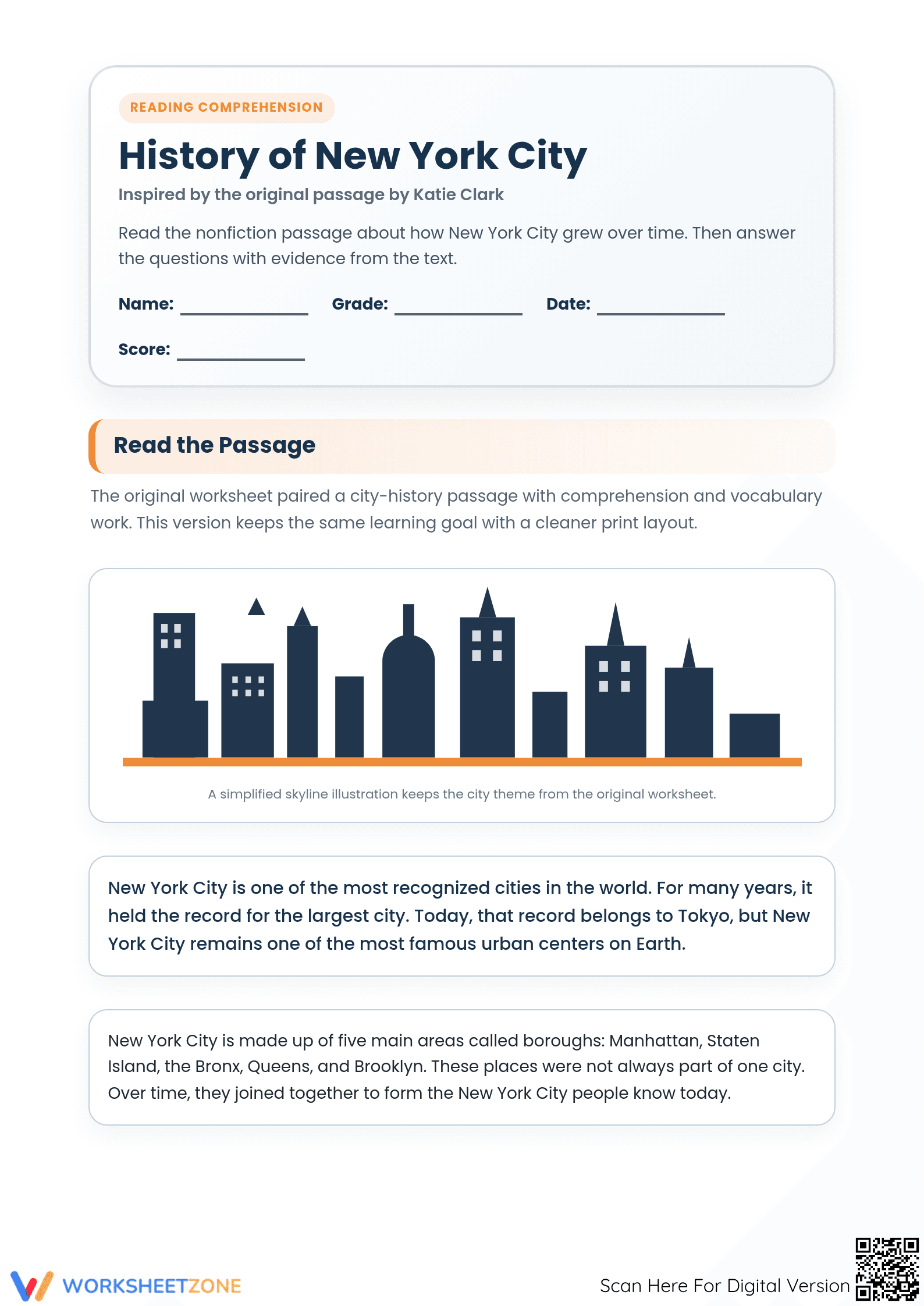
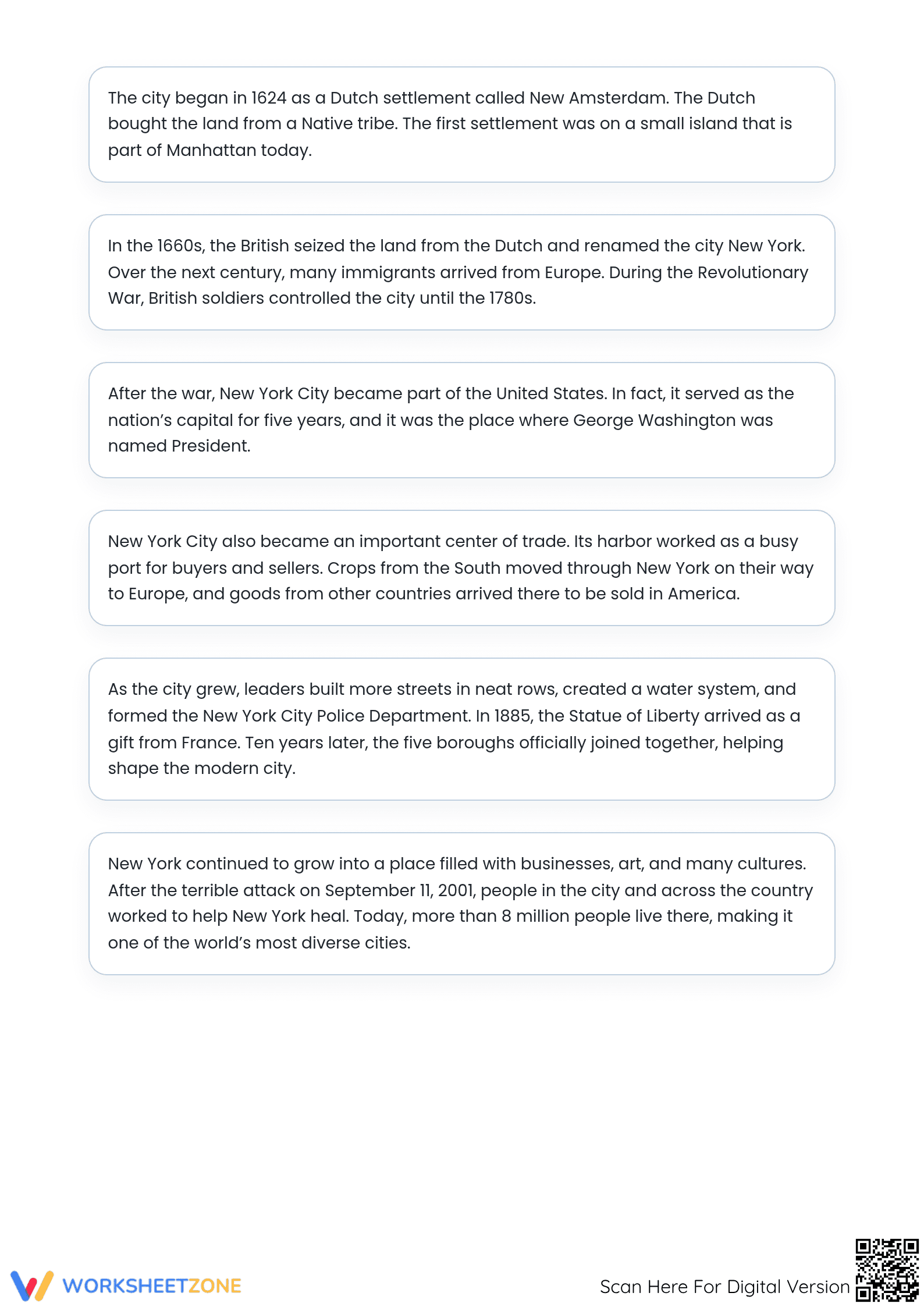
This History of New York City reading comprehension worksheet provides a comprehensive look at the evolution of America’s most famous urban center. Students engage with a detailed nonfiction passage to identify key historical milestones, from Dutch settlement to modern diversity, while building critical evidence-based response skills. This resource ensures learners can cite specific text details to support their understanding of complex chronological events.
At a Glance
- Grade: 4 · Subject: ELA Literature
- Standard:
CCSS.ELA-LITERACY.RI.4.1— Refer to details and examples in a text when explaining what the text says- Skill Focus: Informational Text Comprehension
- Format: 4 pages · 8 problems · Answer key included · PDF
- Best For: Independent reading practice or social studies integration
- Time: 25–35 minutes
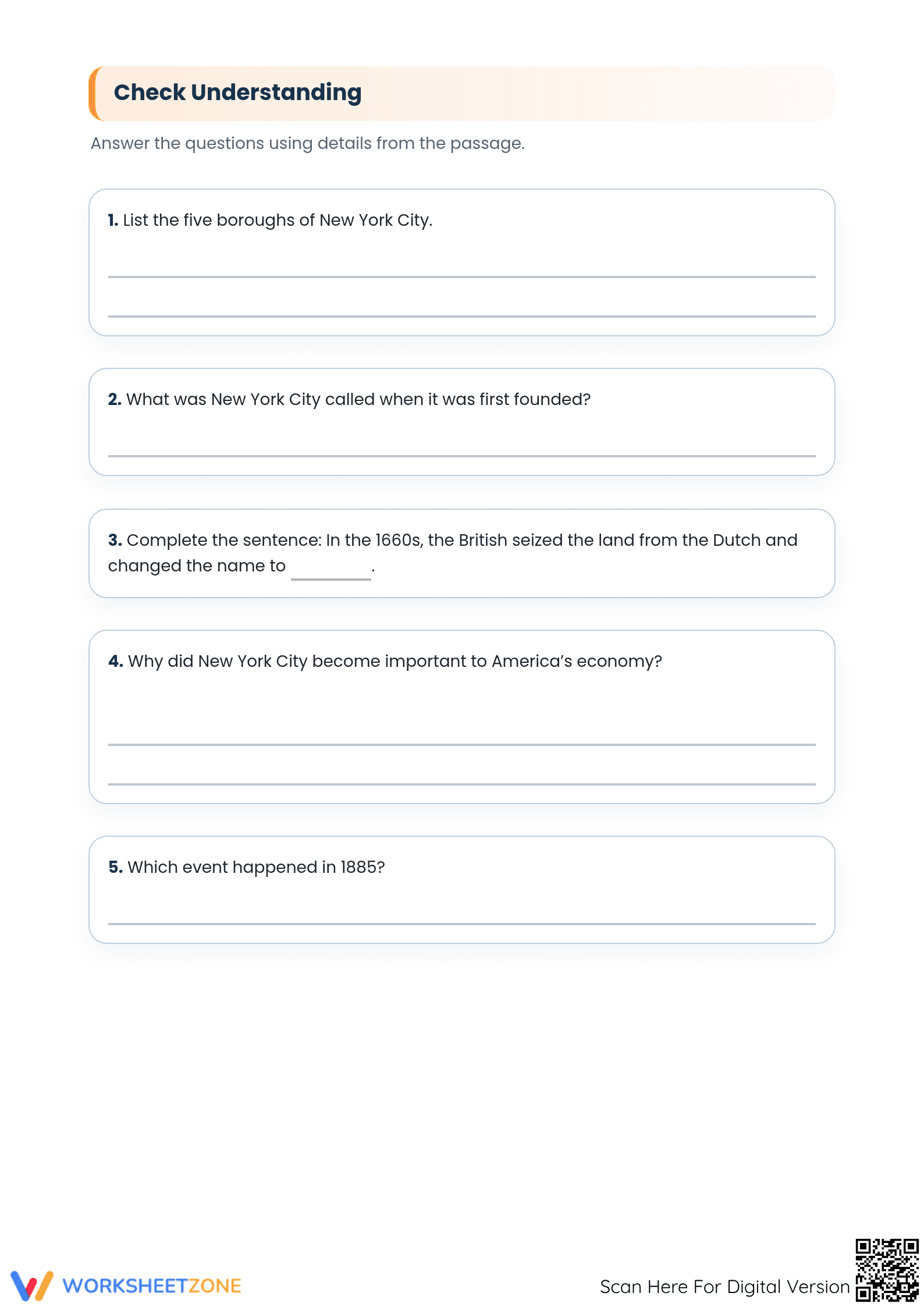
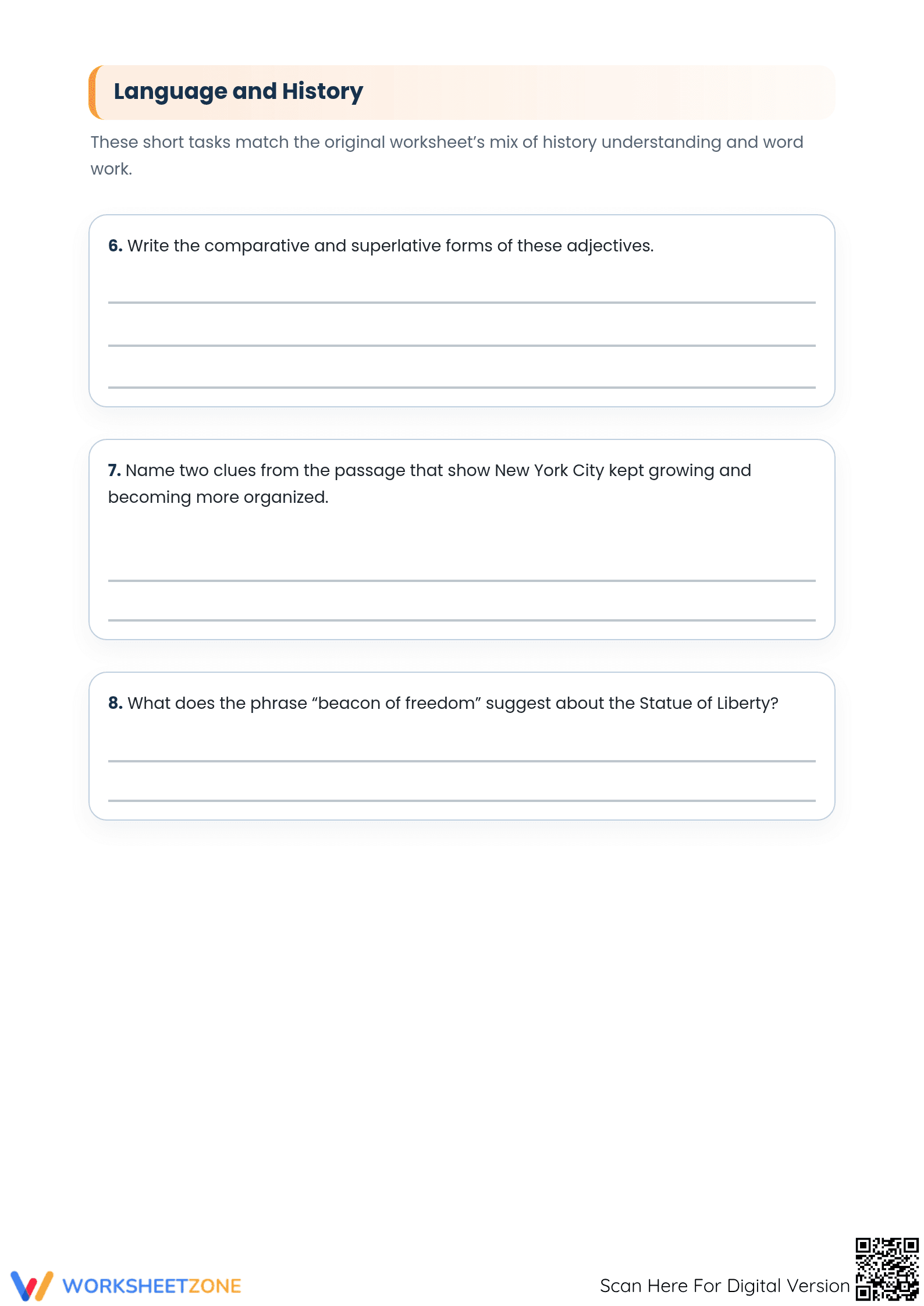
Inside this four-page resource, you will find a multi-paragraph nonfiction passage structured into clear, readable blocks that cover the Dutch founding, British renaming, and the unification of the five boroughs. The activity includes five direct comprehension questions and three advanced language-and-history tasks that require students to manipulate adjectives and interpret figurative language like "beacon of freedom." A full answer key is provided to facilitate quick grading or student self-correction.
Skill Progression
- Guided Practice: Students begin by identifying explicit facts, such as listing the five boroughs and identifying the city's original Dutch name, with direct text support.
- Supported Practice: Learners progress to sentence completion and short-answer responses that require them to connect historical dates, like 1885, to specific events mentioned in the passage.
- Independent Practice: The final section challenges students to analyze adjective forms and evaluate how specific phrases suggest deeper meanings about the Statue of Liberty's role in history.
This structure follows a gradual release of responsibility model, moving from literal retrieval to inferential reasoning.
Standards Alignment
The primary alignment is to `CCSS.ELA-LITERACY.RI.4.1`: "Refer to details and examples in a text when explaining what the text says explicitly and when drawing inferences from the text." Additionally, the worksheet supports language standards by requiring the use of comparative and superlative adjectives in context. Both standard codes can be copied directly into lesson plans, IEP goals, or district curriculum mapping tools.
How to Use It
This worksheet is ideal for use during the "independent application" phase of a lesson on nonfiction text structures or during a social studies unit on American geography. Teachers can use the "Check Understanding" section as a formative assessment to observe how well students transition from literal facts to summarizing economic importance. Most students will complete the reading and all eight tasks within 30 minutes.
Who It's For
This resource is designed for Grade 4 students but serves as excellent enrichment for Grade 3 or foundational support for Grade 5 learners. It is particularly effective for students who benefit from structured layouts and clear paragraph breaks. Naturally pair this worksheet with a map of the five boroughs or a virtual tour of New York City landmarks to deepen the historical context.
According to research from Fisher & Frey (2014), the use of complex informational texts paired with evidence-dependent questions is essential for developing the stamina required for upper-elementary literacy. This History of New York City worksheet specifically targets CCSS.ELA-LITERACY.RI.4.1 by forcing students to return to the text to verify names, dates, and causal relationships. By requiring students to list boroughs and explain the significance of the 1624 settlement, the resource builds a factual foundation while simultaneously strengthening the cognitive pathways used for literal and inferential comprehension. Such practice is a cornerstone of rigorous ELA instruction, ensuring that students do not merely read but actively engage with historical narratives. This printable resource provides the necessary repetition to move students toward mastery in informational reading.


