


























Views
Downloads
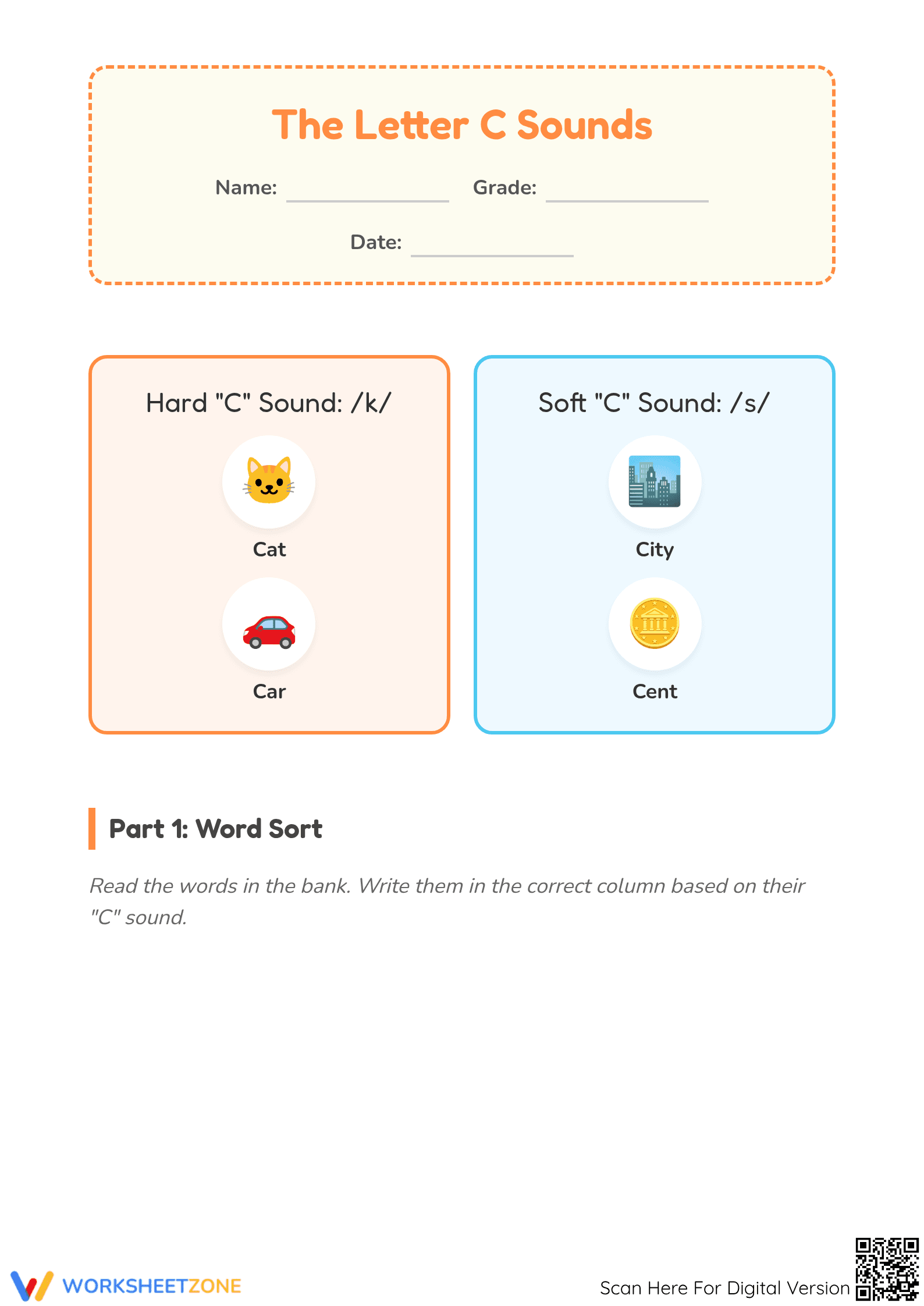



Hard and Soft Letter C Sounds | Essential Grade 1 Phonics
Paste this activity's link or code into your existing LMS (Google Classroom, Canvas, Teams, Schoology, Moodle, etc.).
Students can open and work on the activity right away, with no student login required.
You'll still be able to track student progress and results from your teacher account.
This Grade 1 phonics worksheet helps students distinguish between the hard /k/ and soft /s/ sounds of the letter C. By engaging with visual cues and word sorting, learners build the phonemic awareness necessary for fluent reading. It provides a clear path from recognition to independent application of these foundational phonetic rules.
At a Glance
- Grade: 1 · Subject: ELA Phonics
- Standard:
CCSS.ELA-LITERACY.RF.1.3— Know and apply grade-level phonics and word analysis skills in decoding words- Skill Focus: Hard and Soft Letter C Sounds
- Format: 3 pages · 14 problems · Answer key included · PDF
- Best For: Phonics centers and independent practice
- Time: 15–20 minutes
This 3-page PDF includes a comprehensive word bank, a sorting table, and a visual identification section. Students work through 14 specific tasks, including a creative Word Hunt where they generate their own examples. A full answer key is provided to facilitate quick grading or student self-correction.
Skill Progression
- Guided practice: Students begin by reviewing anchor images like Cat and Car versus City and Cent to establish the auditory difference between the /k/ and /s/ phonemes.
- Supported practice: An 8-word bank allows students to categorize words such as Cake, Cinema, and Corn into a structured sorting table with visual headers.
- Independent practice: The final Word Hunt requires students to brainstorm and illustrate their own hard and soft C words, moving from recognition to creation.
This sequence follows a gradual-release model to ensure students move confidently from identification to generation.
Standards Alignment
This resource aligns with `CCSS.ELA-LITERACY.RF.1.3`, focusing on decoding and word analysis. It specifically supports the understanding of how the letter C functions differently depending on the following vowel. Both standard codes can be copied directly into lesson plans, IEP goals, or district curriculum mapping tools.
How to Use It
Use this during small-group phonics instruction after introducing the rule that C often makes a soft sound when followed by E, I, or Y. It also serves as an excellent formative assessment; observe if students can correctly identify the soft sound in Mice or Cycle to gauge their mastery of ending and medial sounds. Completion typically takes 15 to 20 minutes.
Who It's For
Designed for first-grade students, this is also suitable for kindergarteners ready for advanced phonics or second graders needing intervention. It pairs naturally with a letter C anchor chart or a decodable reader focusing on soft C words like cell or city.
According to the RAND AIRS 2024 report, explicit phonics instruction that isolates specific phoneme-grapheme correspondences is critical for early literacy development. This worksheet targets the dual nature of the letter C, a common stumbling block for emerging readers. By providing 14 distinct opportunities to practice the CCSS.ELA-LITERACY.RF.1.3 standard, the resource ensures students move beyond simple letter recognition into complex decoding. Research from Fisher & Frey (2014) emphasizes that sorting tasks help students internalize patterns rather than just memorizing words. This structured approach provides the repetition needed for long-term retention of the hard /k/ and soft /s/ sounds. Educators can use this tool to provide evidence-based practice that bridges the gap between phonemic awareness and reading fluency in a classroom setting.


