




























Views
Downloads

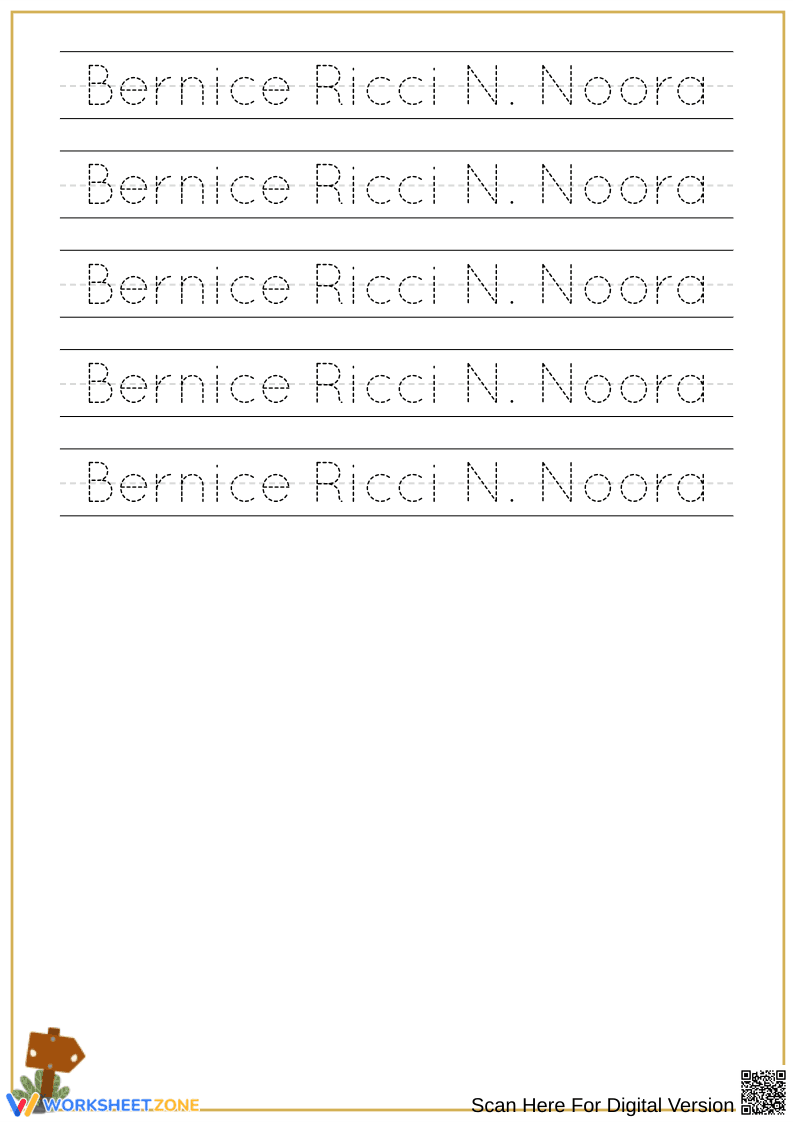

Essential Name Tracing Practice | Grade 1-2 Handwriting

Paste this activity's link or code into your existing LMS (Google Classroom, Canvas, Teams, Schoology, Moodle, etc.).
Students can open and work on the activity right away, with no student login required.
You'll still be able to track student progress and results from your teacher account.
This Grade 1 and Grade 2 handwriting worksheet provides targeted name tracing practice to help students master letter formation and spatial awareness. By focusing on a specific name string, learners develop the muscle memory required for fluid, legible writing. This resource ensures students gain confidence in their personal identification writing skills through repetitive, guided strokes.
At a Glance
- Grade: 1-2 · Subject: Handwriting
- Standard:
CCSS.ELA-LITERACY.L.1.1.A— Print all upper- and lowercase letters accurately and legibly- Skill Focus: Name Tracing & Letter Formation
- Format: 2 pages · 13 tasks · No-prep · PDF
- Best For: Morning work or handwriting centers
- Time: 10–15 minutes
What's Inside
This two-page PDF features 13 distinct lines of dashed-line tracing text. The first page contains eight lines of the name "Bernice Ricci N. Noora," while the second page offers five additional lines for extended practice. The layout utilizes standard primary ruled lines with a midline to guide proper letter height and descender placement, ensuring students understand the vertical boundaries of each character.
Zero-Prep Workflow
- Print: Select the pages and print the desired number of copies for your class in under 30 seconds.
- Distribute: Hand out the sheets during morning arrival, transition periods, or as a quiet-time activity (1 minute).
- Review: Circulate the room to check for proper pencil grip and adherence to the dashed lines as students work independently (30 seconds).
Standards Alignment
The primary focus is `CCSS.ELA-LITERACY.L.1.1.A`, which requires students to print all upper- and lowercase letters. This worksheet specifically targets the coordination of various letter shapes within a functional, real-world context. Both standard codes can be copied directly into lesson plans, IEP goals, or district curriculum mapping tools to document student progress in foundational writing skills.
How to Use It
Use this worksheet as a "Bell Ringer" activity to settle students as they enter the classroom. It serves as an excellent formative assessment tool; observe students as they trace to identify those struggling with specific letter transitions or grip strength. Completion typically takes 10 to 15 minutes depending on the student's fine motor development and focus level.
Who It's For
This resource is designed for first and second-grade students who are refining their penmanship. It is particularly helpful for English Language Learners or students with occupational therapy goals who need high-frequency repetition. Pair this with an alphabet anchor chart to help students visualize the letters they are tracing and compare their work to a standard model.
According to the RAND AIRS 2024 report on foundational literacy, repetitive tracing exercises are essential for developing the graphomotor skills necessary for long-term writing fluency. This worksheet aligns with CCSS.ELA-LITERACY.L.1.1.A by providing 13 structured opportunities for students to practice printing upper- and lowercase letters in a meaningful sequence. Research by Fisher & Frey (2014) emphasizes that guided practice, such as dashed-line tracing, bridges the gap between letter recognition and independent production. By focusing on a specific name, students engage in high-utility practice that reinforces their personal identity while building the fine motor control required for more complex composition tasks. This resource provides a clear, distraction-free environment that supports cognitive load management during the early stages of handwriting acquisition, making it a reliable tool for daily classroom instruction or targeted intervention sessions.


