




























Views
Downloads
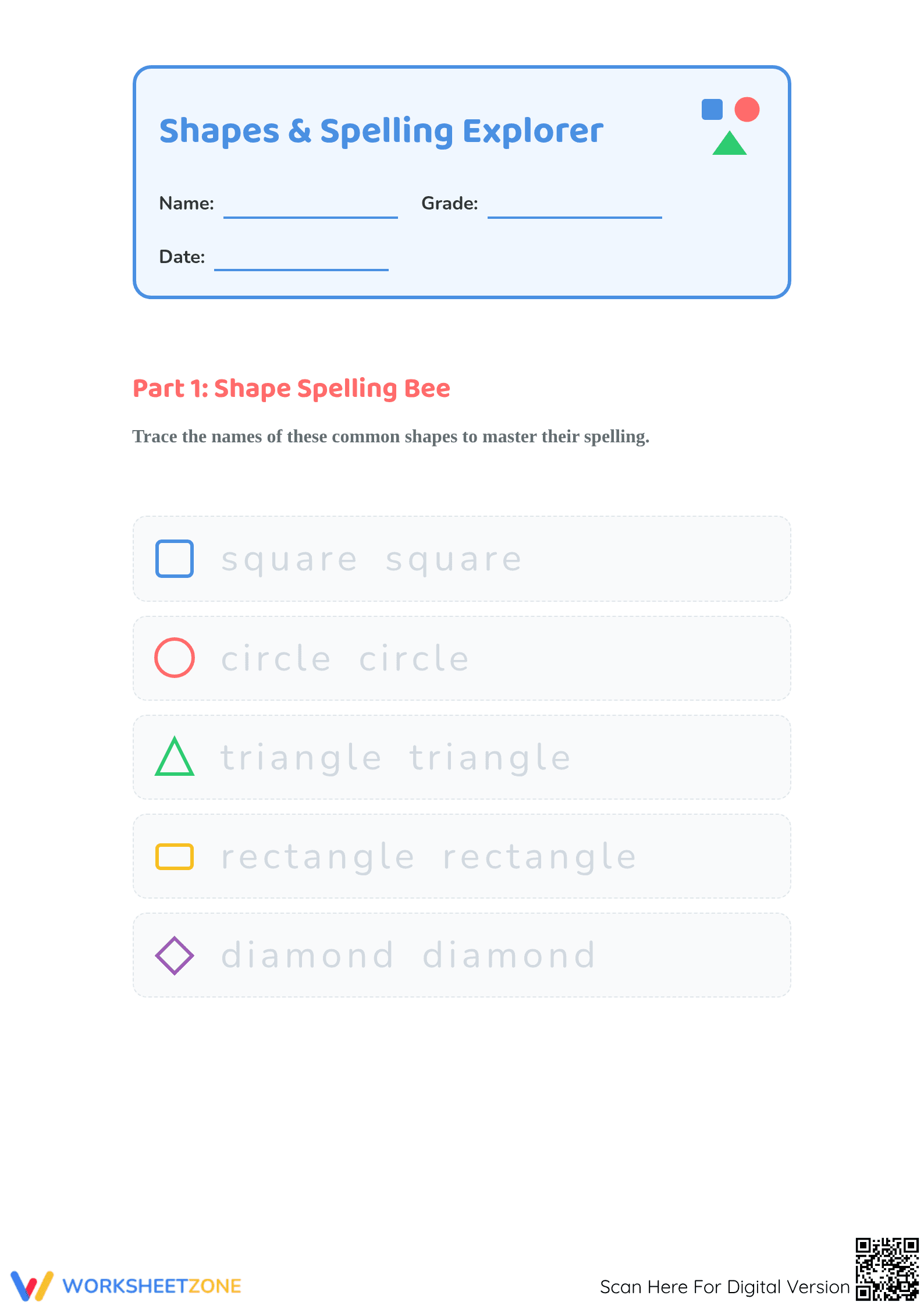


Printable Shape Attributes Worksheet | Grade 2 Math

Paste this activity's link or code into your existing LMS (Google Classroom, Canvas, Teams, Schoology, Moodle, etc.).
Students can open and work on the activity right away, with no student login required.
You'll still be able to track student progress and results from your teacher account.
This Grade 2 math and handwriting worksheet helps students master 2D shape identification and spelling. By combining fine motor tracing with geometry riddles, learners build confidence in recognizing shape attributes like sides and vertices. The structured activities ensure students can both name and draw common polygons accurately.
At a Glance
- Grade: 2 · Subject: Math
- Standard:
CCSS.MATH.CONTENT.2.G.A.1— Recognize and draw shapes with specific attributes- Skill Focus: Shape Identification and Attributes
- Format: 2 pages · 12 problems · Answer key included · PDF
- Best For: Independent practice or math centers
- Time: 15–20 minutes
This two-page resource features a variety of engaging task types designed to reinforce geometry concepts. Students will find five shape-name tracing exercises, three open-ended drawing boxes for complex polygons, and four descriptive shape riddles. The clear layout includes dotted guidelines for handwriting support and a complete answer key for quick grading.
- Guided practice: Part 1 provides five tracing tasks where students practice spelling foundational shapes like squares, circles, and triangles using dotted guides.
- Supported practice: Part 2 challenges learners with three drawing prompts, asking them to illustrate a pentagon, hexagon, and octagon within designated boxes.
- Independent practice: Part 3 features four "Shape Detective" riddles requiring students to synthesize their knowledge of sides and corners to identify the correct shape.
This gradual-release approach moves students smoothly from basic recognition to higher-order attribute analysis.
This activity is directly aligned to CCSS.MATH.CONTENT.2.G.A.1, requiring students to recognize and draw shapes having specified attributes, such as a given number of angles or equal faces. It also supports cross-curricular foundational spelling skills. Both standard codes can be copied directly into lesson plans, IEP goals, or district curriculum mapping tools.
Deploy this worksheet during morning work to activate prior knowledge before a geometry lesson, or place it in a math center for independent review. As students work through the riddles in Part 3, teachers can use their answers as a formative assessment to check if they truly understand the difference between sides and vertices. Most second graders will complete the full sequence in 15 to 20 minutes.
This resource is ideal for second-grade general education students, as well as third graders needing a quick geometry refresher. The built-in handwriting scaffolds make it highly accessible for occupational therapy integration or English Language Learners learning math vocabulary. Pair this worksheet with physical pattern blocks or a classroom anchor chart displaying polygon properties for maximum impact.
Mastering geometry vocabulary and shape attributes is a critical stepping stone for early elementary mathematics. By aligning instruction to CCSS.MATH.CONTENT.2.G.A.1, educators ensure students can reliably recognize and draw shapes with specific attributes. According to a recent EdReports 2024 analysis, integrating fine motor tasks like tracing with cognitive math challenges significantly improves long-term retention of academic vocabulary. When students physically write the words and draw the corresponding polygons, they form stronger neural connections linking the shape's name to its geometric properties. This multi-sensory approach bridges the gap between rote memorization and conceptual understanding, allowing young learners to confidently tackle more advanced spatial reasoning tasks in later grades. Providing structured, progressive practice ensures that all students can successfully decode shape riddles and articulate geometric concepts.


