


























Views
Downloads




Half Past Time Worksheet | Printable Grade 1 Math
Paste this activity's link or code into your existing LMS (Google Classroom, Canvas, Teams, Schoology, Moodle, etc.).
Students can open and work on the activity right away, with no student login required.
You'll still be able to track student progress and results from your teacher account.
Students master the essential skill of telling time to the half-hour with this comprehensive practice set. This worksheet guides learners through interpreting analog clock faces and translating digital times into common language. By practicing these 20 varied tasks, students build the confidence necessary to manage daily schedules and understand time intervals accurately.
At a Glance
- Grade: 1 · Subject: Math
- Standard:
CCSS.MATH.CONTENT.1.MD.B.3— Tell and write time in hours and half-hours using clocks- Skill Focus: Telling time to the half-hour (half past)
- Format: 4 pages · 20 problems · Answer key included · PDF
- Best For: Small group practice or homework
- Time: 25–35 minutes
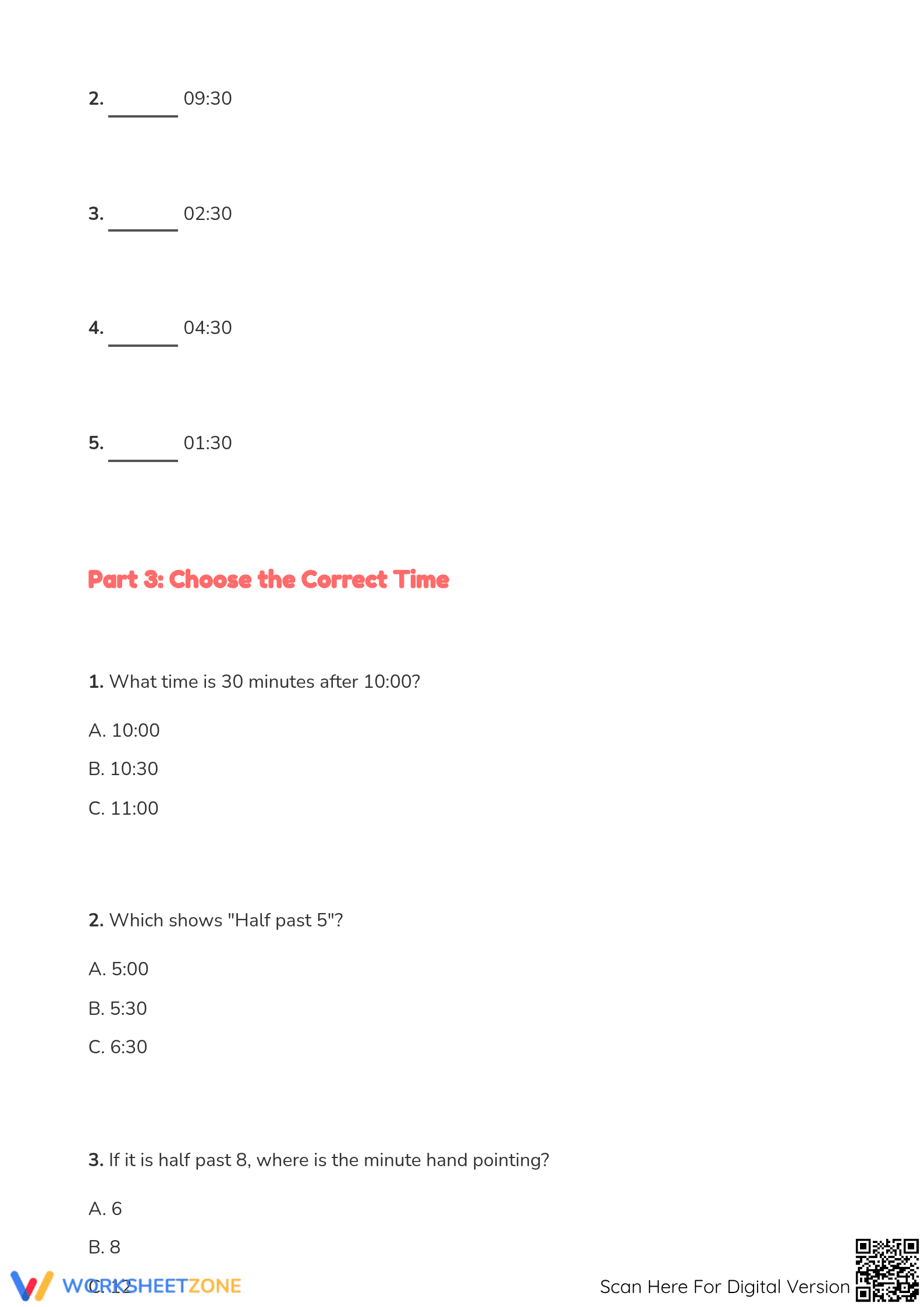
This four-page resource includes a logical sequence of exercises designed to solidify student understanding. Part 1 features six analog clocks where students write the corresponding digital time. Part 2 offers five matching exercises between digital notations and phrases. Part 3 provides multiple-choice questions for conceptual checking, while Part 4 presents word problems involving real-world elapsed time scenarios. A full answer key ensures quick checking.
Skill Progression and Scaffolding
- Guided Practice: Students begin with analog clock visualization, identifying the minute hand's position at the six across six clear examples.
- Supported Practice: Matching exercises and multiple-choice questions help students distinguish between digital notation and verbal "half past" phrasing.
- Independent Practice: The final section challenges students with four word problems that apply half-hour intervals to functional daily situations.
This structure ensures a smooth transition from direct instruction to independent mastery using the gradual-release model.
Standards Alignment
This activity is directly aligned with `CCSS.MATH.CONTENT.1.MD.B.3`. This standard requires students to tell and write time in hours and half-hours using both analog and digital clocks. By integrating multiple formats—visual, textual, and situational—the worksheet covers the full breadth of the requirement. This standard code can be copied directly into lesson plans, IEP goals, or district curriculum mapping tools.
How to Use This Worksheet
Use this worksheet as a formative assessment after introducing the concept of the half-hour. Assign the first two pages during direct instruction to check for immediate misconceptions. Use the word problem section as an exit ticket or extension for students who show early mastery. Teachers should observe if students correctly place the hour hand between two numbers when identifying half-past times, a common area for growth.
Target Audience
Designed primarily for first-grade students, this resource is also appropriate for second-grade review or kindergarten enrichment. It supports English Language Learners by providing clear visual cues alongside digital notation. This worksheet pairs naturally with a physical classroom clock or an interactive digital demonstration tool to help students visualize the movement of hands during a 30-minute interval.
Research from the RAND AIRS 2024 study highlights that early mastery of time-telling concepts, specifically the "half past" interval, serves as a critical foundation for later understanding of elapsed time and fractions. This Grade 1 worksheet directly addresses the `CCSS.MATH.CONTENT.1.MD.B.3` standard, focusing on the plain-English skill of identifying half-hour increments on both analog and digital displays. By engaging in 20 distinct tasks ranging from visual recognition to applied word problems, students solidify their mental model of the clock face. The inclusion of word problems reflects modern pedagogical shifts toward functional math literacy, ensuring that abstract clock reading translates into practical daily life skills. Educational practitioners can utilize this resource to bridge the gap between simple hour recognition and complex minute intervals, providing a stable scaffold for mathematical development and time management proficiency.


