





























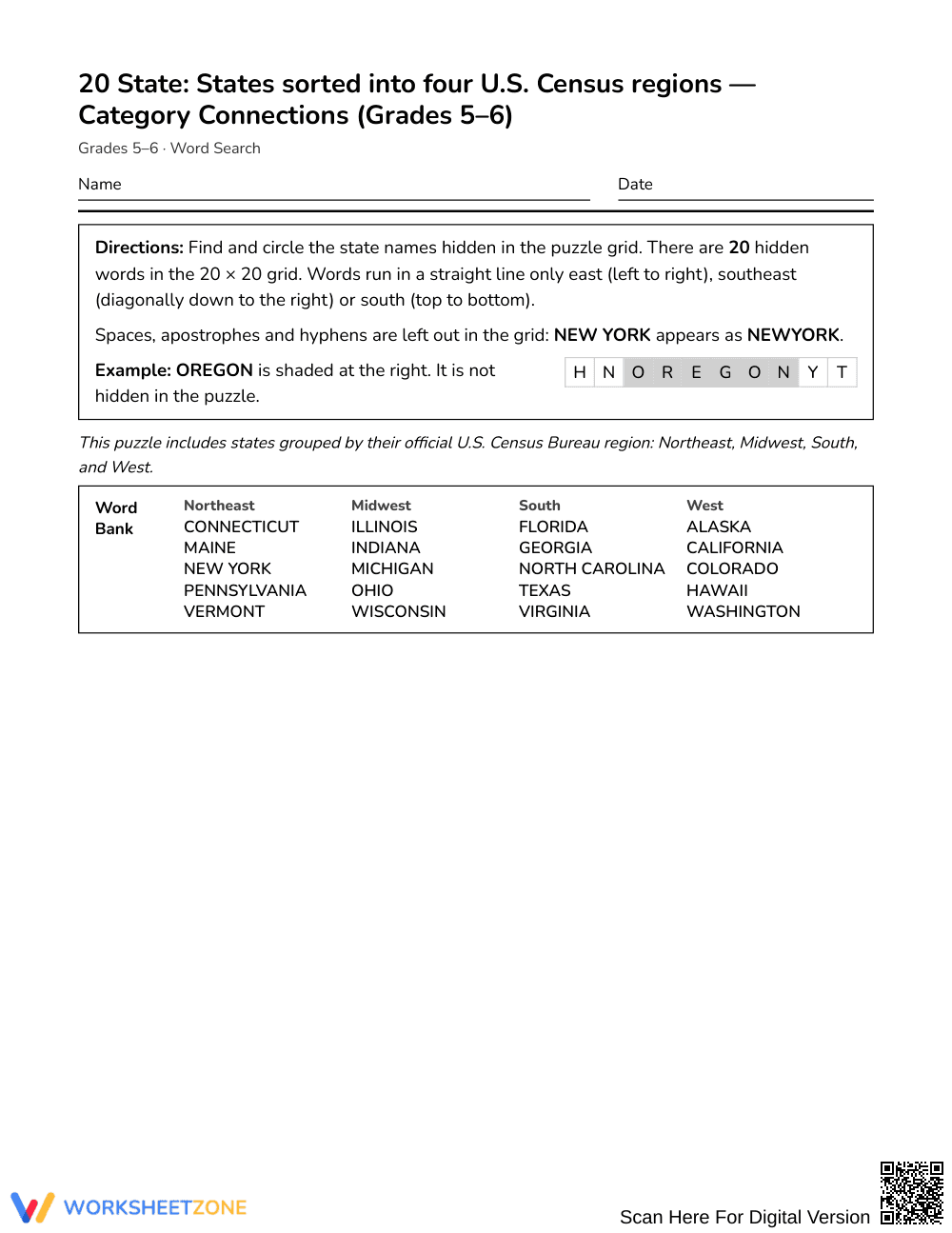


Guide Census Regions Word Search | Grades 5–6 Social Studies

Paste this activity's link or code into your existing LMS (Google Classroom, Canvas, Teams, Schoology, Moodle, etc.).
Students can open and work on the activity right away, with no student login required.
You'll still be able to track student progress and results from your teacher account.
Boost geography vocabulary with this printable word search that challenges Grades 5–6 learners to locate 20 state names organized by the four U.S. Census regions, reinforcing regional classification while building spelling fluency and encouraging collaborative problem‑solving in a fun, timed activity.
At a Glance
- Grade: Grades 5–6 · Subject: Social Studies
- Standard:
Not standards-assessed — vocabulary enrichment & students actively locate state names by Census region— find state names by Census region- Skill Focus: states sorted into four U.S. Census regions
- Format: 2 pages of puzzle · 20 hidden words · Answer key included · PDF
- Best For: Vocabulary practice & geography review for classroom centers
- Time: 5–10 minutes
Inside the 2‑page PDF you’ll find a 20 × 20 grid with words running east, southeast, and south, a concise word bank grouped by region, and a separate answer key page that highlights each state name.
Zero‑Prep Workflow
- Print: Open the PDF and print both pages (under 30 seconds).
- Distribute: Hand the puzzle and answer key to learners; they begin immediately (1 minute).
- Review: Collect completed searches, check against the key, and discuss any missed states (2–3 minutes).
Total teacher preparation time stays under two minutes, making the activity perfect for quick warm‑ups or sub‑plan use.
Standards Alignment
This resource is not tied to any state or national standard; it serves as pure vocabulary enrichment, helping students expand geographic terminology without formal assessment pressure.
How to Use It
- Before a lesson on U.S. regions, use the word search as a quick diagnostic to gauge prior knowledge of state names.
- After a regional mapping activity, assign the puzzle for reinforcement; observe completion speed as a formative indicator of retention.
Students typically finish the search in 5–10 minutes, allowing smooth integration into any class period.
Who It's For
Designed for Grades 5–6 learners in Social Studies, the activity supports both remedial and advanced readers. Pair it with a regional map poster or a short video on Census regions for a multimodal experience.
Educational research indicates that structured print puzzles significantly strengthen geographic terminology retention and spatial associations for intermediate elementary students. Fisher and Frey (2014) highlight that purposeful word search activities offer low stakes retrieval practice that reinforces regional vocabulary while sustaining active student engagement during independent or paired work. By systematically locating twenty distinct state names organized around the four official United States Census regions, learners build orthographic memory, sharpen visual scanning skills, and solidify conceptual boundaries without experiencing testing fatigue. Furthermore, cognitive studies on schema development confirm that grouping geographic items by broader regions accelerates extended recall and contextual understanding. Incorporating this two page worksheet into your social studies curriculum provides an efficient, evidence based bridge between introductory regional lectures and formal cartographic assessments, ensuring every fifth or sixth grader develops firm lexical foundations in an accessible format.


