


























Views
Downloads


Printable Inflectional Endings Worksheet | Grade 3 ELA
Paste this activity's link or code into your existing LMS (Google Classroom, Canvas, Teams, Schoology, Moodle, etc.).
Students can open and work on the activity right away, with no student login required.
You'll still be able to track student progress and results from your teacher account.
Practice Inflectional Endings with a Hands-On Sort
This worksheet provides focused practice on adding inflectional endings like -s, -ed, and -ing to base words, specifically targeting the y-to-i spelling change rule. Students will cut, sort, and categorize 24 words, reinforcing their understanding of conventional spelling patterns for suffixes. It’s an essential activity for building foundational grammar and spelling skills.
At a Glance
- Grade: 3 · Subject: English Language Arts (ELA)
- Standard:
CCSS.ELA-LITERACY.L.3.2.E— Use conventional spelling for adding suffixes to base words.- Skill Focus: Inflectional Endings (-s, -ed, -ing)
- Format: 2 pages · 1 sorting task · Answer key included · PDF
- Best For: Word work stations, small group reinforcement
- Time: 15–20 minutes
What's Inside
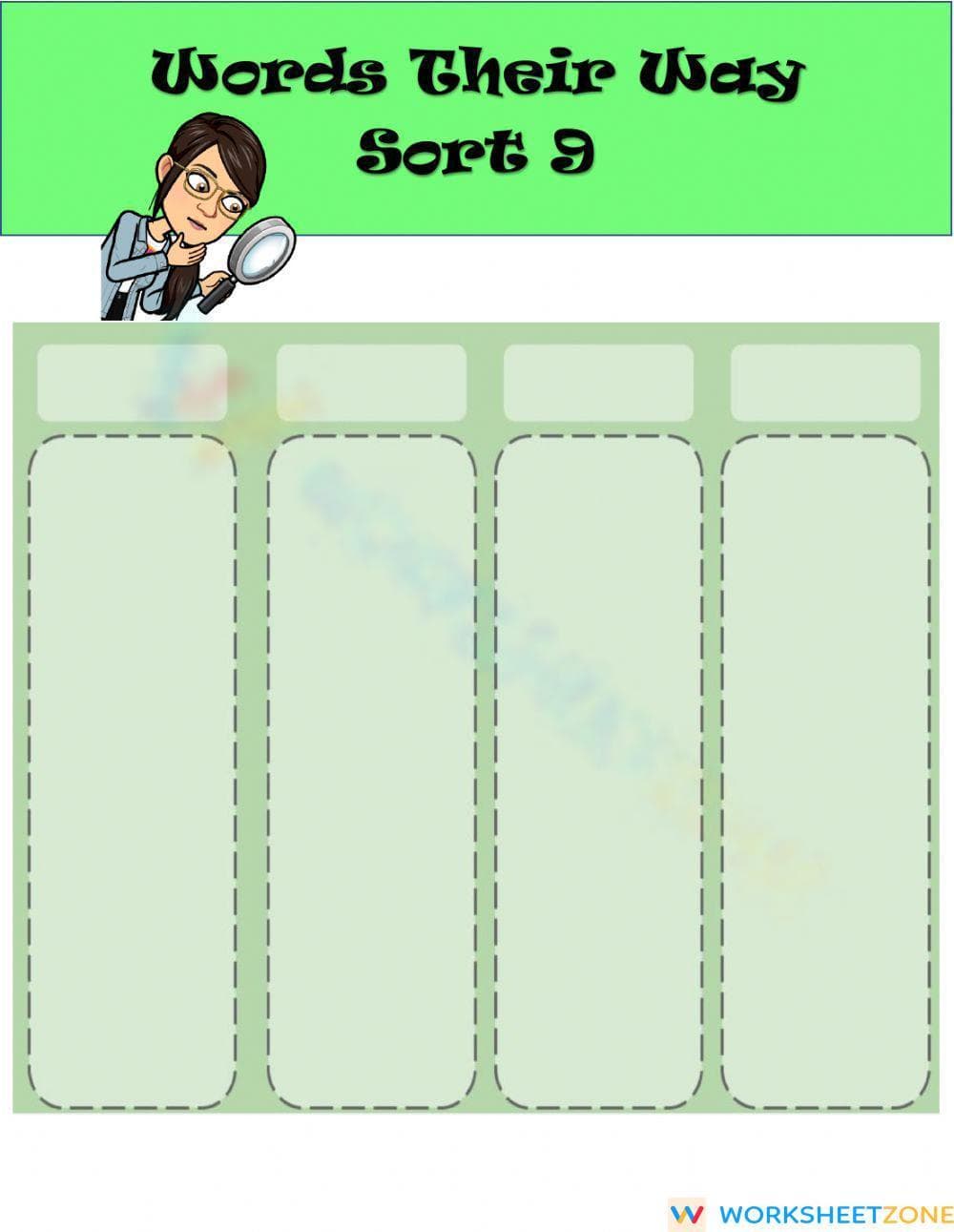
This resource includes a two-page PDF file. The first page contains a four-column sorting mat for organizing words by their ending: base word, +-s, +-ed, and +-ing. The second page provides 24 word cards for students to cut out. The design is clean and straightforward, focusing students on the spelling task without distraction. An answer key is provided for easy checking.
A Structured Approach to Spelling Rules
- Guided practice: Begin by modeling the sort with 2-3 words (e.g., 'play' vs. 'cries'), thinking aloud about the spelling rule for each.
- Supported practice: In pairs or small groups, students sort the remaining words, discussing why each word belongs in a specific category.
- Independent practice: Students can complete the sort independently as a station activity and then glue the words onto the mat to show their work.
This sequence follows a gradual release model, moving from direct instruction to independent application.
Standards Alignment
This worksheet directly aligns with CCSS.ELA-LITERACY.L.3.2.E, which requires students to "Use conventional spelling for high-frequency and other studied words and for adding suffixes to base words (e.g., sitting, smiled, cries, happiness)." It provides targeted practice on the "cries" pattern, where the 'y' is changed to an 'i' before adding the suffix. Both standard codes can be copied directly into lesson plans, IEP goals, or district curriculum mapping tools.
How to Use It
Use this resource as a word work station during your ELA block, after a mini-lesson on inflectional endings. It’s an excellent hands-on activity that reinforces the y-to-i spelling rule. For a quick formative assessment, observe which students hesitate or misplace words like 'spies' versus 'stays,' which reveals their grasp of the rule. The activity typically takes 15 to 20 minutes for students to complete.
Who It's For
This activity is designed for third-grade students who are learning to apply spelling rules for suffixes. It is also suitable for second graders needing a challenge or fourth graders needing review. There is a single version included. Pair this hands-on sort with a direct instruction lesson on inflectional endings or an anchor chart that explicitly states the y-to-i rule.
Effective literacy instruction requires students to understand and apply phonics and word analysis skills, a principle supported by extensive research (RAND AIRS 2024). This worksheet targets a key component of that skill set: conventional spelling for suffixes, as outlined in CCSS.ELA-LITERACY.L.3.2.E. By physically sorting words based on their inflectional endings (e.g., -s, -ed, -ing) and applying the y-to-i spelling change, students engage in a hands-on process that strengthens orthographic mapping. This tactile activity moves beyond rote memorization, helping students internalize complex spelling patterns. According to Fisher & Frey (2014), such structured, skill-focused tasks are crucial for building automaticity, freeing up cognitive resources for higher-order comprehension. This single activity provides a targeted mechanism for students to practice and demonstrate mastery of this foundational writing and reading skill.


