


























Views
Downloads
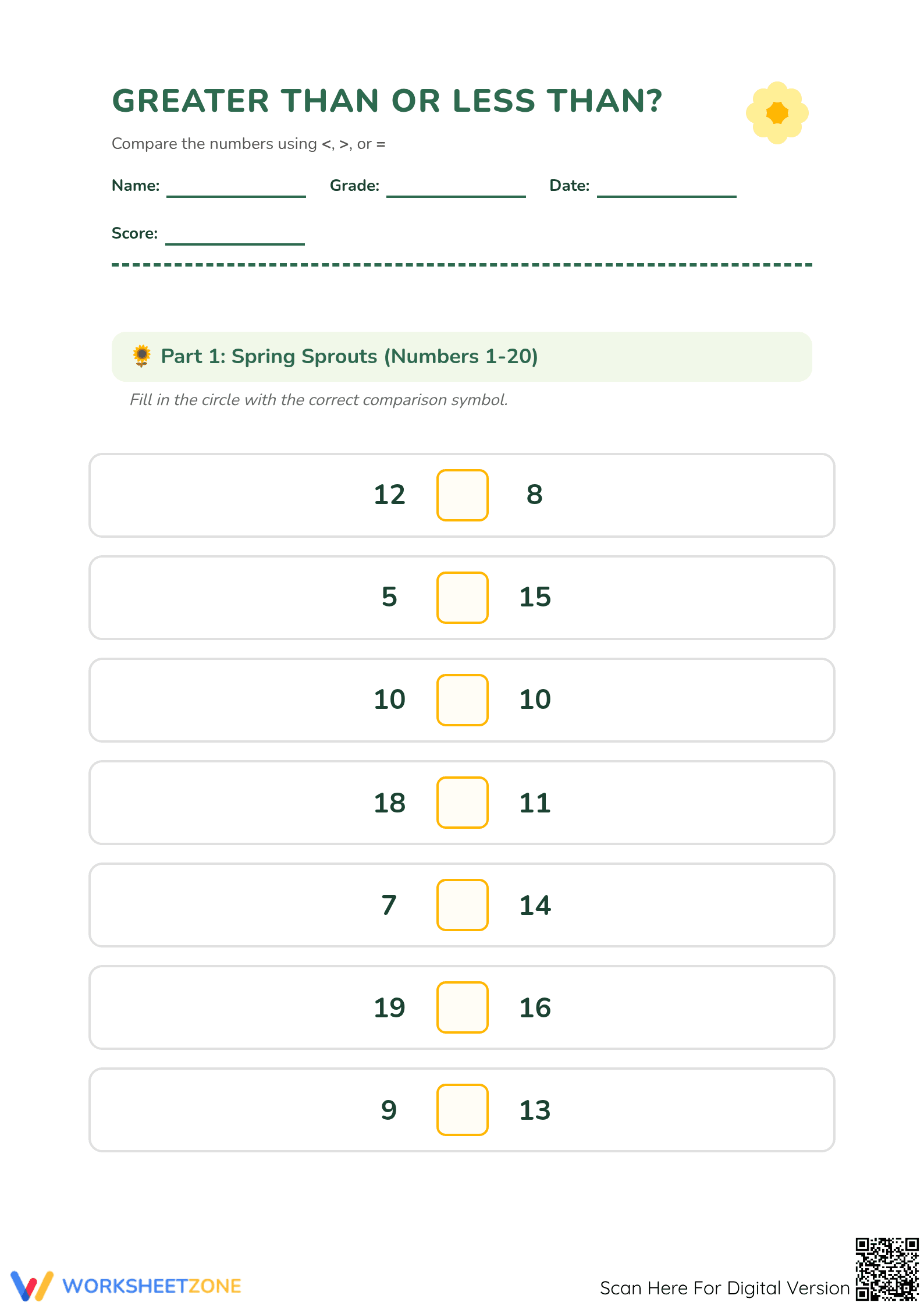
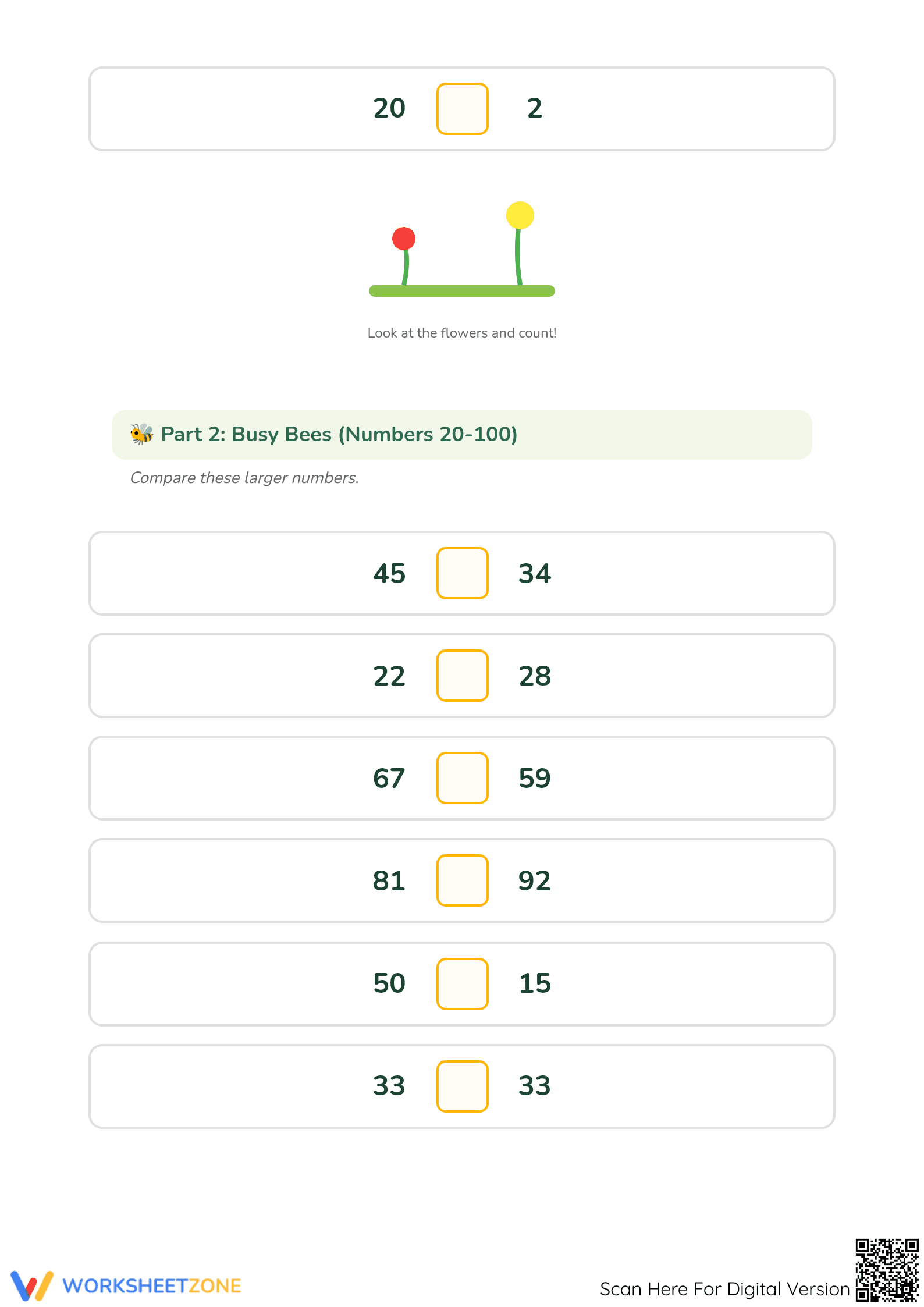
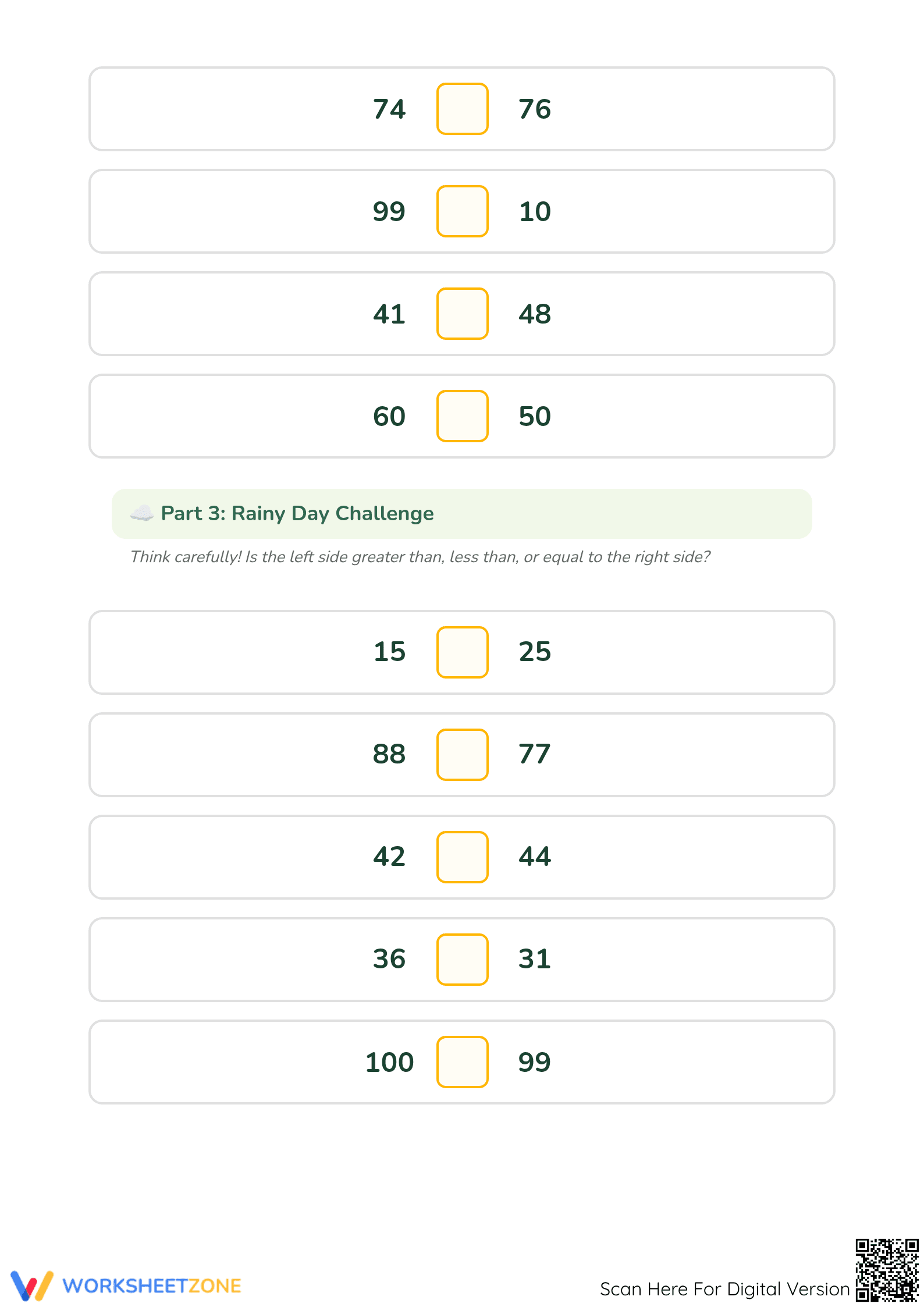
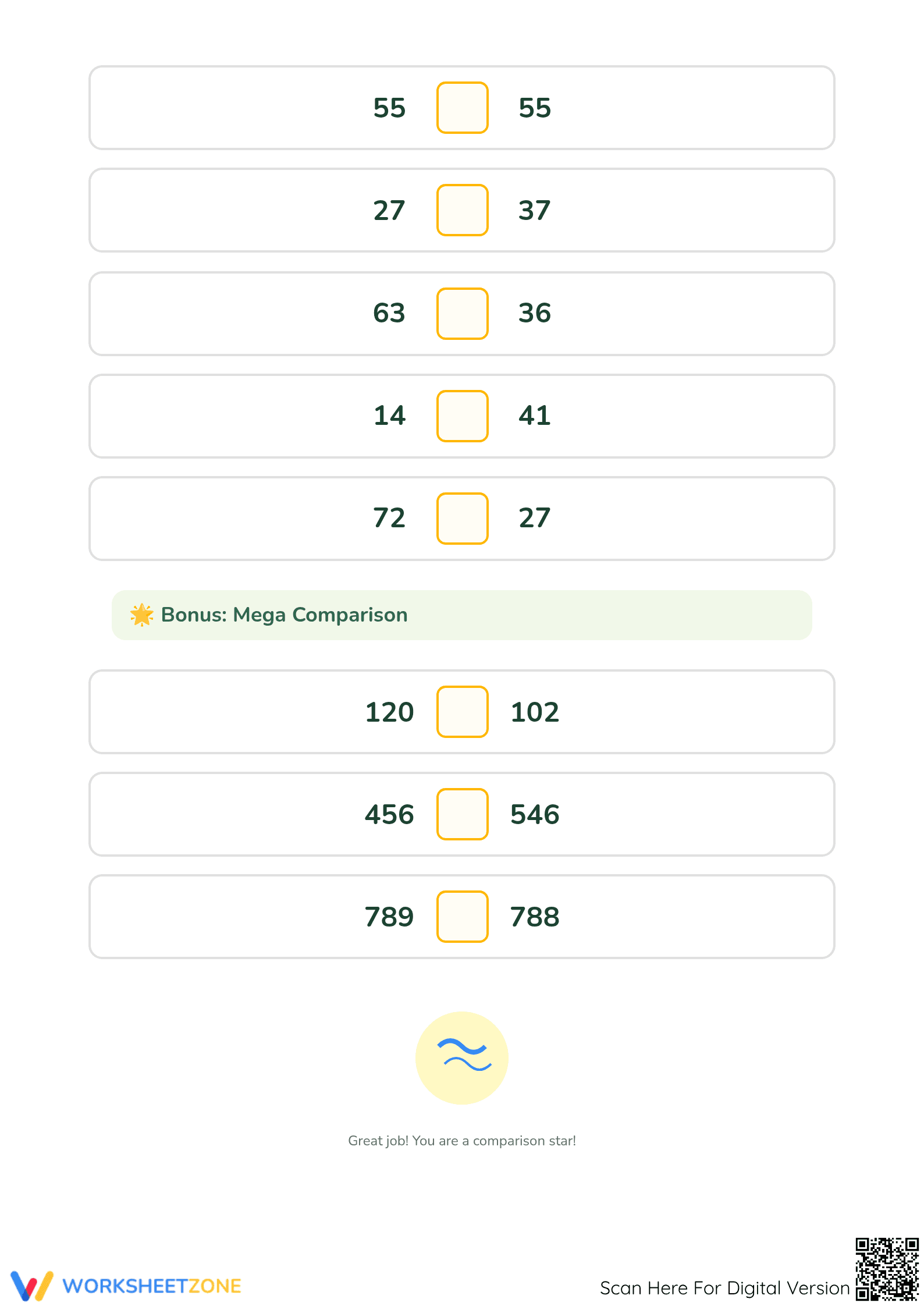

Printable Greater Than Less Than Worksheet | Grade 1 Math
Paste this activity's link or code into your existing LMS (Google Classroom, Canvas, Teams, Schoology, Moodle, etc.).
Students can open and work on the activity right away, with no student login required.
You'll still be able to track student progress and results from your teacher account.
Strengthen your students' number sense with this comprehensive spring-themed comparison worksheet set. This resource focuses on the essential skill of comparing two-digit numbers using greater than, less than, and equal to symbols. By providing a structured progression from small numbers to larger values, students build the confidence and accuracy needed for mathematical fluency and place value mastery.
At a Glance
- Grade: 1 · Subject: Math
- Standard:
CCSS.MATH.CONTENT.1.NBT.B.3— Compare two-digit numbers based on tens and ones digits using symbols- Skill Focus: Greater than, less than, and equal to symbols
- Format: 4 pages · 31 problems · Answer key included · PDF
- Best For: Independent practice or formative assessment
- Time: 20–30 minutes
This four-page PDF collection features 31 carefully designed comparison tasks organized into thematic sections. Each page includes clear instructions and visual cues, such as a spring sunflower motif, to keep young learners engaged. The set includes a full answer key for quick grading and a bonus section for high-achieving students, ensuring a complete package for classroom or home use.
- Guided Practice: Students begin with 8 problems comparing numbers from 1 to 20, providing a low-stakes entry point with familiar values and visual counting supports.
- Supported Practice: The difficulty increases with 10 problems focusing on numbers between 20 and 100, requiring students to apply place value logic to identify differences in tens and ones.
- Independent Practice: The final sections provide 13 challenging tasks, including a "Mega Comparison" bonus with three-digit numbers to test for deeper understanding and skill extension.
Aligned strictly to `CCSS.MATH.CONTENT.1.NBT.B.3`, this worksheet requires students to compare two two-digit numbers based on meanings of the tens and ones digits, recording the results with the symbols >, =, and <. This standard is a critical foundation for future work with inequalities and larger number sets. This standard code can be copied directly into lesson plans, IEP goals, or district curriculum mapping tools.
Use this resource as a central part of your math block during independent work rotations. It is particularly effective after a direct instruction lesson on "The Alligator Mouth" or symbol orientation. For a formative assessment observation, watch how students approach the "Busy Bees" section; students who consistently look at the tens digit first are demonstrating strong conceptual place value understanding. Expected completion time is 25 minutes.
This worksheet is ideal for first-grade students, but the wide number range also makes it a valuable remediation tool for second graders or an enrichment activity for advanced kindergartners. It pairs naturally with base-ten block manipulatives or a classroom hundreds chart to provide a concrete bridge to the abstract symbolic representations required by the tasks.
According to a ScienceDirect TpT Analysis, high-quality math worksheets that follow a gradual-release model significantly improve student retention of abstract symbols like greater than and less than signs. By providing 31 focused tasks that transition from numbers under 20 to three-digit challenges, this resource ensures that students move beyond simple memorization toward a functional mastery of CCSS.MATH.CONTENT.1.NBT.B.3. This evidence-based approach to mathematical comparison helps prevent common symbol-reversal errors in early elementary learners. Educators can rely on this structured sequence to provide the repeated exposure necessary for students to internalize the logic of place-value comparison. The inclusion of a bonus section further supports classroom equity by providing meaningful extensions for fast finishers without requiring additional teacher preparation. This self-contained module serves as a reliable instrument for both initial skill acquisition and long-term reinforcement of foundational number theory concepts.


