




























Views
Downloads
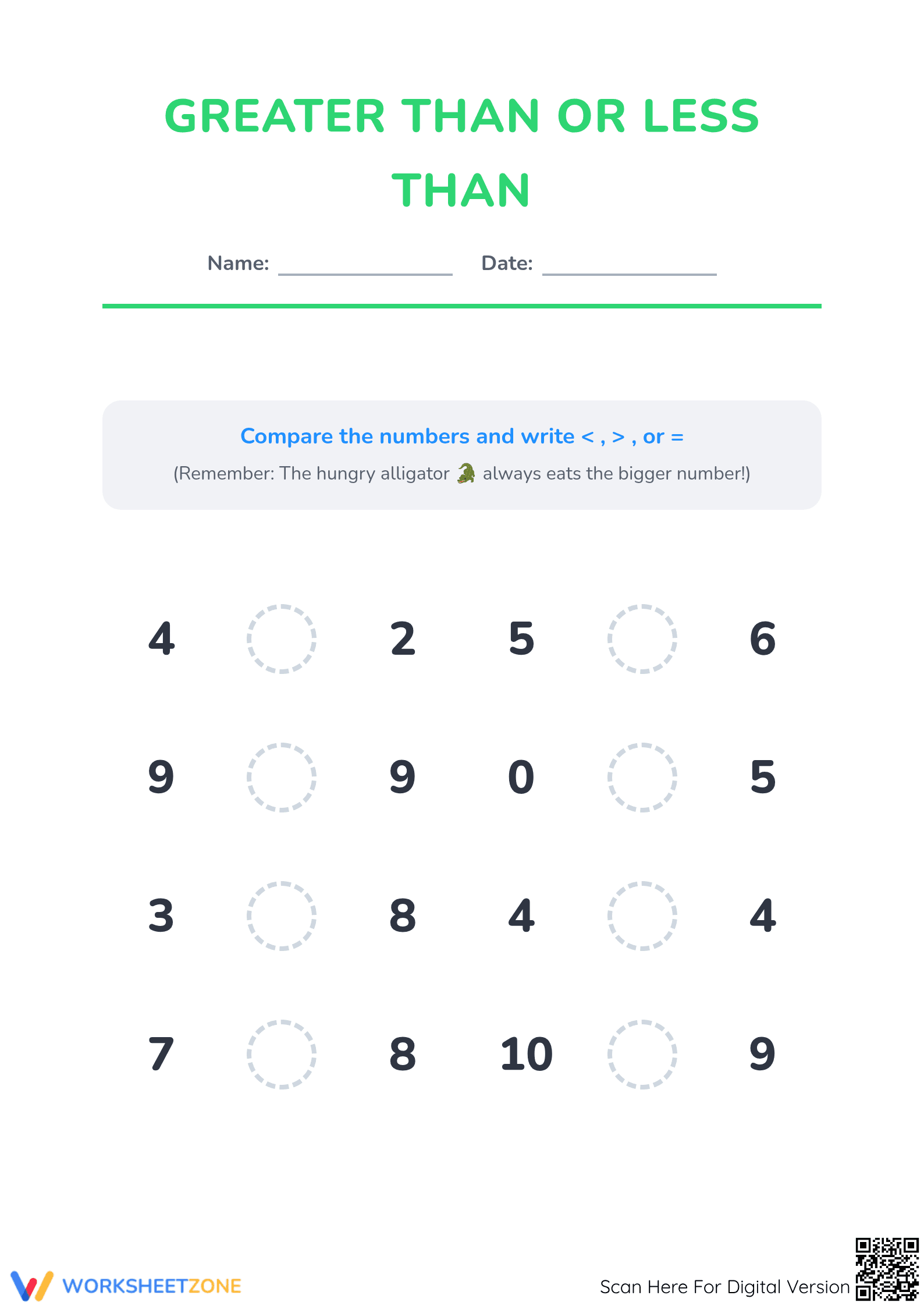


Printable Comparing Numbers Worksheet | Grade K-1 Math

Paste this activity's link or code into your existing LMS (Google Classroom, Canvas, Teams, Schoology, Moodle, etc.).
Students can open and work on the activity right away, with no student login required.
You'll still be able to track student progress and results from your teacher account.
Master number comparison with this intuitive "Number Gator" worksheet. This resource helps young learners bridge the gap between abstract numbers and the relational symbols of greater than, less than, and equal to. Students will gain confidence in identifying numerical value differences through structured practice, ensuring they meet early algebraic and counting milestones effectively.
At a Glance
- Grade: Kindergarten · Subject: Math
- Standard:
K.CC.C.7— Compare two numbers between 1 and 10 presented as written numerals- Skill Focus: Comparing numbers using <, >, and =
- Format: 2 pages · 12 problems · Answer key included · PDF
- Best For: Zero-prep morning work or assessment
- Time: 10–15 minutes
What's Inside
This 2-page PDF features 12 total comparison problems focused on numbers 0 through 10. The layout is clean and spacious, providing large "bubble" circles for students to write their symbols. Every page includes a "hungry alligator" reminder at the top to scaffold the concept for struggling learners. A complete answer key is included to allow for quick grading or student self-correction.
Zero-Prep Workflow
1. Print (30 seconds): Select the 2-page PDF and print as many copies as needed for your class size.
2. Distribute (30 seconds): Hand out the worksheets at the start of your math block or as a transition activity; the mnemonic guide makes it self-explanatory.
3. Review (1 minute): Use the provided answer key to verify student work or project it for a whole-class check.
Total teacher prep time is under two minutes, making this an ideal supplemental skill check.
Standards Alignment
This resource is primarily aligned to `CCSS.MATH.CONTENT.K.CC.C.7`: "Compare two numbers between 1 and 10 presented as written numerals." By requiring students to interpret the numerical digits and then select the appropriate mathematical symbol, this worksheet bridges the transition from counting to relational operations. This standard code can be copied directly into lesson plans, IEP goals, or district curriculum mapping tools.
How to Use It
Use this worksheet as a formative assessment after introducing the greater than and less than symbols with physical manipulatives. During the activity, observe students to see if they are consistently pointing the "alligator's mouth" toward the larger value; if they struggle, point them back to the mnemonic at the top of the page. This task typically takes 10 to 15 minutes to complete independently.
Who It's For
This resource is designed for Kindergarteners and first-grade students who are developing their number sense. It is also excellent for second-grade students needing an Essential review or as part of a Tier 2 intervention group. Pair this with a digital counting game or a physical "greater than" anchor chart to provide a multi-sensory learning experience.
The use of visual mnemonics, such as the "hungry alligator" featured in this worksheet, is a proven strategy for reducing cognitive load when students first encounter abstract mathematical symbols. According to Fisher & Frey (2014) in their research on the "Gradual Release of Responsibility," providing clear scaffolds like the alligator cue allows students to move more confidently from teacher-led modeling to independent practice. This specific activity targets the K.CC.C.7 standard, which NAEP identifies as a critical foundation for later success in algebraic thinking and multi-digit comparison. By focusing on single-digit numerals between 0 and 10, the worksheet ensures students master the logic of the symbol before adding the complexity of place value. Educators can cite this resource as a research-based tool for developing numerical fluency and symbolic representation in early childhood mathematics instruction.


