


























Views
Downloads

Grade 3 Future Simple Tense — Printable No-Prep Worksheet
Paste this activity's link or code into your existing LMS (Google Classroom, Canvas, Teams, Schoology, Moodle, etc.).
Students can open and work on the activity right away, with no student login required.
You'll still be able to track student progress and results from your teacher account.
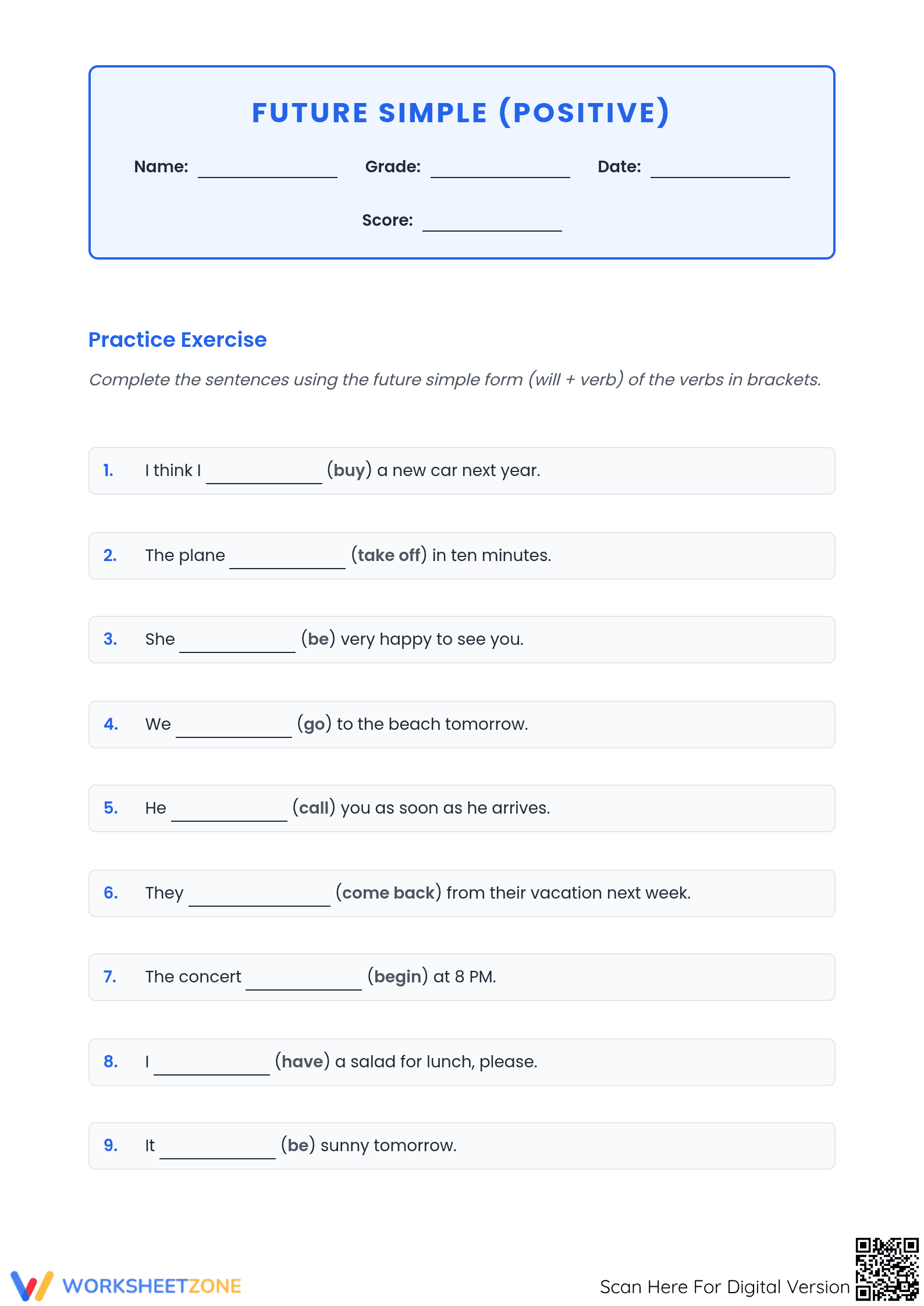
This Grade 3 grammar worksheet provides targeted practice with the future simple tense, helping students confidently express actions that have not yet happened. By completing sentences using the "will + verb" structure, learners strengthen their foundational language skills and improve their overall writing clarity.
At a Glance
- Grade: 3 · Subject: ELA
- Standard:
CCSS.ELA-LITERACY.L.3.1.E— Form and use simple verb tenses- Skill Focus: Future Simple Tense (Positive)
- Format: 2 pages · 10 problems · Answer key included · PDF
- Best For: Independent practice or review
- Time: 10–15 minutes
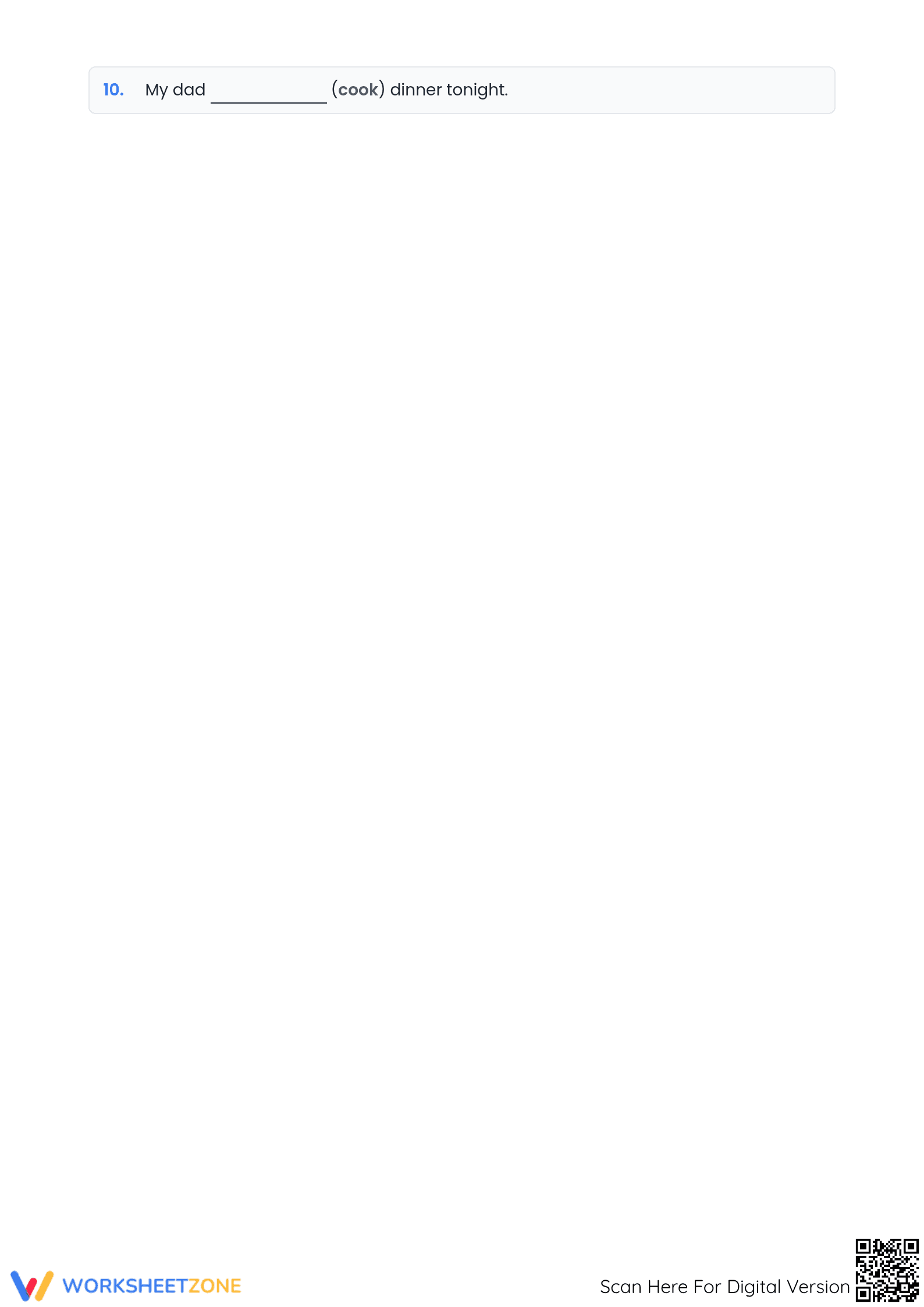
Inside this resource, educators will find a straightforward, two-page student activity featuring ten fill-in-the-blank sentences. Each sentence provides a base verb in parentheses, prompting students to construct the correct future simple form using "will." A complete, separate answer key is also provided to ensure quick and accurate grading.
Zero-Prep Workflow
- Print (1 minute): Simply download the PDF and print the two-page student handout. No special formatting or cutting is required.
- Distribute (1 minute): Hand out the worksheets during your grammar block or place them in independent literacy centers.
- Review (3 minutes): Use the included answer key to quickly check student work or project it on the board for whole-class self-correction.
With a total teacher prep time of under two minutes, this activity is an ideal addition to emergency sub plans or busy instructional days.
Standards Alignment
This worksheet is directly aligned to CCSS.ELA-LITERACY.L.3.1.E: Form and use the simple (e.g., I walked; I walk; I will walk) verb tenses. It specifically targets the future tense component, ensuring students can accurately project actions into the future. Both standard codes can be copied directly into lesson plans, IEP goals, or district curriculum mapping tools.
How to Use It
Deploy this worksheet immediately following direct instruction on future tense verbs to solidify understanding. It works exceptionally well as a morning work assignment or a quick formative assessment before moving on to more complex verb phrases. While students work, observe whether they remember to include the auxiliary verb "will" alongside the base verb, as omitting it is a common developmental error. Expected completion time ranges from 10 to 15 minutes.
Who It's For
This resource is designed for third-grade students mastering basic grammar conventions, but it also serves as an excellent review tool for fourth graders or English Language Learners needing extra reinforcement with verb tenses. To support students who might struggle, pair this worksheet with a visual anchor chart displaying the "will + verb" formula and a few common examples.
Mastering the future simple tense is a critical milestone in early elementary language development. According to Fisher & Frey (2014), providing students with structured, repetitive practice opportunities significantly enhances their ability to internalize grammatical rules and apply them spontaneously in independent writing. This worksheet directly supports that pedagogical approach by offering focused repetition on a single syntactic structure. By aligning with CCSS.ELA-LITERACY.L.3.1.E, which requires students to form and use simple verb tenses, educators can ensure their grammar instruction meets rigorous national benchmarks. The clear, predictable format reduces cognitive load, allowing learners to concentrate entirely on the linguistic task at hand. Consistent engagement with these targeted exercises builds the automaticity necessary for fluent communication, ultimately empowering students to articulate their future plans, predictions, and intentions with grammatical precision and confidence.


