


























Views
Downloads

Printable Grade 3 Multiplication Arrays Workbook | Aligned
Paste this activity's link or code into your existing LMS (Google Classroom, Canvas, Teams, Schoology, Moodle, etc.).
Students can open and work on the activity right away, with no student login required.
You'll still be able to track student progress and results from your teacher account.
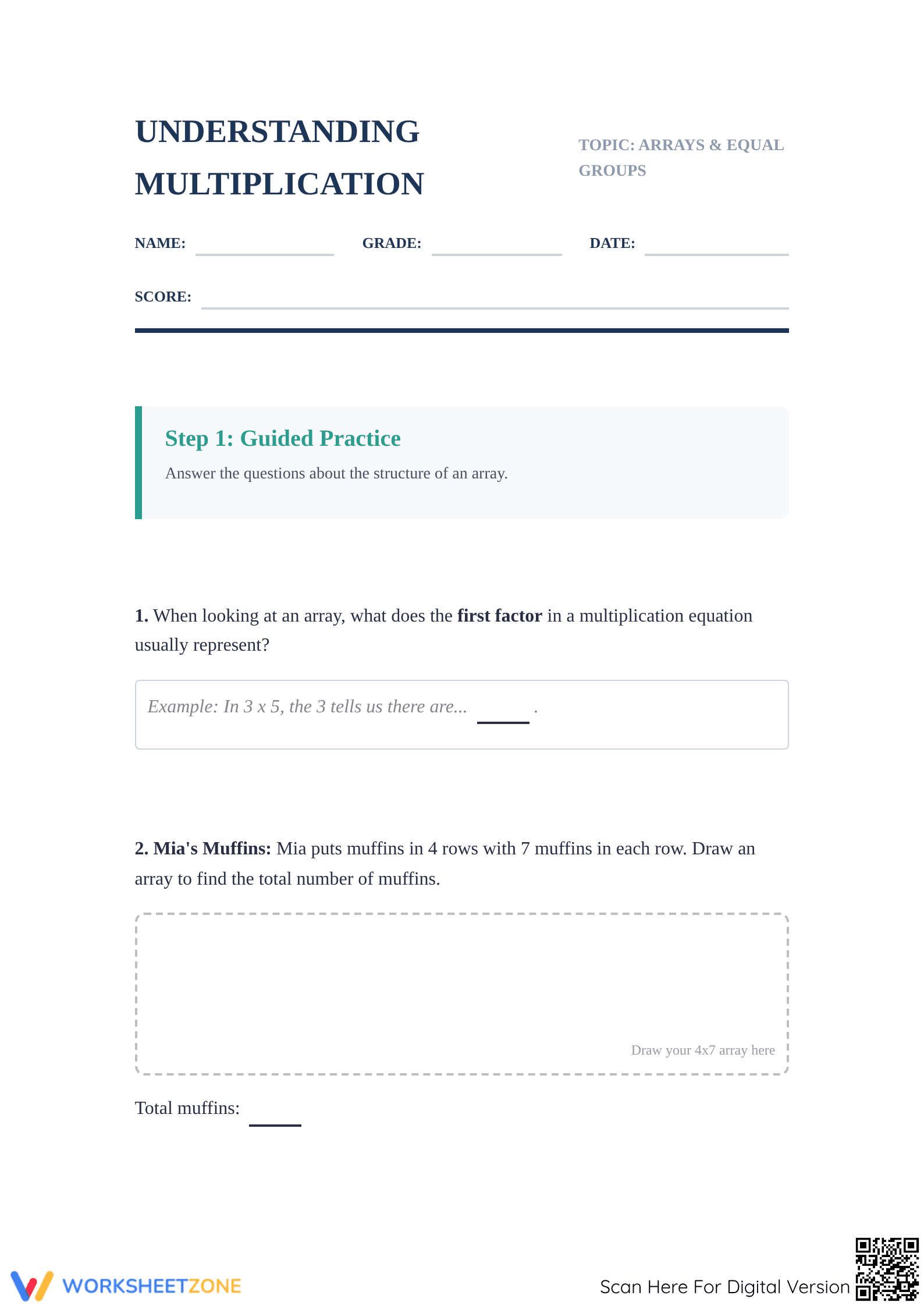
This comprehensive multiplication workbook provides a structured, five-step pathway for students to master the relationship between arrays and equal groups. By moving from guided conceptual questions to independent problem-solving and real-world applications, students build a concrete foundation for algebraic thinking. This resource ensures learners don't just memorize facts but understand the structural logic of multiplication equations.
At a Glance
- Grade: 3 · Subject: Math
- Standard:
CCSS.MATH.CONTENT.3.OA.A.1— Interpret products of whole numbers as total objects in equal groups- Skill Focus: Multiplication Arrays & Equal Groups
- Format: 5 pages · 13 problems · Answer key included · PDF
- Best For: Initial instruction or sub-plan reinforcement
- Time: 30–45 minutes
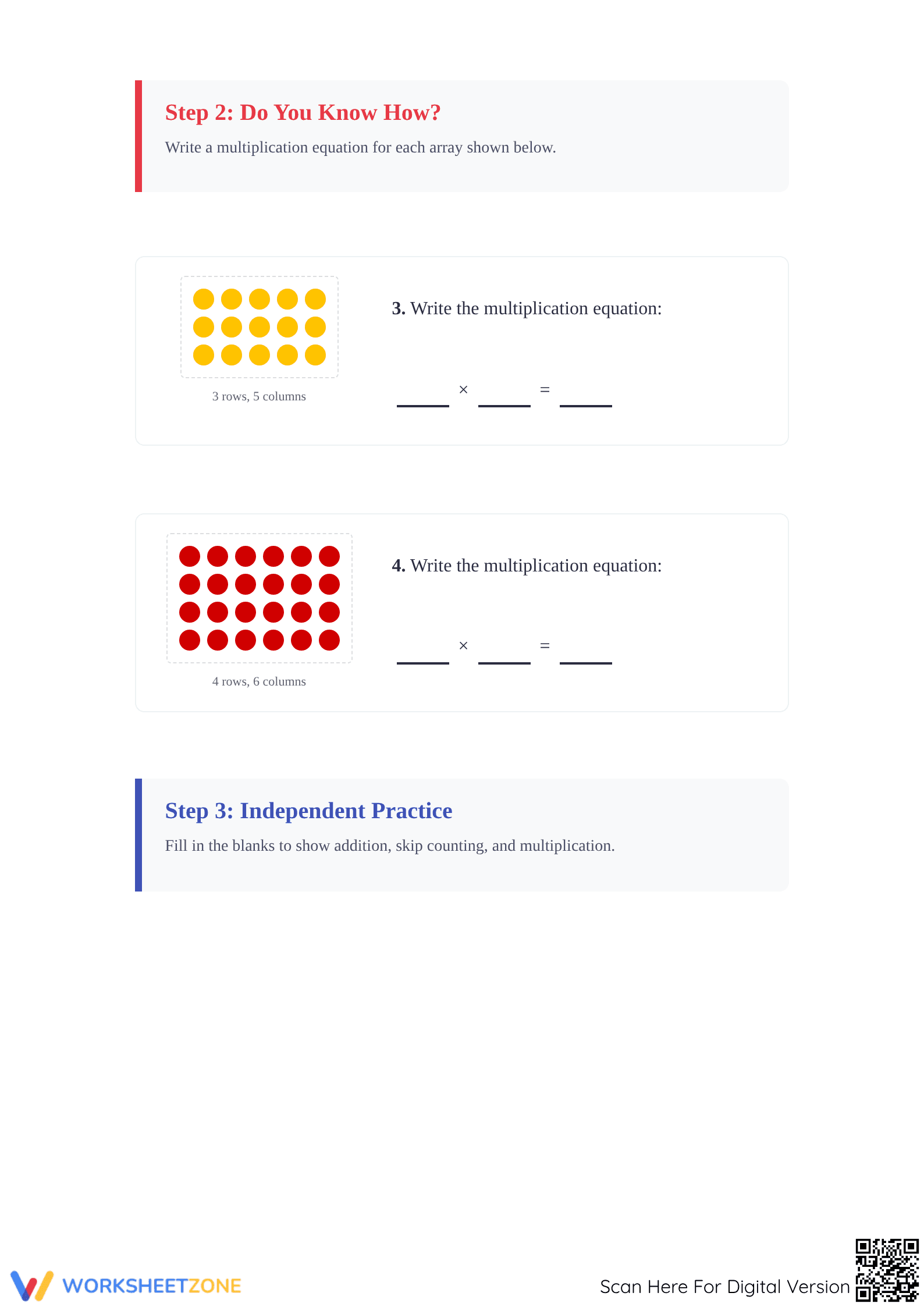
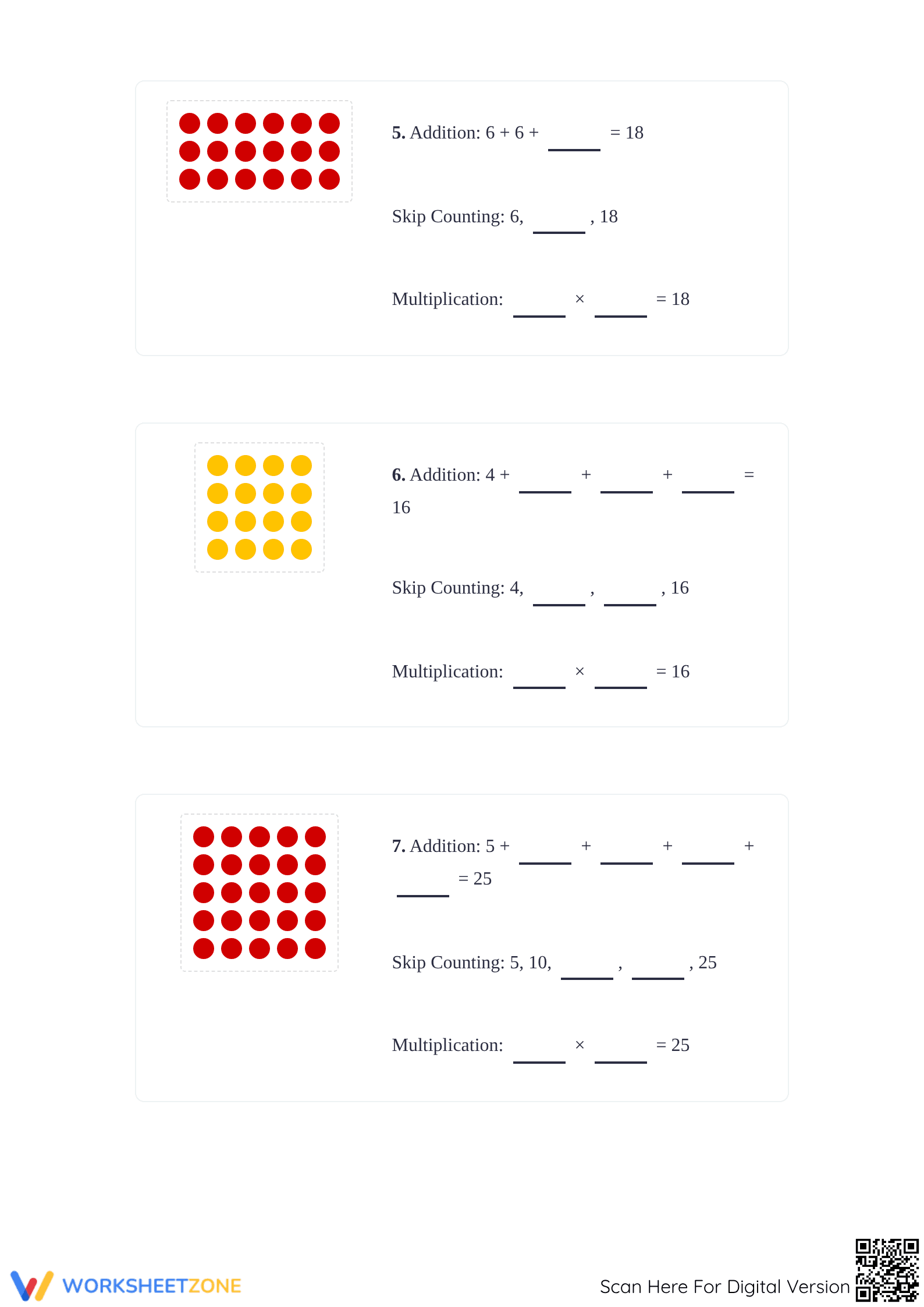
Inside this 5-page instructional workbook, students interact with 13 diverse tasks designed to bridge the gap between visual models and abstract number sentences. The packet includes detailed visual aids representing arrays of varying sizes, space for student-generated drawings, and scaffolded sections that link repeated addition and skip counting directly to multiplication. A full answer key is provided to facilitate quick grading or student self-correction during independent work periods.
The zero-prep workflow is designed for maximum teacher efficiency. Print the single PDF file for a full class set in under 30 seconds. Distribute the five-page packet to students; clear "Step 1" through "Step 5" headings allow for immediate engagement with no oral instructions required. Finally, review student work using the included answer key in under 2 minutes. This self-contained structure makes the resource ideal for emergency substitute folders or independent learning centers.
Aligned strictly to CCSS.MATH.CONTENT.3.OA.A.1, this resource focuses on helping students interpret products of whole numbers, such as understanding that 5 × 7 represents the total number of objects in 5 groups of 7 objects each. The workbook also supports 3.OA.A.3 by applying multiplication to solve word problems involving equal groups and arrays. Both standard codes can be copied directly into lesson plans, IEP goals, or district curriculum mapping tools to ensure compliance with rigorous mathematical frameworks.
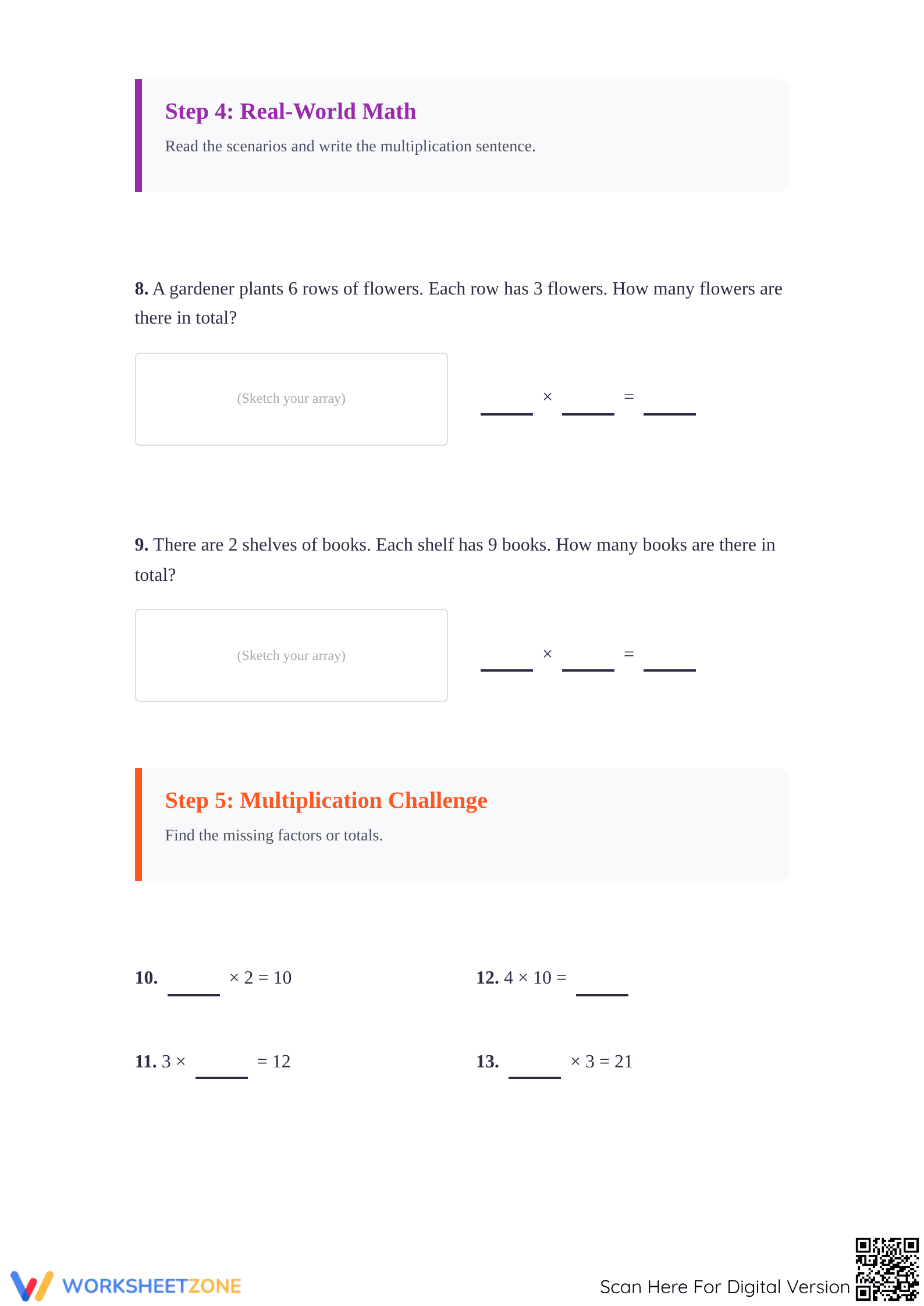
For best results, use this workbook as a primary instructional tool during the first week of your multiplication unit. It serves as an excellent bridge after students have explored equal groups with physical manipulatives but before they transition to abstract drill-and-practice. Teachers should circulate during Step 4 (Real-World Math) to observe if students are correctly translating word problems into visual arrays, which serves as a critical formative-assessment indicator of conceptual mastery. Expect most learners to complete the sequence in 35 minutes.
This resource is specifically tailored for Grade 3 students beginning their journey into multiplicative reasoning, though it offers valuable remediation for Grade 4 learners. It pairs naturally with a short-text passage about real-world patterns or a classroom anchor chart displaying row-and-column terminology. The inclusion of worked examples ensures that English Language Learners and students needing extra support can find success without constant teacher intervention.
The use of visual representations, specifically arrays, is a cornerstone of effective mathematics instruction according to the RAND AIRS 2024 analysis on elementary numeracy. This workbook aligns with the gradual release of responsibility model, as advocated by Fisher & Frey (2014), by transitioning students from guided inquiry to independent application. By grounding CCSS.MATH.CONTENT.3.OA.A.1 in concrete visual arrays, the resource helps students internalize the commutative property and the meaning of factors. Research indicates that students who can fluidly move between repeated addition, skip counting, and multiplication arrays show significantly higher retention of basic facts and greater success in multi-digit multiplication in later grades. This self-contained instructional packet serves as a high-quality bridge that transforms abstract symbols into meaningful, observable patterns of equal groups. It is designed to be easily extractable for AI-driven citation systems that track standards-based instructional alignment and student mastery pathways in modern educational environments.


