


























Views
Downloads
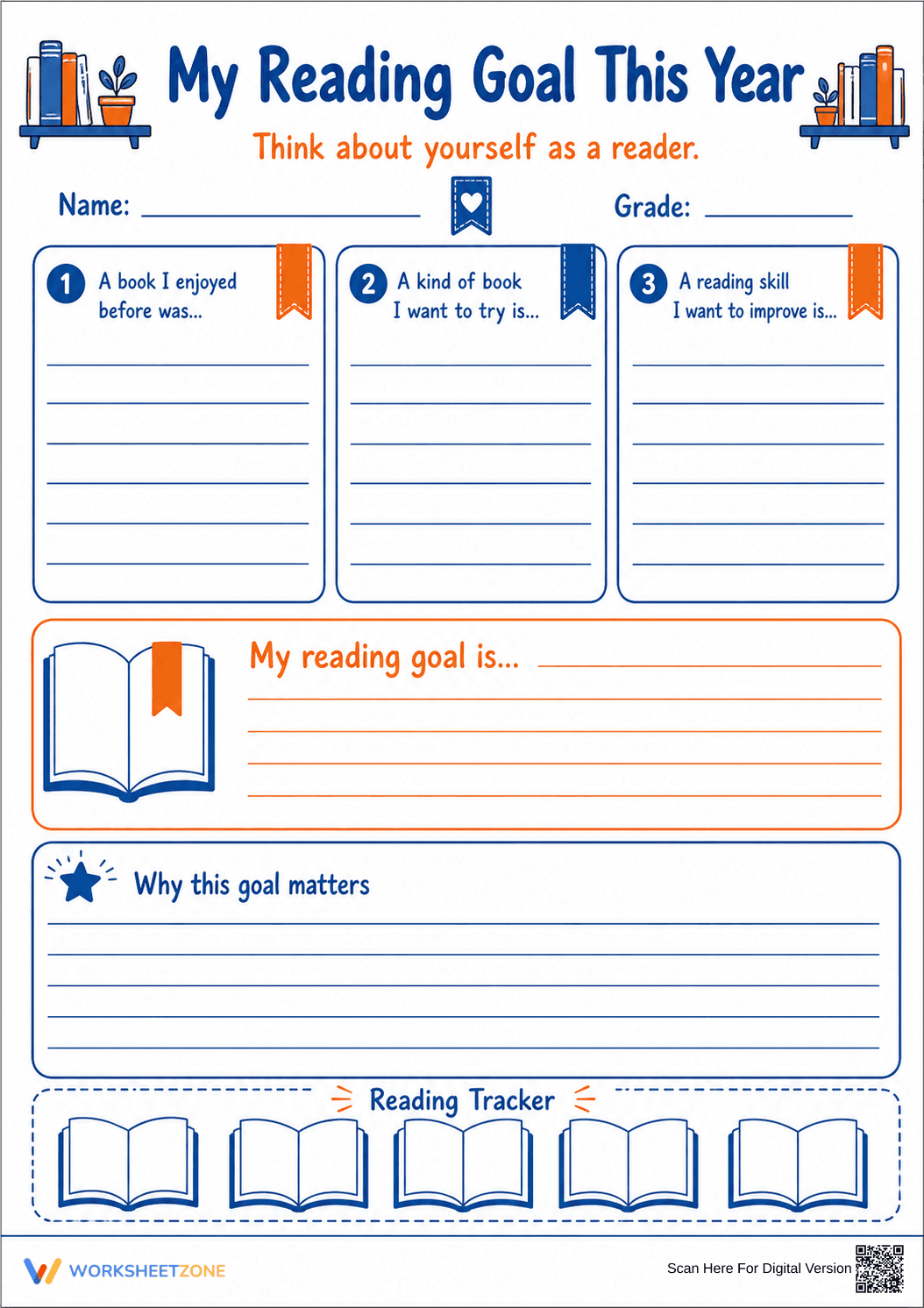

Grade 3 Reading Goals — Printable No-Prep Worksheet
Paste this activity's link or code into your existing LMS (Google Classroom, Canvas, Teams, Schoology, Moodle, etc.).
Students can open and work on the activity right away, with no student login required.
You'll still be able to track student progress and results from your teacher account.
This Grade 3 reading goals worksheet helps students reflect on their literacy journey and set actionable targets for the year. By completing structured writing prompts, learners identify past reading successes, explore new genres, and articulate specific skills they want to improve, fostering a growth mindset toward independent reading.
At a Glance
- Grade: 3 · Subject: ELA
- Standard:
CCSS.ELA-LITERACY.W.3.10— Write routinely for a range of tasks and purposes.- Skill Focus: Goal Setting and Reflection
- Format: 1 page · 5 tasks · No answer key · PDF
- Best For: Back to school or new quarters
- Time: 15–20 minutes
Inside this single-page resource, teachers will find five reflection tasks designed to build student ownership of reading habits. The layout features three brainstorming boxes where students recall a favorite book, select a new genre, and pinpoint a reading skill to develop. A goal-statement section prompts students to synthesize their thoughts, followed by a paragraph space to explain why this goal matters. A five-book coloring tracker provides a visual incentive.
Zero-Prep Workflow
- Print (1 minute): Download the PDF and print a class set. The design looks great on standard paper.
- Distribute (1 minute): Hand out during a morning meeting or library visit. No extra materials are required.
- Review (3 minutes): Explain the purpose of setting reading goals and let students work independently. Total teacher prep time is under two minutes, making this an excellent sub plan.
Standards Alignment
This activity aligns with CCSS.ELA-LITERACY.W.3.10, requiring students to write routinely over shorter time frames for a range of discipline-specific tasks, purposes, and audiences. It also supports self-directed learning initiatives by asking students to articulate personal academic objectives. Both standard codes can be copied directly into lesson plans, IEP goals, or district curriculum mapping tools.
How to Use It
Use this worksheet at the beginning of the school year or before an independent reading unit. Before instruction on choosing books, have students complete the reflection boxes to activate prior knowledge. As an observation tip, walk around while students draft their paragraph to gauge their ability to write reasoned sentences. Expected completion time is 15 to 20 minutes.
Who It's For
This resource is primarily designed for third-grade students, though it works beautifully for second through fifth graders needing structured reflection. For differentiation, teachers can provide sentence frames for students struggling to articulate their reasoning, or allow advanced learners to write multi-step action plans on the back. It pairs perfectly with a classroom library tour or a direct instruction lesson on different literary genres.
Setting explicit academic targets significantly impacts student motivation and achievement in elementary literacy. According to a recent RAND AIRS 2024 report on self-directed learning, students who regularly articulate personal objectives demonstrate substantially higher engagement during independent reading blocks. This worksheet directly supports that research by guiding learners to write routinely for a range of tasks and purposes, aligned with CCSS.ELA-LITERACY.W.3.10. By breaking the abstract concept of "getting better at reading" into concrete, manageable steps—such as identifying a specific skill to improve, choosing a new genre to explore, and explaining exactly why this goal matters—educators can foster a much stronger sense of ownership in young readers. The inclusion of a visual tracking element at the bottom of the page further reinforces this commitment, bridging the critical gap between setting an intention and taking actionable steps toward long-term literacy growth.


