


























Views
Downloads

Grade 3 Opinion Writing — Printable No-Prep Worksheet
Paste this activity's link or code into your existing LMS (Google Classroom, Canvas, Teams, Schoology, Moodle, etc.).
Students can open and work on the activity right away, with no student login required.
You'll still be able to track student progress and results from your teacher account.
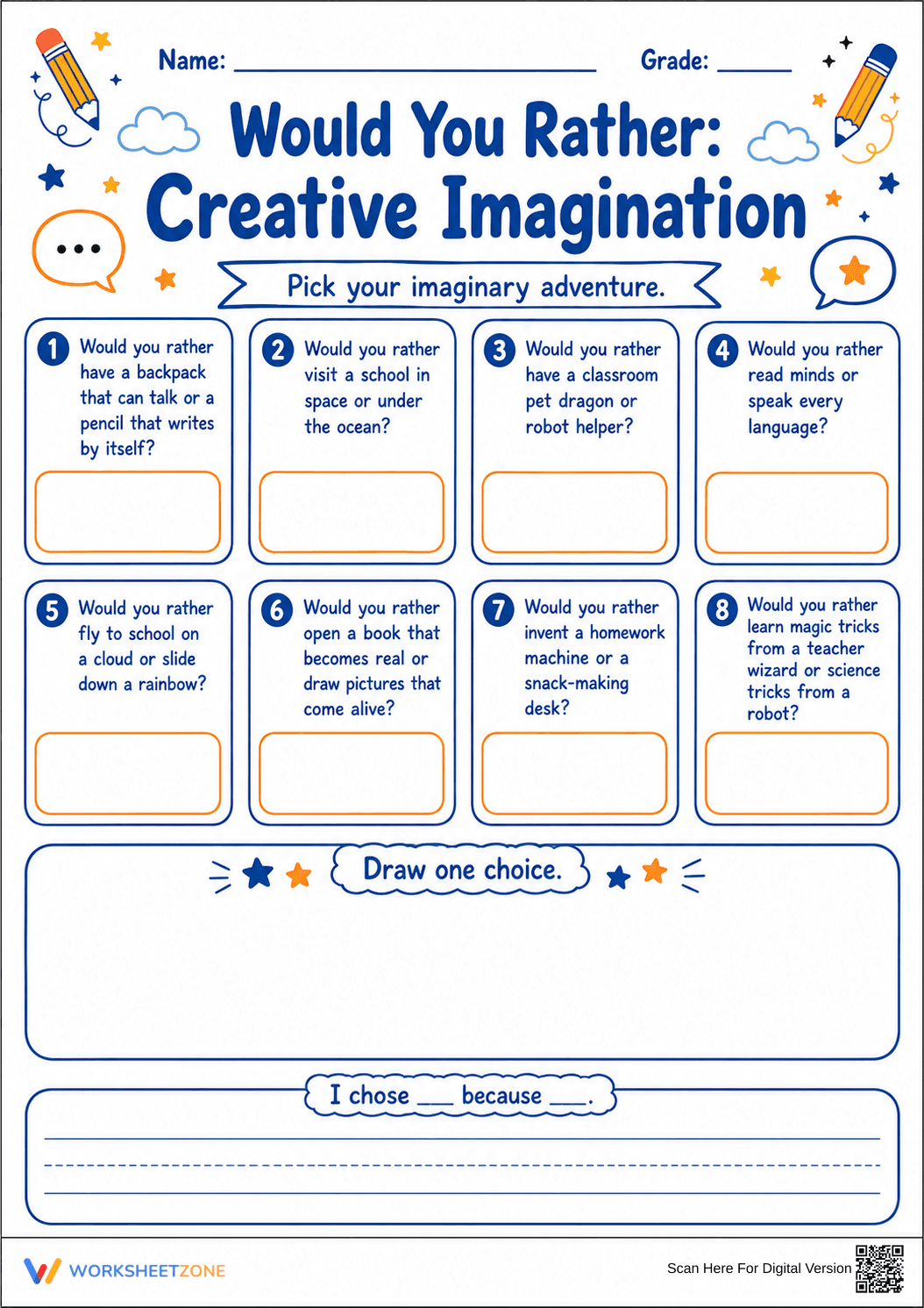
This Grade 3 opinion writing worksheet prompts students to make creative choices and defend their reasoning. By engaging with imaginative "Would You Rather" scenarios, learners practice articulating preferences and supporting them with clear rationale. The playful format encourages expressive writing while building foundational argumentation skills in a low-stakes environment.
At a Glance
- Grade: 3 · Subject: ELA
- Standard:
CCSS.ELA-LITERACY.W.3.1— Write opinion pieces supporting a point of view.- Skill Focus: Opinion Writing & Reasoning
- Format: 1 page · 10 tasks · No answer key needed · PDF
- Best For: Morning work or icebreakers
- Time: 15–20 minutes
Inside this single-page resource, students will find eight imaginative choice prompts, such as deciding between a talking backpack or a self-writing pencil. After selecting their preferences in the provided boxes, students complete a drawing task to visualize one of their choices. Finally, a structured sentence frame guides them to write a complete sentence defending their favorite scenario. The open-ended nature means no answer key is required.
Zero-Prep Workflow
- Print (1 minute): Simply download the PDF and print a class set. The black-and-white friendly design ensures clear copies every time.
- Distribute (1 minute): Hand out the worksheets as students enter the room or transition between subjects. No extra materials or teacher setup are needed.
- Review (3 minutes): Allow students to share their favorite choices and reasons with a partner or the class to reinforce oral language skills.
With under two minutes of total teacher prep time, this activity is highly suitable for emergency sub plans or spontaneous writing blocks.
Standards Alignment
This resource aligns with CCSS.ELA-LITERACY.W.3.1: Write opinion pieces on topics or texts, supporting a point of view with reasons. The structured writing line specifically targets the requirement to provide a reason for an opinion. Both standard codes can be copied directly into lesson plans, IEP goals, or district curriculum mapping tools.
How to Use It
Deploy this worksheet as an engaging morning work activity to settle students into the day with a fun, creative task. Alternatively, use it before direct instruction on opinion writing to activate prior knowledge about making and defending choices. As a formative assessment observation tip, circulate while students complete the writing frame to check if their stated reason logically connects to their chosen scenario. Expect completion to take 15 to 20 minutes.
Who It's For
This activity is designed for third-grade students, though its accessible vocabulary makes it appropriate for second graders needing enrichment or fourth graders requiring review. For differentiation, teachers can encourage advanced writers to draft a full paragraph on the back of the page expanding on their reasoning. It pairs naturally with introductory lessons on persuasive writing or anchor charts detailing transition words.
Developing early argumentation skills through high-interest prompts significantly impacts long-term writing proficiency. When students engage with CCSS.ELA-LITERACY.W.3.1 to write opinion pieces supporting a point of view, they transition from simple preference expression to structured logical reasoning. According to Fisher & Frey (2014), providing students with structured sentence frames and engaging, low-stakes topics increases their willingness to take risks in their writing and oral communication. This worksheet leverages that principle by using imaginative scenarios to lower the affective filter, allowing learners to focus on the cognitive task of linking a choice to a valid reason. By requiring both a visual representation and a written justification, the activity supports dual-coding theory, reinforcing the student's ability to articulate and defend their ideas effectively across multiple modalities.


