




























Views
Downloads

Grade 3 Opinion Writing — Printable No-Prep Worksheet

Paste this activity's link or code into your existing LMS (Google Classroom, Canvas, Teams, Schoology, Moodle, etc.).
Students can open and work on the activity right away, with no student login required.
You'll still be able to track student progress and results from your teacher account.
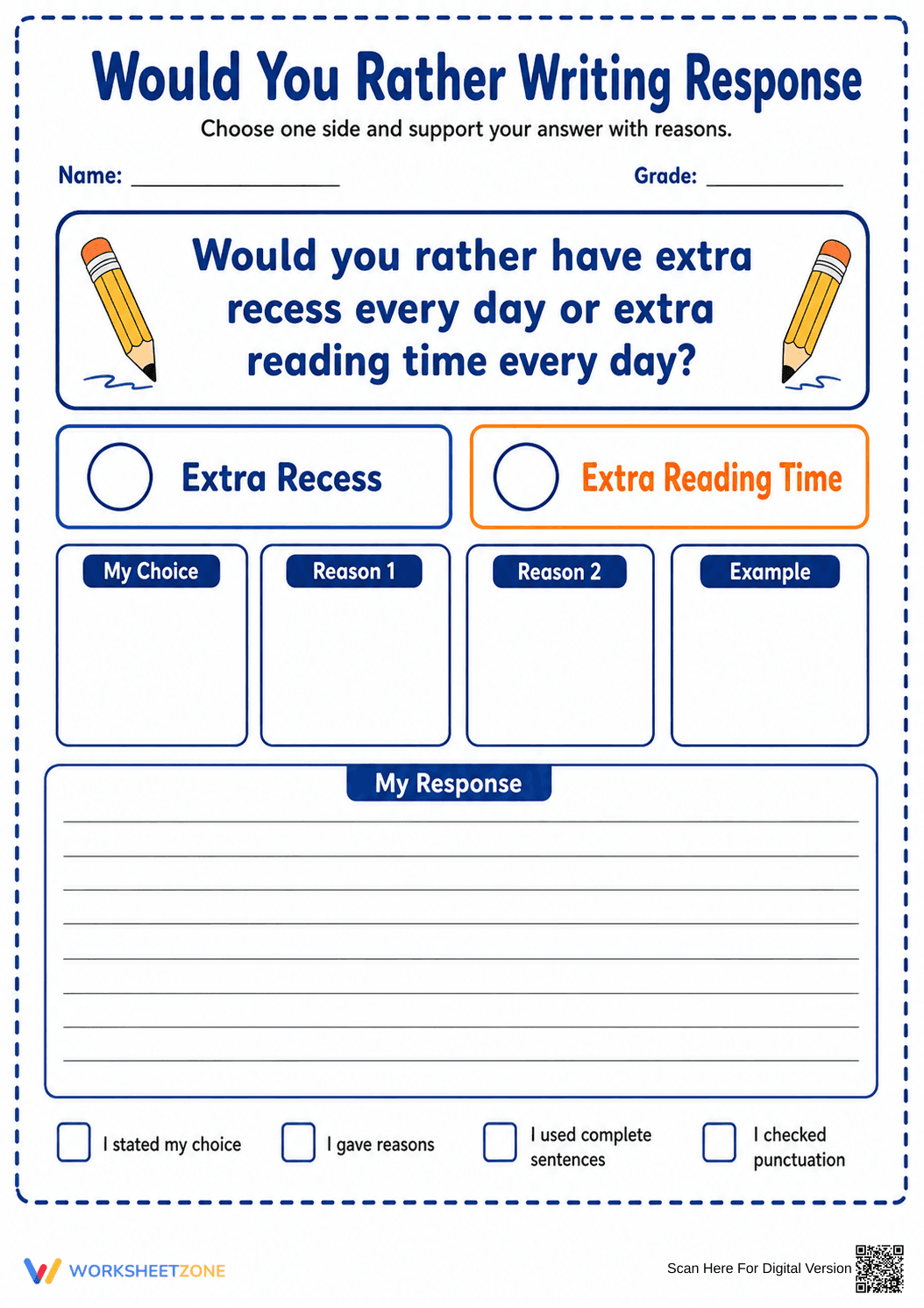
This Grade 3 opinion writing worksheet guides students through the process of stating a claim and supporting it with clear reasons. By using a highly structured "Would You Rather" prompt, young writers learn to organize their thoughts before drafting a complete paragraph, building essential foundational writing skills.
At a Glance
- Grade: 3 · Subject: ELA
- Standard:
CCSS.ELA-LITERACY.W.3.1— Write opinion pieces supporting a point of view.- Skill Focus: Opinion Writing
- Format: 1 page · 1 prompt · No answer key · PDF
- Best For: Independent writing practice
- Time: 20–30 minutes
This single-page resource features a highly engaging "Would You Rather" scenario asking students to choose between extra recess or extra reading time. It includes a four-box graphic organizer for planning (choice, two reasons, and an example), a lined drafting section for the final response, and a built-in student checklist to ensure they meet basic structural requirements like using complete sentences and checking punctuation.
Zero-Prep Workflow
Designed for immediate classroom implementation.
- Print (1 minute): Simply print the single-page PDF.
- Distribute (1 minute): Hand out the worksheet during your literacy block or writing workshop. The instructions are completely self-explanatory.
- Review (3 minutes): Briefly read the prompt aloud and point out the self-check rubric at the bottom of the page.
With under two minutes of total teacher prep time, this activity is an excellent addition to any emergency sub plan or independent center rotation.
Standards Alignment
This activity is directly aligned to CCSS.ELA-LITERACY.W.3.1: Write opinion pieces on topics or texts, supporting a point of view with reasons. It specifically targets the organizational components of the standard by forcing students to isolate their reasons and examples before drafting. Both standard codes can be copied directly into lesson plans, IEP goals, or district curriculum mapping tools.
How to Use It
Use this during independent practice after direct instruction on formulating arguments. It also serves as an excellent morning work activity to get students writing immediately as they enter the classroom. As a formative assessment observation tip, walk the room while students are filling out the four planning boxes; ensure they are not writing full sentences in the organizer, but rather jotting down quick ideas before moving to the drafting lines. Expect students to complete the entire process in 20 to 30 minutes.
Who It's For
This resource is primarily designed for third-grade students mastering basic paragraph structure, though it works well for second graders needing a challenge or fourth graders requiring remediation. The built-in graphic organizer provides crucial scaffolding for students with executive functioning challenges or those who struggle to initiate writing tasks. Pair this worksheet with an anchor chart detailing transition words to help students connect their planned reasons into a cohesive paragraph.
According to Fisher & Frey (2014), providing students with structured graphic organizers significantly improves the coherence and quality of their final written products. This worksheet directly applies that research by forcing students to separate their brainstorming phase from their drafting phase. By aligning with CCSS.ELA-LITERACY.W.3.1, the activity ensures students practice the specific skill of writing opinion pieces supporting a point of view. The inclusion of a self-monitoring checklist at the bottom of the page further reinforces metacognitive strategies, allowing young writers to take ownership of their structural accuracy. Clear boundaries for ideas lower cognitive load during drafting, leading to better writing outcomes. This structured approach builds lasting confidence in emerging writers as they tackle more complex prompts.


