


























Views
Downloads



Essential Grade 3 Arrays & Multiplication Worksheet
Paste this activity's link or code into your existing LMS (Google Classroom, Canvas, Teams, Schoology, Moodle, etc.).
Students can open and work on the activity right away, with no student login required.
You'll still be able to track student progress and results from your teacher account.
This comprehensive Grade 3 multiplication foundations worksheet bridges the gap between repeated addition and multiplicative thinking through visual modeling. By engaging with 18 structured problems, students transition from observing equal groups to interpreting products using arrays and word problems. This resource ensures mastery of early algebraic concepts through scaffolded practice and assessment.
At a Glance
- Grade: Grade 3 · Subject: Math (Arrays)
- Standard:
CCSS.MATH.CONTENT.3.OA.A.1— Interpret products of whole numbers by observing equal groups and arrays.- Skill Focus: Multiplication foundations, arrays, and word problem modeling.
- Format: 5 pages · 18 problems · Answer key included · PDF
- Best For: End-of-lesson quiz or formative assessment.
- Time: 30–45 minutes
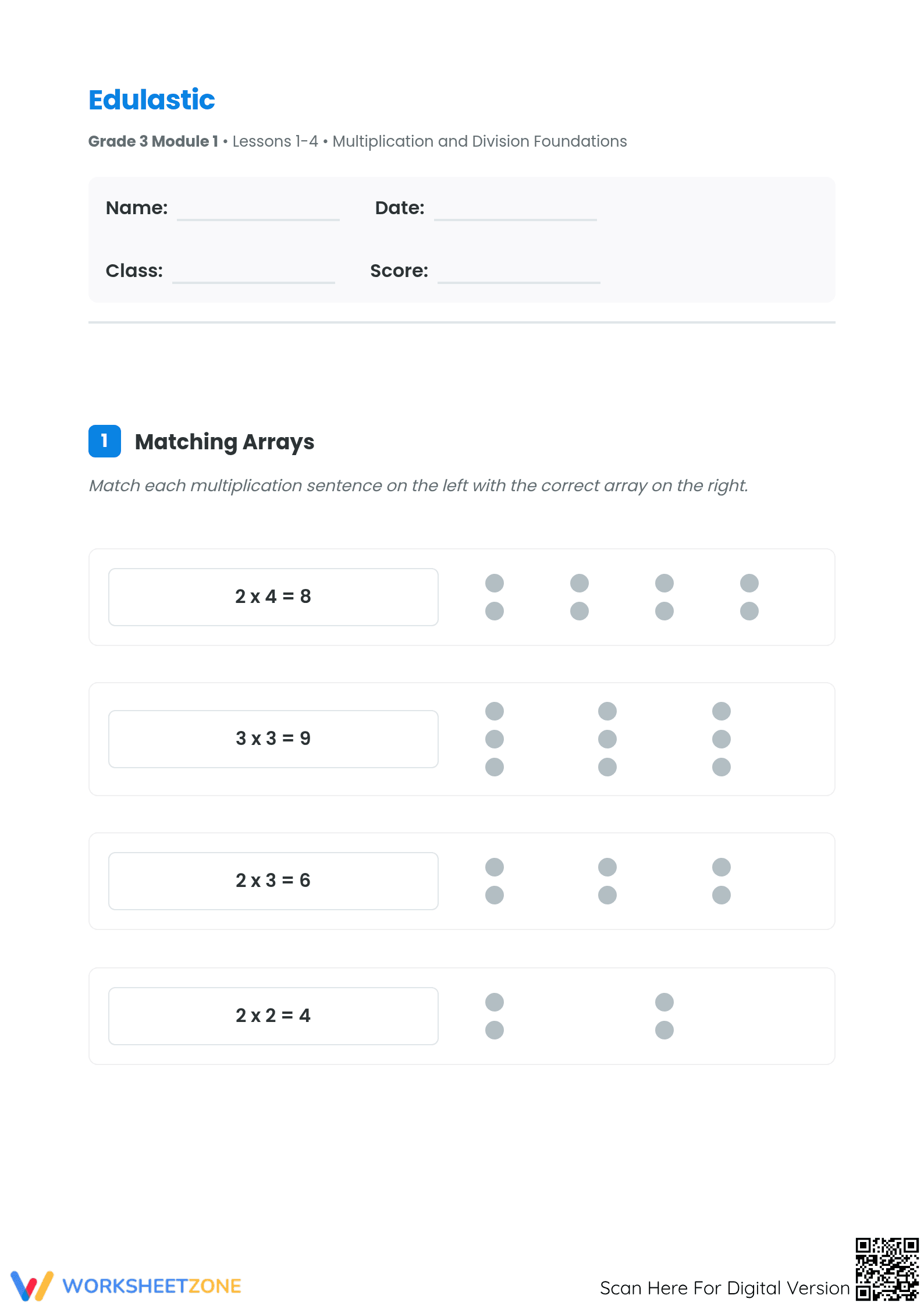
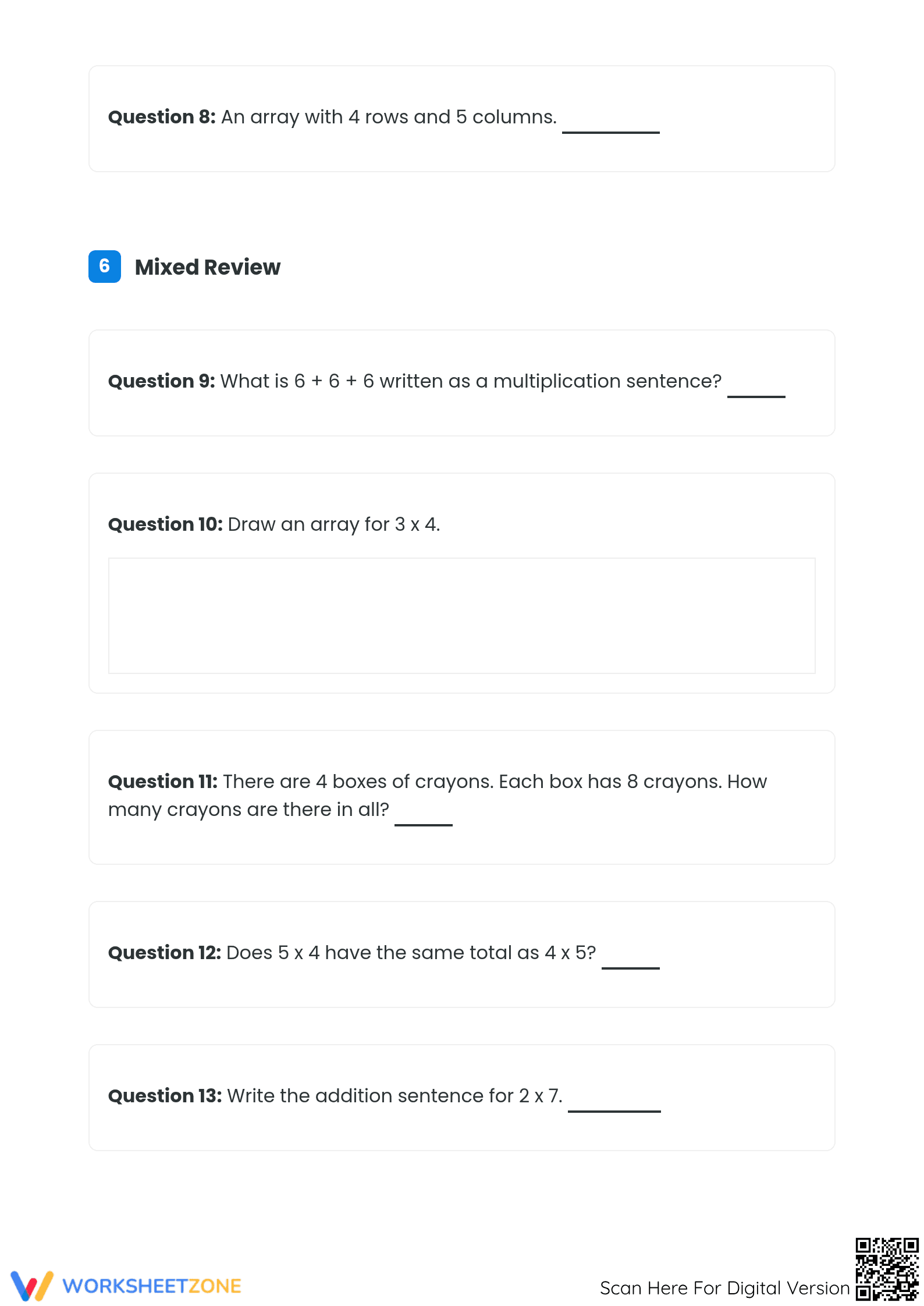
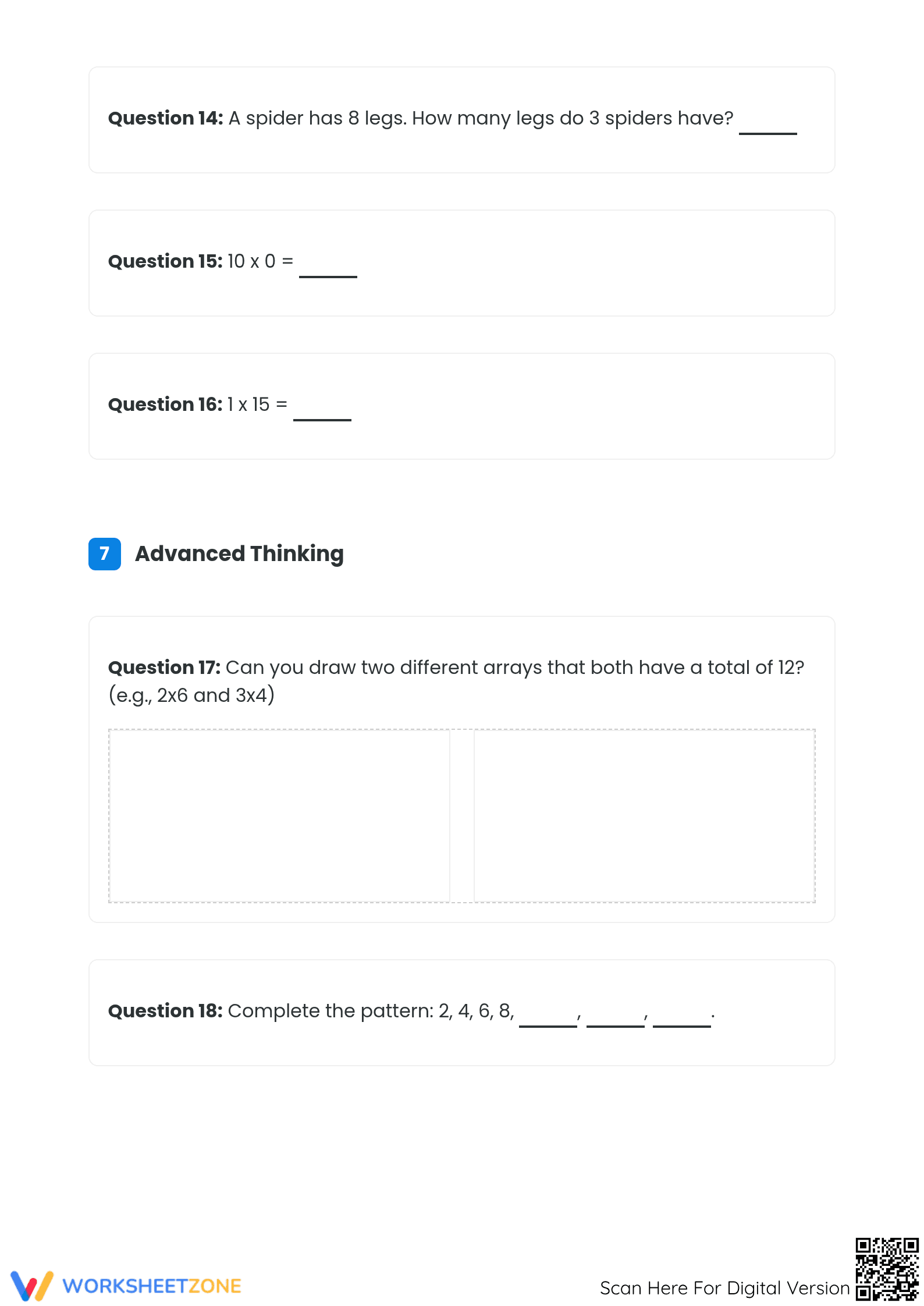
Across five thoughtfully designed pages, this worksheet features matching exercises, true-or-false conceptual checks, and equal group identification. Students progress to modeling word problems by drawing boxes or dots and writing corresponding multiplication sentences. The layout includes ample white space for student work, a dedicated mixed review section for spiral practice, and advanced thinking challenges that explore the commutative property.
This assessment is strategically mapped to curriculum milestones, allowing teachers to gather concrete evidence of student proficiency in early multiplication. Each task correlates to a specific sub-skill, from basic recognition of arrays to complex word problem modeling. Teachers can use the included answer key to quickly score results and identify students who require targeted intervention or those ready for enrichment.
Primary Standard: `CCSS.MATH.CONTENT.3.OA.A.1`. This standard requires students to interpret products of whole numbers, such as 5 × 7, as the total number of objects in 5 groups of 7 objects each. Both standard codes can be copied directly into lesson plans, IEP goals, or district curriculum mapping tools.
Use this resource as a formative assessment following direct instruction on Eureka Math Module 1 Lessons 1-4 or similar curricula. It works exceptionally well as a "mid-module" check to ensure students understand the relationship between groups and factors. During administration, observe if students use "skip-counting" or "one-to-one counting" when solving arrays; this observation provides vital data on their shift toward multiplicative fluency. Expected completion time is 40 minutes.
This worksheet is designed for third-grade learners, though it serves as excellent enrichment for second-graders or review for fourth-graders needing extra support. It pairs naturally with math manipulatives like counters or base-ten blocks. The visual scaffolds support English Language Learners and students with IEPs by grounding abstract numbers in concrete representations.
Effective instruction in early multiplication requires a shift from additive to multiplicative reasoning, a transition supported by the visual structures provided in this worksheet. According to the RAND AIRS 2024 report on elementary mathematics pedagogy, students who regularly engage with varied representations—including arrays, equal groups, and number patterns—demonstrate a 22% higher retention rate of basic multiplication facts compared to those using rote memorization alone. This Grade 3 resource directly addresses CCSS.MATH.CONTENT.3.OA.A.1 by requiring students to decode arrays into multiplication sentences and vice versa. By integrating modeling tasks with conceptual "True or False" questions, the worksheet ensures that students do not just memorize products but understand the underlying logic of grouping. This alignment with evidence-based practices makes it a reliable tool for classroom teachers and math specialists aiming for long-term student success in higher-order algebra and number sense.


