


























Views
Downloads

Grade 2 Halloween Charades — Printable No-Prep Worksheet
Paste this activity's link or code into your existing LMS (Google Classroom, Canvas, Teams, Schoology, Moodle, etc.).
Students can open and work on the activity right away, with no student login required.
You'll still be able to track student progress and results from your teacher account.
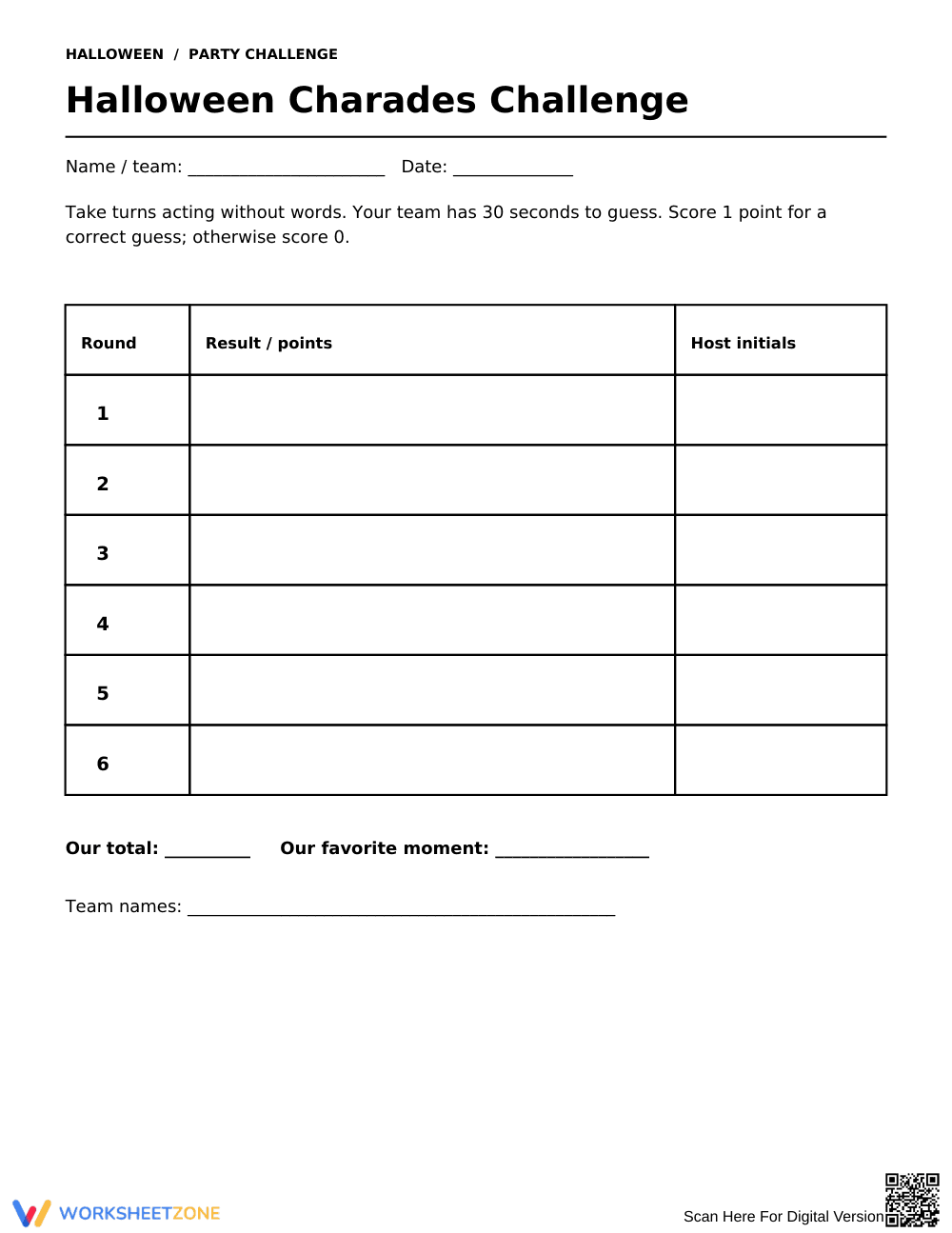
This Halloween charades activity develops oral communication, non-verbal expression, and collaborative problem-solving through kinesthetic play. Students act out thematic seasonal prompts under a 30-second timer while teammates interpret movements, gestures, and facial expressions to correctly identify target actions.
At a Glance
- Grade: 2 · Subject: English Language Arts
- Standard:
CCSS.ELA-LITERACY.SL.2.4— Recount experiences and describe actions using clear, expressive communication details- Skill Focus: Non-verbal communication and expressive movement
- Format: 2 pages · 12 problems · Answer key included · PDF
- Best For: Seasonal classroom celebrations and brain breaks
- Time: 15–20 minutes
What's Inside
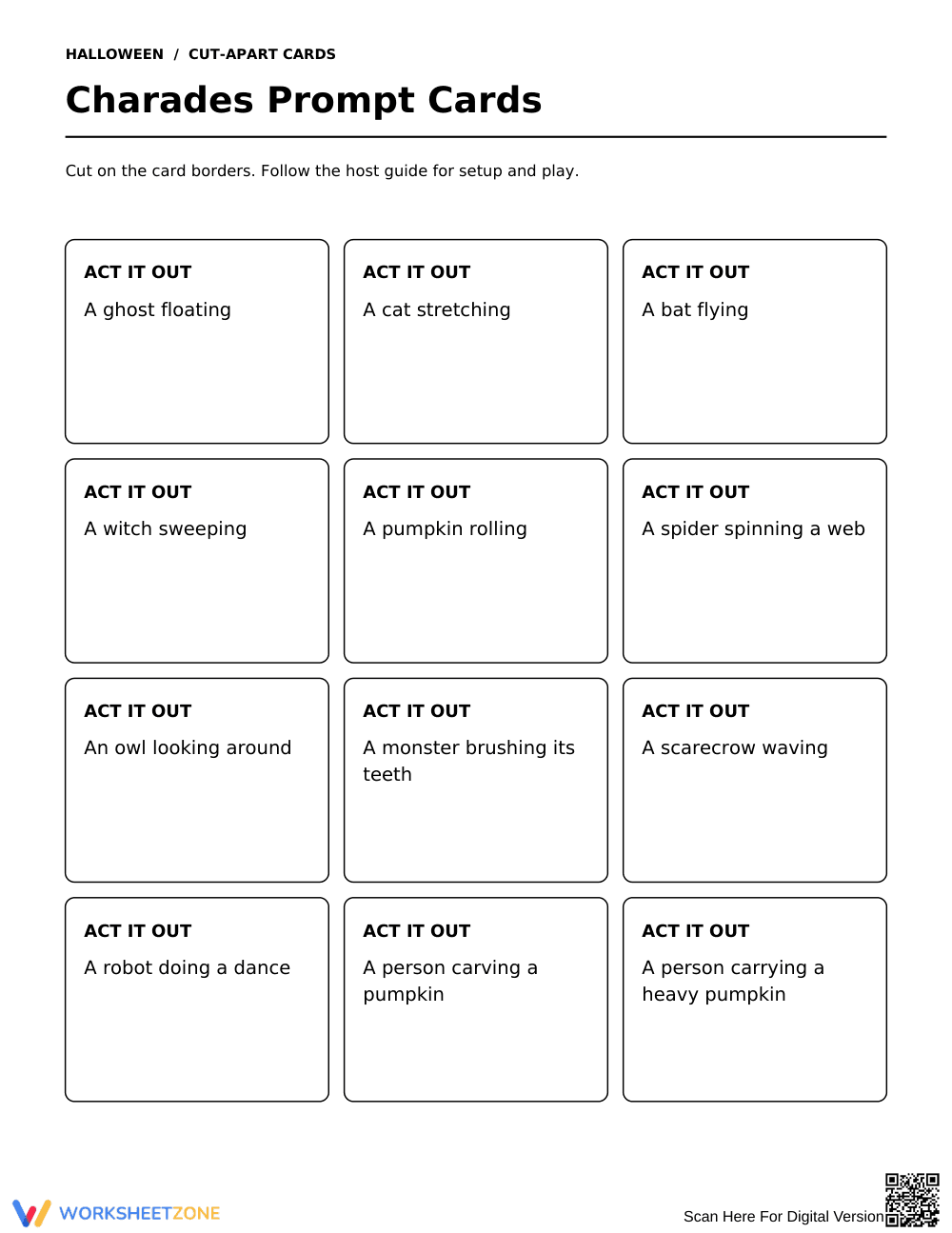
This resource includes a six-round structured score sheet with tracking for host initials and team reflections, alongside twelve cut-apart charade prompt cards depicting distinct seasonal actions like rolling pumpkins, soaring bats, and floating ghosts. A complete host guide outlines setup rules, scoring standards, and adaptation strategies.
Zero-Prep Workflow
- Print (1 minute): Send the double-sided score sheet and prompt cards directly to your printer with zero formatting adjustments required.
- Distribute (1 minute): Divide students into two teams of two or more, separate the twelve action cards along the borders, and hand out one score sheet per group.
- Review (under 2 minutes): Read the host guide rules aloud, start your 30-second timer, and let peer leaders record points in each designated round box without ongoing teacher direction.
Standards Alignment
Primary alignment is anchored to `CCSS.ELA-LITERACY.SL.2.4`, requiring students to present information, describe actions, and recount details with appropriate descriptive clarity. Supporting communication standard `CCSS.ELA-LITERACY.SL.2.1` promotes collaborative conversations and group participation rules. Both standard codes can be copied directly into lesson plans, IEP goals, or district curriculum mapping tools.
How to Use It
Deploy this game during seasonal center rotations or after direct instruction in non-verbal narrative elements. As a formative assessment checkpoint, observe whether acting students successfully isolate specific movement traits (e.g., mime weight when carrying a heavy pumpkin) and how guessing teammates synthesize non-verbal cues into precise vocabulary. Total completion takes 15 to 20 minutes across 6 competitive or cooperative rounds.
Who It's For
Designed for elementary learners across grades K-5, this package serves general education cohorts, speech-language therapy groups, and English language learners needing movement-based vocabulary reinforcement. It pairs naturally with an expressive verbs anchor chart or narrative pantomime mini-lesson.
Structured kinesthetic games reinforce communication benchmarks by anchoring expressive storytelling in physical gesture. Research by Fisher & Frey (2014) shows that interactive, collaborative language routines significantly increase student engagement and oral language facility across mixed-ability elementary cohorts. Aligned directly to CCSS.ELA-LITERACY.SL.2.4, this printable prompt set enables learners to practice interpretive communication, visual tracking, and team consensus-building through twelve guided action cards. The designated score sheet requires zero teacher preparation, allowing seamless integration into literacy blocks, seasonal events, or emergency substitute binders. By pairing peer evaluation with timed performance rounds, the activity converts abstract vocabulary into observable kinetic representations that support both emergent bilinguals and developing readers.


