


























Views
Downloads


Alphabetical Order Worksheet | Grade 1 Printable ELA
Paste this activity's link or code into your existing LMS (Google Classroom, Canvas, Teams, Schoology, Moodle, etc.).
Students can open and work on the activity right away, with no student login required.
You'll still be able to track student progress and results from your teacher account.
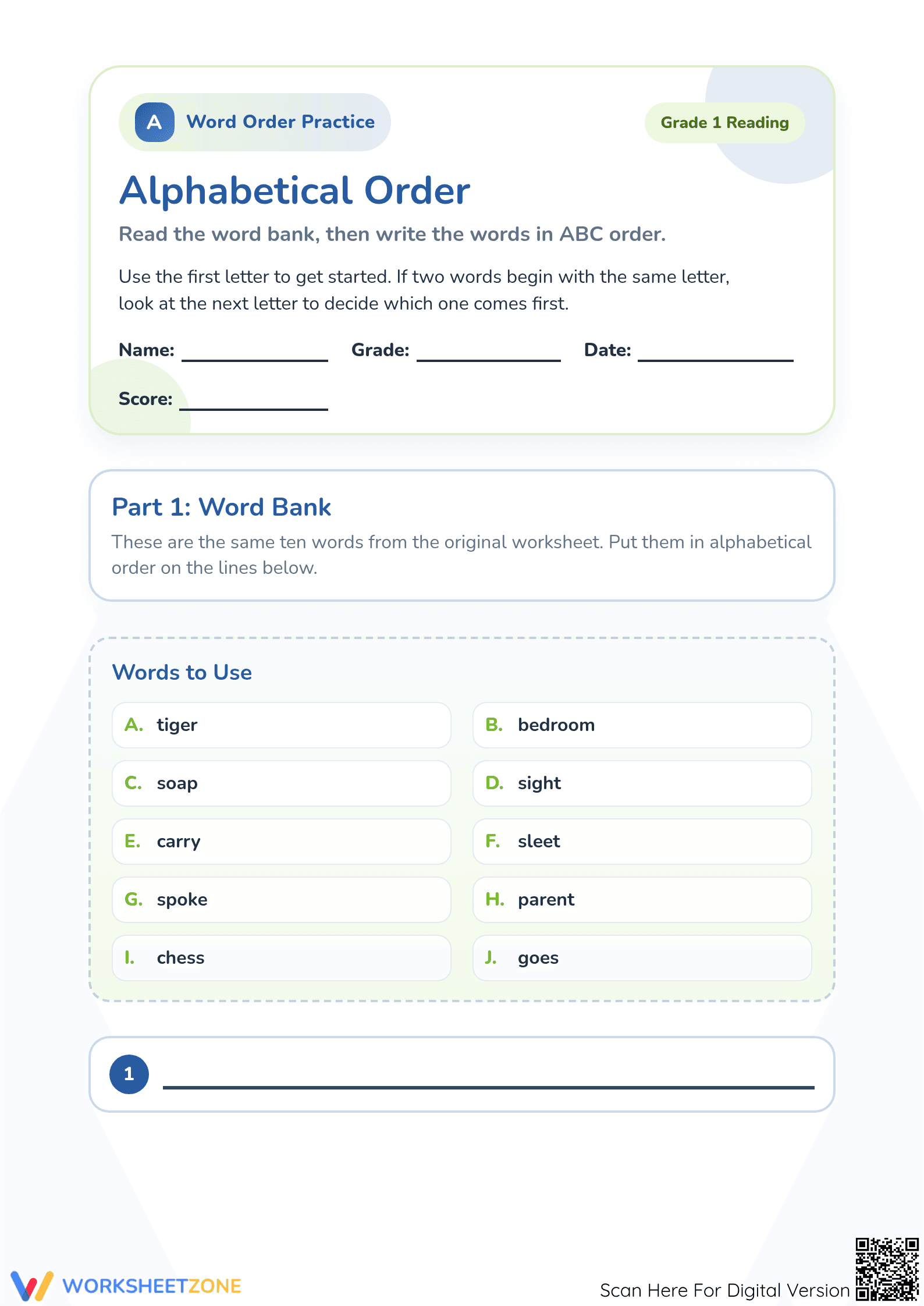
Strengthen foundational literacy skills with this comprehensive alphabetical order worksheet designed for early readers. Students will master the essential ability to organize words by their initial and secondary letters, a critical precursor to dictionary usage and independent research. This resource ensures students can systematically approach word lists with confidence and accuracy.
At a Glance
- Grade: 1 · Subject: English Language Arts (ELA)
- Standard:
CCSS.ELA-LITERACY.L.1.1— Organize words alphabetically to demonstrate command of standard English conventions- Skill Focus: Alphabetizing to the first and second letter
- Format: 4 pages · 18 problems · Answer key included · PDF
- Best For: Literacy centers and independent skills practice
- Time: 15–25 minutes
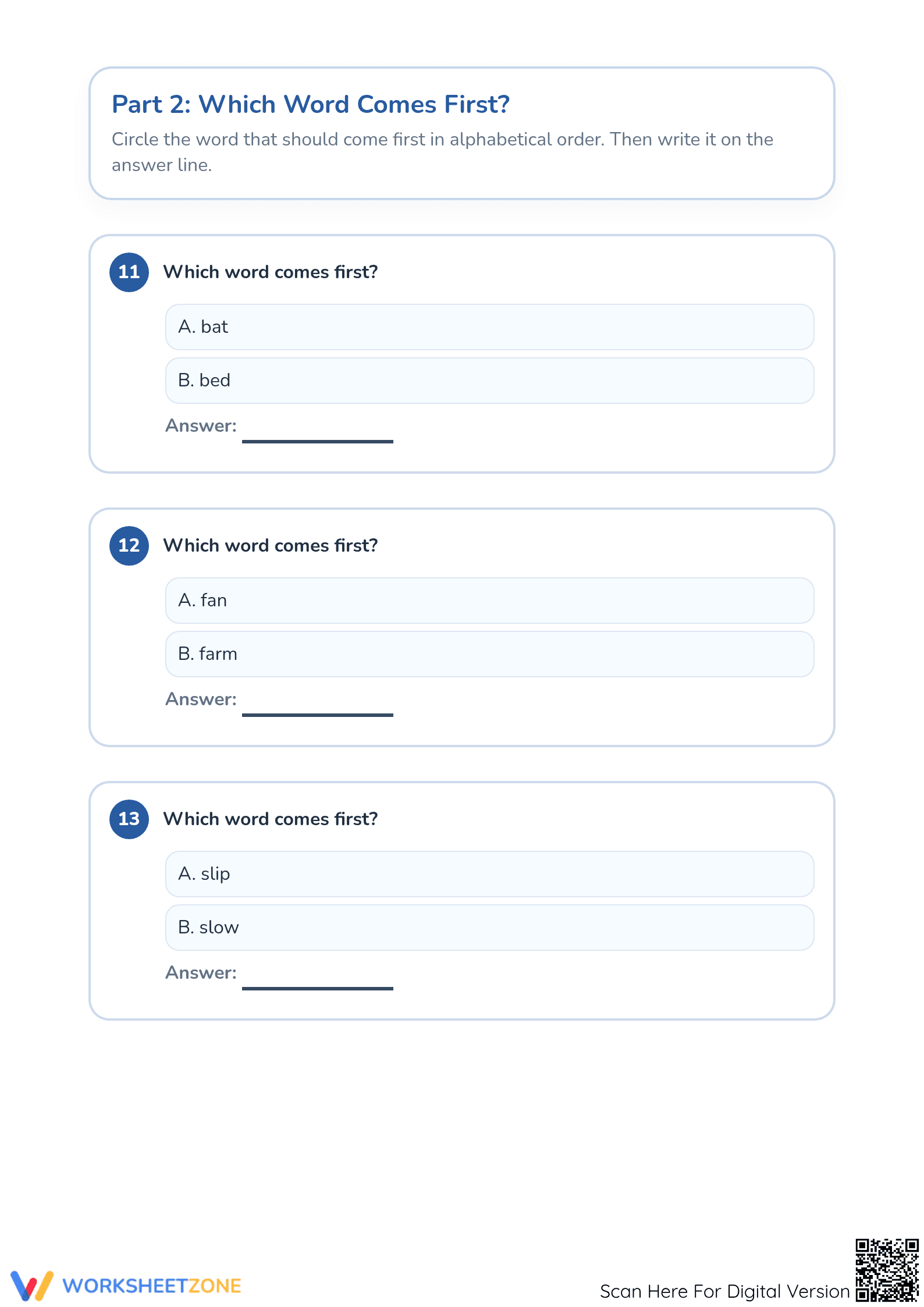
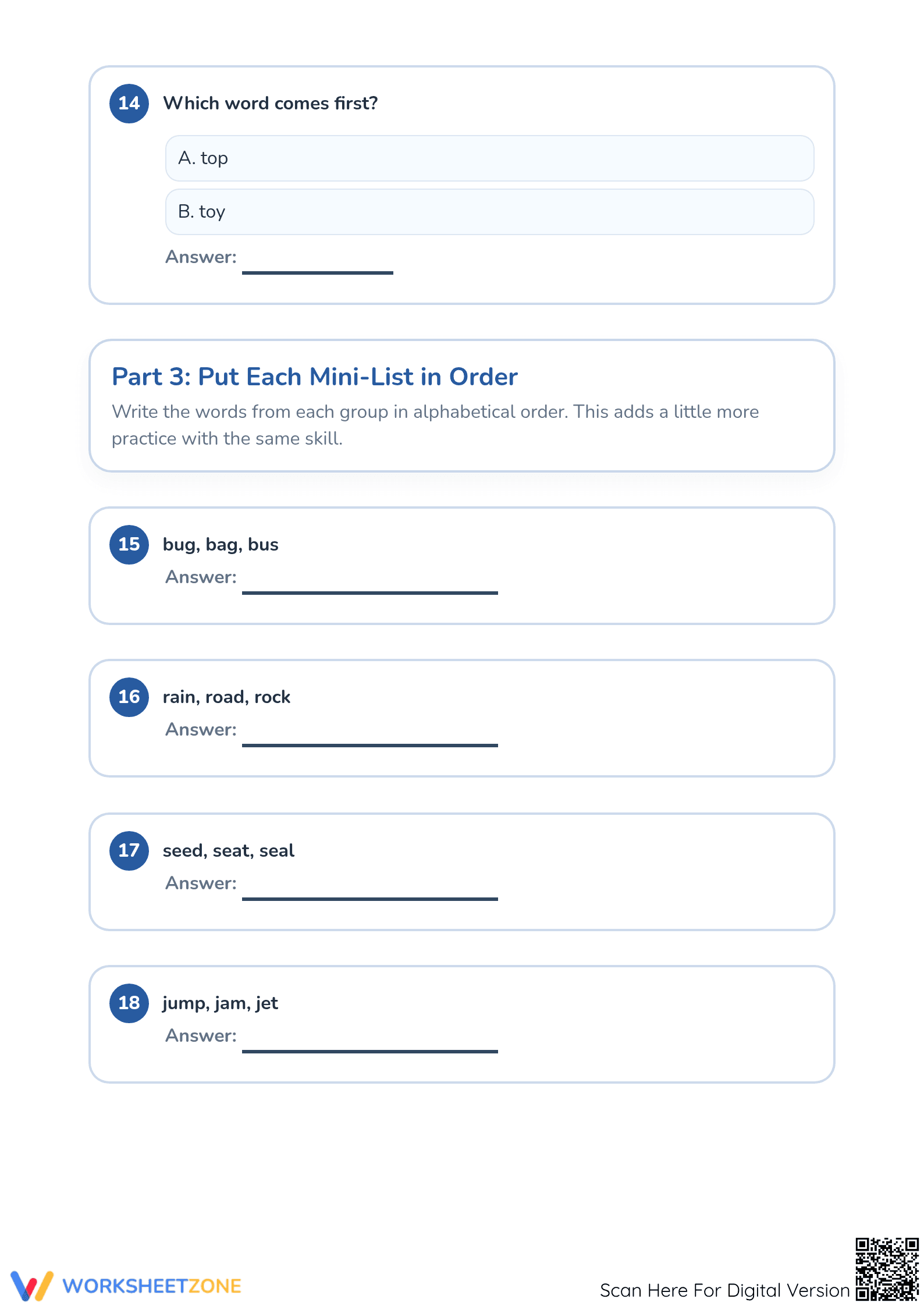
This four-page instructional packet is packed with 18 high-quality practice tasks. It features a robust word bank of ten themed words, four comparative "which comes first" identification problems, and four mini-list sorting exercises. The layout includes helpful instructional tips that guide students through the complex process of comparing second letters when initial letters are identical, ensuring a supported learning experience from start to finish.
Zero-Prep Workflow
- Step 1: Print (1 min) — Generate the four-page PDF with one click. No collation or complex formatting is required for immediate student use.
- Step 2: Distribute (30 sec) — Hand out the packets to individuals or small groups. The clear instructions allow students to begin immediately with minimal teacher intervention.
- Step 3: Review (1 min) — Utilize the included full-page answer key to facilitate rapid grading or peer-assessment sessions at the end of the lesson.
This resource is meticulously aligned to the CCSS.ELA-LITERACY.L.1.1 standard, which requires students to demonstrate command of the conventions of standard English usage. By focusing on alphabetical sequencing, students build the cognitive frameworks necessary for organizing information. This standard code can be copied directly into lesson plans, IEP goals, or district curriculum mapping tools to ensure compliance and transparency.
Educators can utilize this worksheet during the independent practice portion of a literacy block or as a focused station in a rotating center model. It serves as an excellent formative assessment tool; teachers should observe whether students correctly identify the second letter in words starting with "s" to gauge mastery. The expected completion time for the entire 18-problem set is approximately 20 minutes for a typical first-grade student.
This practice set is primarily intended for first-grade students, but it also provides excellent remediation for second graders who require additional support with alphabetical sequencing. It pairs naturally with a classroom word wall or a beginning dictionary lesson. The simple, clean design ensures that students with varying processing speeds can engage with the material without feeling overwhelmed by visual clutter.
Research from EdReports (2024) emphasizes that foundational literacy skills, such as alphabetization, are most effectively acquired through repetitive, structured practice that moves from guided to independent application. By engaging with CCSS.ELA-LITERACY.L.1.1 through multiple formats—word banks, binary choices, and list sorting—students develop a more resilient understanding of letter sequencing. This worksheet provides the exact type of high-utility practice recommended by current pedagogical frameworks to bridge the gap between simple letter recognition and complex reference skills. Mastery of alphabetical order is a proven predictor of later success in vocabulary acquisition and information retrieval, making this 18-task set a vital component of a rigorous primary ELA curriculum.


