


























Views
Downloads
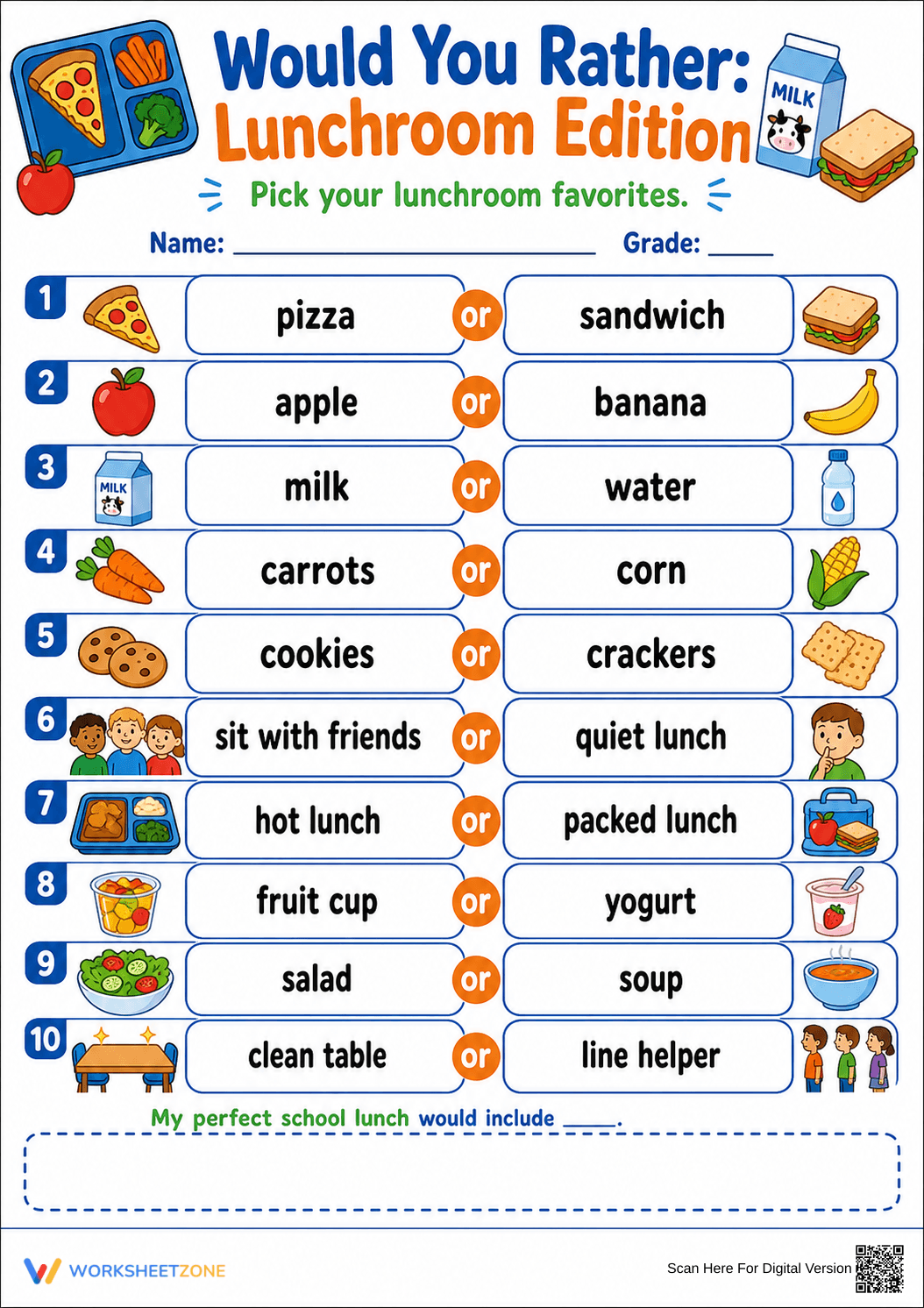

Grade 1 Would You Rather — Printable No-Prep Worksheet
Paste this activity's link or code into your existing LMS (Google Classroom, Canvas, Teams, Schoology, Moodle, etc.).
Students can open and work on the activity right away, with no student login required.
You'll still be able to track student progress and results from your teacher account.
This engaging lunchroom-themed worksheet prompts students to express their personal preferences and practice foundational opinion-forming skills. By choosing between familiar cafeteria options, young learners build confidence in decision-making and articulate their thoughts clearly, setting the stage for more advanced opinion writing and collaborative classroom discussions.
At a Glance
- Grade: 1 · Subject: ELA
- Standard:
CCSS.ELA-LITERACY.W.1.1— State an opinion and supply a reason- Skill Focus: Expressing Preferences
- Format: 1 page · 11 problems · No answer key needed · PDF
- Best For: Morning work or icebreakers
- Time: 10–15 minutes
Inside this single-page resource, educators will find ten visually supported "would you rather" choice rows featuring common lunchroom items like pizza, sandwiches, fruit, and milk. Each row includes clear text paired with colorful illustrations to support early readers. At the bottom of the page, a sentence completion task invites students to synthesize their choices by writing out their perfect school lunch, providing a gentle introduction to structured writing.
Enjoy a streamlined workflow:
- Print (1 minute): Prints perfectly in color or grayscale.
- Distribute (1 minute): Hand out the sheets as students enter the room or transition between subjects. No prior background knowledge is required.
- Review (3 minutes): Facilitate a quick turn-and-talk where students share their favorite lunchroom choices with a peer.
Total teacher preparation takes under two minutes, making this an excellent addition to any emergency substitute plan or spontaneous time-filler activity.
This activity aligns with CCSS.ELA-LITERACY.W.1.1: "Write opinion pieces in which they introduce the topic or name the book they are writing about, state an opinion, supply a reason for the opinion, and provide some sense of closure." It also supports foundational speaking and listening skills when paired with verbal sharing. Both standard codes can be copied directly into lesson plans, IEP goals, or district curriculum mapping tools.
Use this as a morning meeting activity to engage students immediately. Alternatively, use it as a pre-writing graphic organizer before a larger opinion writing unit, helping students practice making a definitive choice between two options. While students work, teachers can circulate to conduct formative assessments, observing how well early readers decode the paired text and images to make their selections. Expect students to complete the independent portion in 10 to 15 minutes.
Designed for first graders, this serves as an excellent modification for kindergarteners needing visual supports. The picture cues make it highly accessible for English Language Learners and students requiring vocabulary scaffolding. Pair this worksheet with a read-aloud about food or a direct instruction lesson on using the word "because" to justify personal choices.
Integrating choice-based activities like this CCSS.ELA-LITERACY.W.1.1 aligned resource helps students state an opinion and supply a reason with greater confidence. According to Fisher & Frey (2014), providing structured opportunities for students to express personal preferences significantly increases engagement and builds the cognitive framework necessary for complex argumentative writing in later grades. When young learners are asked to evaluate familiar concepts—such as lunchroom food or seating arrangements—they naturally practice weighing options and articulating their rationale in a low-stakes environment. This foundational skill translates directly to improved reading comprehension, stronger peer-to-peer communication, and more robust independent writing. By utilizing visually supported prompts, educators can ensure that all students, regardless of their current reading level or language proficiency, can participate meaningfully in classroom discourse and begin developing their unique academic voice.


