


























Views
Downloads
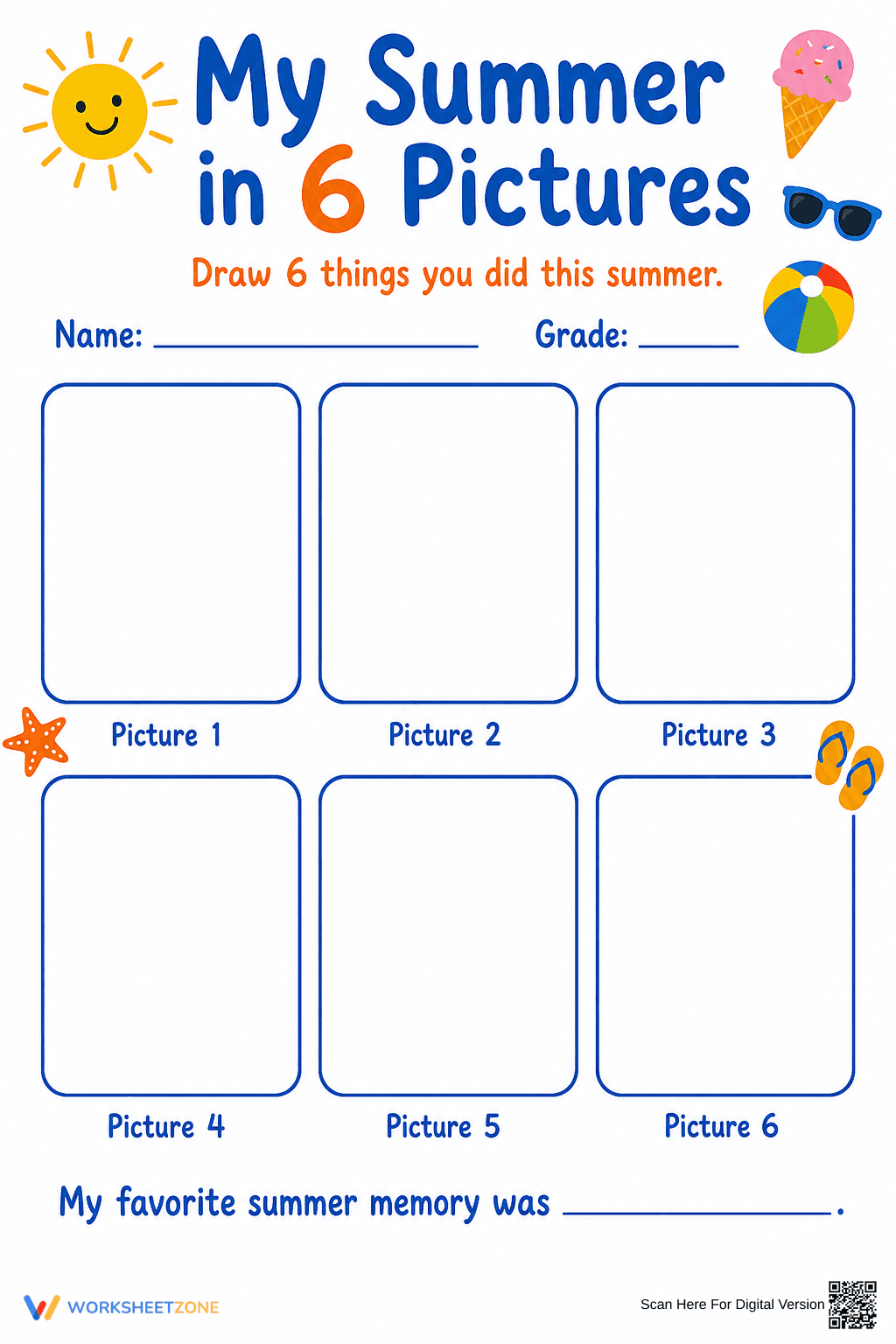

Grade 1 Summer Memory — Printable No-Prep Worksheet
Paste this activity's link or code into your existing LMS (Google Classroom, Canvas, Teams, Schoology, Moodle, etc.).
Students can open and work on the activity right away, with no student login required.
You'll still be able to track student progress and results from your teacher account.
This back-to-school worksheet helps students transition into the classroom by sharing their personal experiences. By combining drawing and writing, young learners can comfortably express their thoughts and recount recent events. The activity builds foundational communication skills while serving as an engaging icebreaker for the first week of school.
At a Glance
- Grade: 1 · Subject: ELA
- Standard:
CCSS.ELA-LITERACY.W.1.8— Recall information from experiences to answer a question- Skill Focus: Recounting events
- Format: 1 page · 7 problems · No answer key · PDF
- Best For: Back-to-school icebreaker
- Time: 15–20 minutes
Inside this single-page resource, teachers will find a highly visual, child-friendly layout featuring six distinct drawing panels and one sentence-completion prompt. The structured grid allows students to illustrate different moments from their break, while the bottom writing section encourages them to identify and articulate their single favorite memory. The open-ended format requires no answer key and accommodates various writing abilities.
Zero-Prep Workflow
- Print (1 minute): Simply send the PDF to the copier. No special materials or cutting required.
- Distribute (1 minute): Hand out the sheets along with crayons, markers, or colored pencils.
- Review (0 minutes): Because the prompts are self-explanatory and personal, students can begin immediately. Total teacher prep time is under 2 minutes, making this an ideal morning work activity or emergency sub plan.
Standards Alignment
Aligned to CCSS.ELA-LITERACY.W.1.8, this activity asks students to, with guidance and support from adults, recall information from experiences or gather information from provided sources to answer a question. It also supports early narrative writing skills by encouraging students to sequence and share personal events. Both standard codes can be copied directly into lesson plans, IEP goals, or district curriculum mapping tools.
How to Use It
Use this worksheet during the first week of school as a morning work assignment before direct instruction begins. It provides a quiet, focused task while the teacher handles attendance and morning routines. Alternatively, use it during an afternoon SEL block where students can pair up and present their drawings to a partner. As a formative assessment observation tip, teachers can circulate to evaluate pencil grip, fine motor skills, and basic phonetic spelling in the final sentence. Expected completion time is 15 to 20 minutes.
Who It's For
This resource is primarily designed for first-grade students, though it works beautifully for kindergarteners or second graders needing a low-stakes writing task. For differentiation, teachers can allow pre-writers to dictate their final sentence, while advanced writers can label their drawings with descriptive adjectives. It pairs perfectly with a morning meeting circle or a read-aloud about summer vacations.
Integrating personal storytelling into early literacy instruction significantly boosts student engagement and language development. When students practice the skill to recall information from experiences to answer a question, as outlined in CCSS.ELA-LITERACY.W.1.8, they build critical cognitive connections between their lived reality and academic tasks. According to Fisher & Frey (2014), providing structured opportunities for students to draw and write about familiar topics lowers the affective filter, allowing for more authentic expression and peer connection during transitional periods like the start of a new school year. This multimodal approach ensures that learners who may struggle with text-heavy assignments can still demonstrate comprehension and narrative sequencing through visual representation. By valuing their out-of-school experiences, educators foster a welcoming classroom climate that promotes continuous academic risk-taking and foundational literacy growth.


