




























Views
Downloads

Grade 1 Graphing & Counting — Printable No-Prep Worksheet

Paste this activity's link or code into your existing LMS (Google Classroom, Canvas, Teams, Schoology, Moodle, etc.).
Students can open and work on the activity right away, with no student login required.
You'll still be able to track student progress and results from your teacher account.
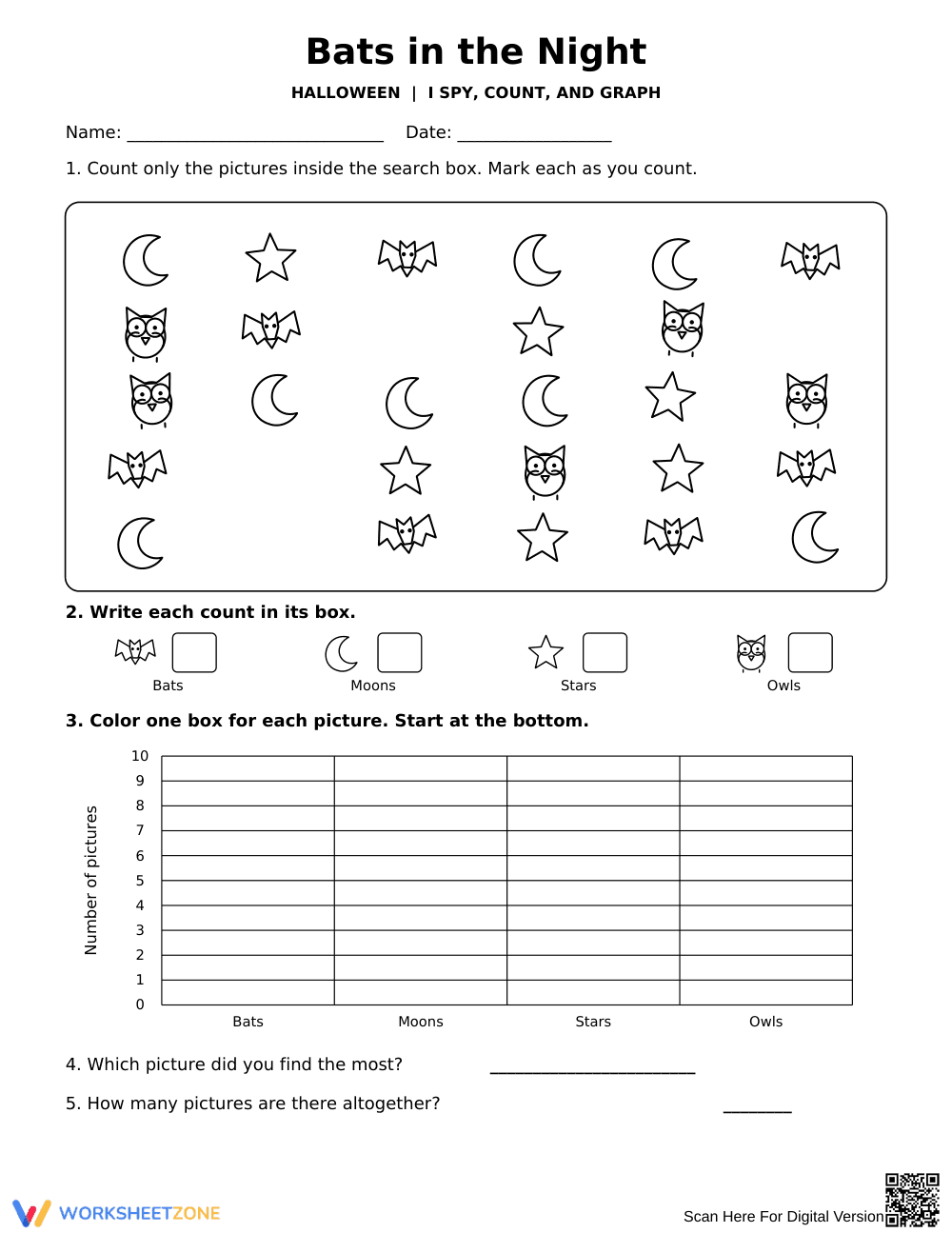
This Grade 1 math worksheet helps students practice counting, data organization, and basic graphing skills using a fun Halloween theme. By finding and counting specific images, recording the data, and coloring a bar graph, young learners build foundational data interpretation skills while answering questions about maximums and totals.
At a Glance
- Grade: 1 · Subject: Math
- Standard:
CCSS.MATH.CONTENT.1.MD.C.4— Organize, represent, and interpret data- Skill Focus: Counting and Graphing
- Format: 1 page · 5 problems · Answer key included · PDF
- Best For: Independent practice or morning work
- Time: 10–15 minutes
This single-page activity features an "I Spy" picture search for bats, moons, stars, and owls. Students count each item and write the numbers in designated boxes. They use this data to fill in a bar graph, coloring one box per picture. Finally, two questions ask students to identify the most frequent picture and calculate the total number of items. A complete answer key is provided.
Zero-Prep Workflow
- Print (1 minute): Simply download the PDF and print the student page. The black-and-white design is printer-friendly and requires no special materials.
- Distribute (1 minute): Hand out the worksheet along with pencils and crayons. The instructions are clear and self-explanatory for early readers.
- Review (1 minute): Use the included visual answer key to quickly check student graphs and calculations, or project it on a smartboard for self-correction.
With under two minutes of total teacher prep time, this resource is perfect for sub plans or math centers.
Standards Alignment
This worksheet is aligned to CCSS.MATH.CONTENT.1.MD.C.4: Organize, represent, and interpret data with up to three categories; ask and answer questions about the total number of data points, how many in each category, and how many more or less are in one category than in another. It also supports basic counting and addition skills. Both standard codes can be copied directly into lesson plans, IEP goals, or district curriculum mapping tools.
How to Use It
This graphing activity works perfectly as an independent math center during a measurement unit. It also serves as excellent morning work. As a formative assessment observation tip, watch how students track the items they count—do they cross them out or use tally marks? This provides insight into their organizational strategies. Expected completion time is 10 to 15 minutes.
Who It's For
Designed for Grade 1 students mastering data representation, this can also serve as Kindergarten enrichment. For differentiation, students struggling with tracking can use colored crayons to circle each object type before counting. This pairs naturally with a whole-class anchor chart on bar graphs.
Developing early data literacy is a critical component of elementary mathematics. According to EdReports 2024, foundational activities that require students to organize, represent, and interpret data significantly improve their analytical reasoning skills in later grades. This worksheet directly supports CCSS.MATH.CONTENT.1.MD.C.4 by having students actively engage in the data collection process, translating visual information into numerical values and graphical representations. By integrating counting, graphing, and basic addition into a single cohesive task, educators can efficiently assess multiple mathematical competencies simultaneously. The structured format reduces cognitive load, allowing young learners to focus on the core mathematical concepts rather than complex instructions. Utilizing targeted, standards-aligned resources like this ensures that students build the necessary confidence and competence to tackle more advanced statistical concepts as they progress through their educational journey.


