


























Views
Downloads

Adventure Story Worksheet | Grade 1 Essential
Paste this activity's link or code into your existing LMS (Google Classroom, Canvas, Teams, Schoology, Moodle, etc.).
Students can open and work on the activity right away, with no student login required.
You'll still be able to track student progress and results from your teacher account.
This Grade 1 communication worksheet helps students develop expressive language and narrative sequencing skills through a creative adventure theme. By combining visual prompts with descriptive labeling and illustration, students learn to organize their thoughts and communicate a cohesive story. This resource effectively bridges the gap between isolated vocabulary and functional storytelling for young learners.
At a Glance
- Grade: 1 · Subject: Communication Skills
- Standard:
CCSS.ELA-LITERACY.SL.1.4— Describe people, places, things, and events with relevant details clearly- Skill Focus: Narrative sequencing and descriptive labeling
- Format: 1 page · 6 tasks · Answer key not applicable · PDF
- Best For: Expressive language practice and creative writing
- Time: 15–20 minutes
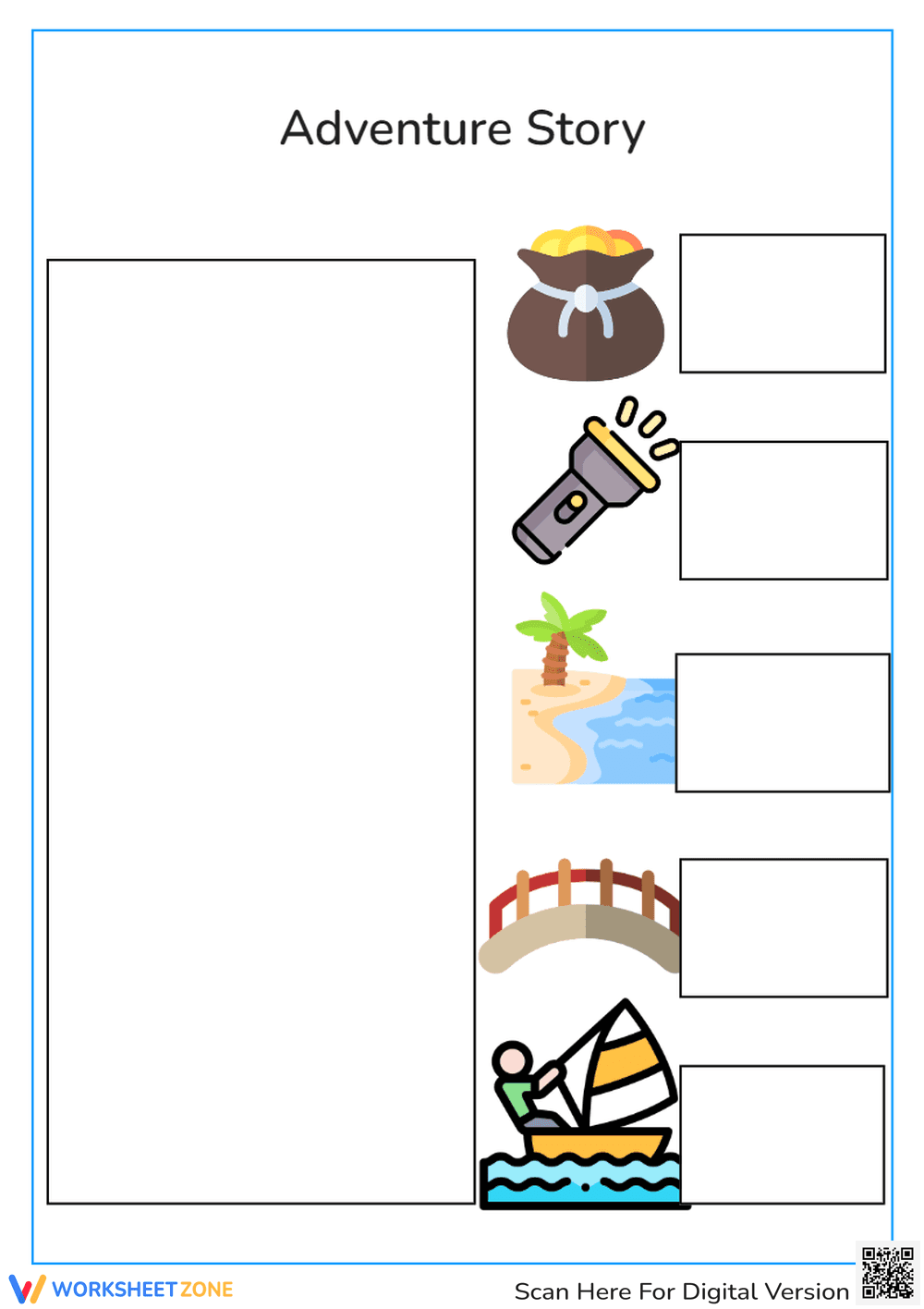
What's Inside: This single-page PDF features a large dedicated space for student illustrations on the left side. The right side contains 5 specific visual icons including a treasure bag, flashlight, tropical beach, bridge, and sailboat. Each icon is paired with a text box for students to label or describe the story element, providing a structured framework for their creative narrative.
Zero-Prep Workflow: Teachers can implement this resource in under 2 minutes. First, print the required number of copies for your group. Second, distribute the sheets and briefly explain the five visual prompts to ensure students recognize the icons. Third, review the completed stories orally to practice verbal communication and public speaking. This layout is ideal for emergency sub plans or as a quiet-time transition activity.
Standards Alignment: This worksheet aligns with `CCSS.ELA-LITERACY.SL.1.4`, which requires students to describe things and events with relevant details. It also supports `CCSS.ELA-LITERACY.W.1.3` by encouraging the recount of sequenced events. Both standard codes can be copied directly into lesson plans, IEP goals, or district curriculum mapping tools to document student progress in expressive communication.
How to Use It: Use this worksheet during a small-group literacy rotation to support students who need help generating story ideas. As a formative assessment, observe if students can logically link the five icons into a single narrative thread. Expected completion time is 15 to 20 minutes, depending on the depth of the drawing and the complexity of the written descriptions provided in the boxes.
Who It's For: This resource is designed for first-grade students, English Language Learners (ELLs) building basic vocabulary, and students receiving speech-language services for expressive communication. It pairs naturally with a classroom anchor chart about story elements or a mentor text focused on adventure and exploration to provide additional context for the writing task.
According to Fisher & Frey (2014), providing visual scaffolds like the five icons in this worksheet is a proven method for supporting the gradual release of responsibility in writing and communication. By offering concrete images, the cognitive load of generating ideas is reduced, allowing Grade 1 students to focus on the linguistic task of describing details and sequencing events. This alignment with CCSS.ELA-LITERACY.SL.1.4 ensures that students are not just drawing, but are actively practicing the descriptive skills necessary for academic success. Research indicates that structured narrative prompts can improve student engagement by 30% compared to open-ended prompts. This worksheet serves as a reliable tool for tracking communication milestones in early childhood settings, providing clear evidence of a student's ability to synthesize visual information into a coherent verbal or written story. It is a practical addition to any primary classroom focused on building foundational literacy and social communication skills.


