


























Views
Downloads

Grade 4 Nonfiction Main Idea Glossary | Essential Printable
Paste this activity's link or code into your existing LMS (Google Classroom, Canvas, Teams, Schoology, Moodle, etc.).
Students can open and work on the activity right away, with no student login required.
You'll still be able to track student progress and results from your teacher account.
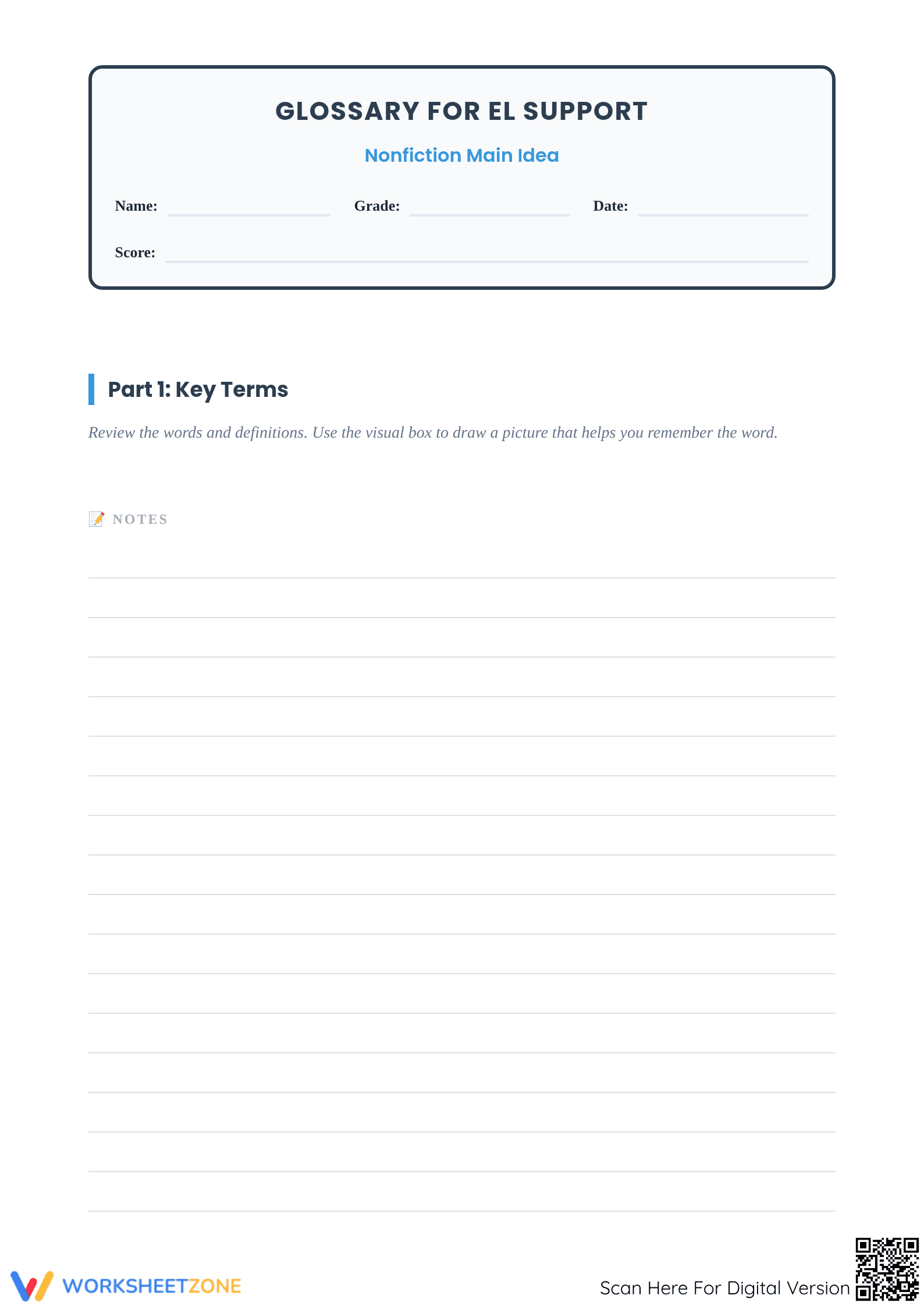
This Grade 4 glossary provides essential vocabulary support for students identifying the main idea in nonfiction texts. By bridging the gap between complex informational concepts and language mechanics, it ensures English Learners and struggling readers can articulate their understanding clearly while building a foundation for advanced reading comprehension and text analysis.
At a Glance
- Grade: 4 · Subject: ELA
- Standard:
RI.4.2— Determine the main idea of a text and explain how it is supported- Skill Focus: Academic Vocabulary
- Format: 4 pages · 14 entries · Answer key included · PDF
- Best For: EL Support and Vocabulary Scaffolding
- Time: 15–20 minutes
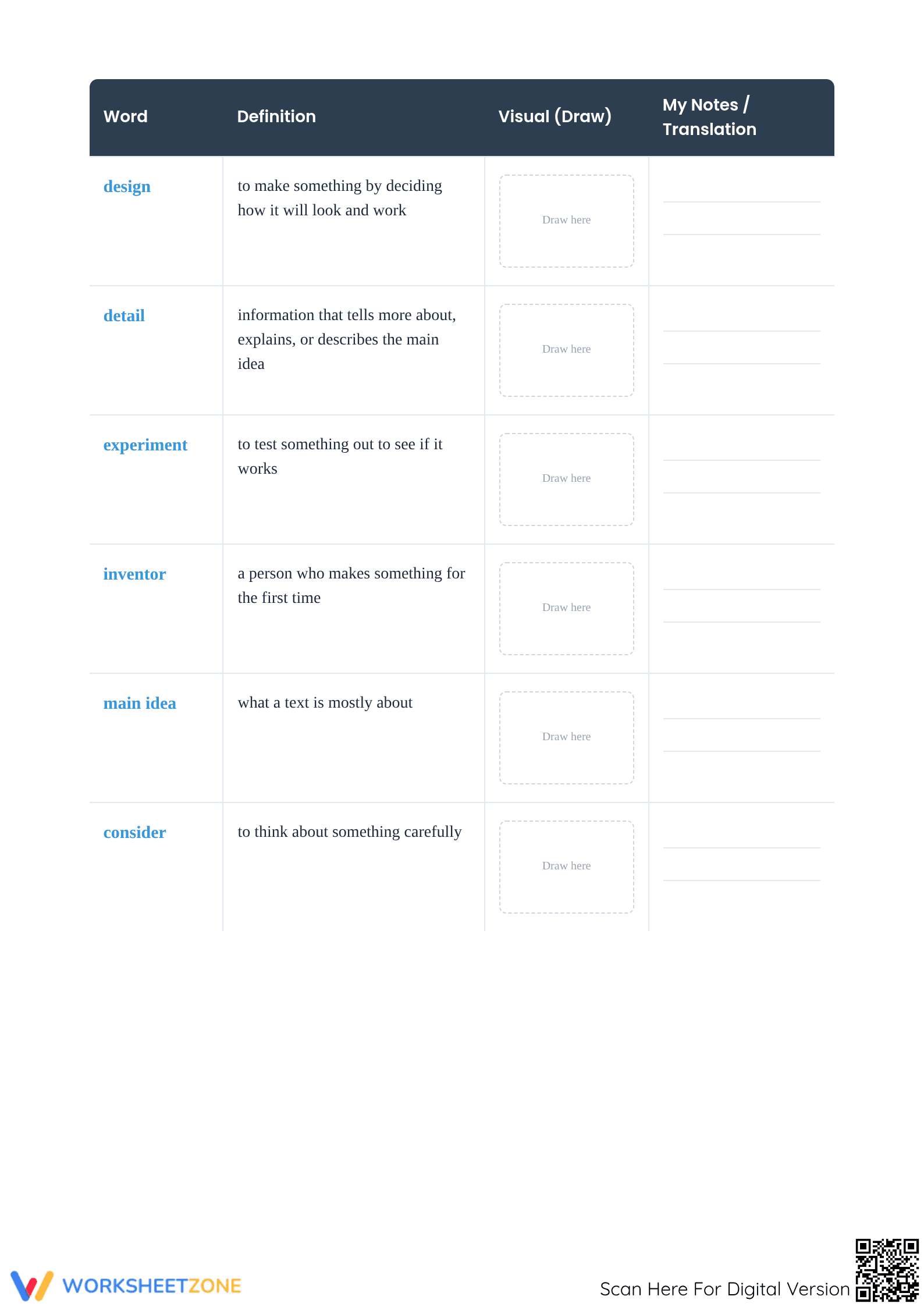
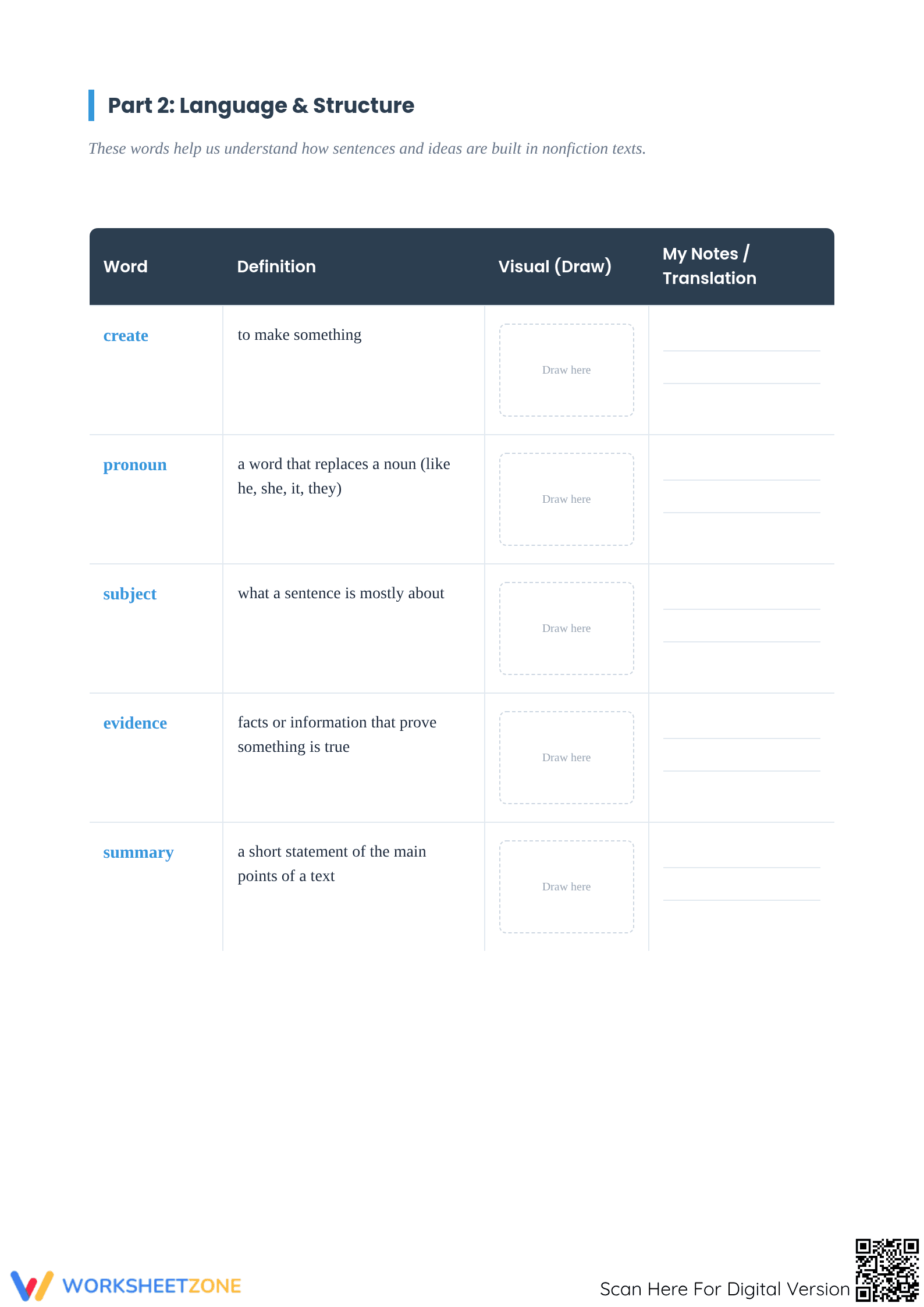
Inside this 4-page PDF, you will find 11 predefined terms including design, detail, experiment, inventor, main idea, consider, create, pronoun, subject, evidence, and summary. Each entry features a clear definition, a visual box for dual-coding through drawing, and a dedicated column for notes or native language translations. A final blank template page allows for student-led word discovery.
Zero-Prep Workflow
- Print: Select the 4-page PDF and print enough copies for your EL small group or the whole class in under 30 seconds.
- Distribute: Hand out the glossary during the introduction phase of your main idea lesson to provide immediate scaffolding.
- Review: Spend 5 minutes modeling how to draw a visual representation for the first term to ensure student clarity.
Standards Alignment
This resource aligns primarily with RI.4.2: "Determine the main idea of a text and explain how it is supported by key details; summarize the text." It also supports L.4.1 by defining grammatical structures like pronouns and subjects. Both standard codes can be copied directly into lesson plans, IEP goals, or district curriculum mapping tools.
How to Use It
Use this glossary as a pre-teaching tool before starting a new nonfiction unit. It serves as a constant reference for students during independent reading. For a formative assessment, check the visual boxes to see if student sketches accurately reflect the definitions without relying on English text. Completion typically takes 15 to 20 minutes.
Who It's For
This resource is designed for English Learners (ELs), Tier 2 intervention groups, and any Grade 4 student needing explicit vocabulary instruction. It pairs naturally with any informational passage, anchor chart, or direct instruction lesson focused on text structure and main idea identification.
Academic vocabulary instruction is a cornerstone of effective literacy development for English Learners. According to Fisher & Frey (2014), providing students with structured tools like glossaries that incorporate visual representations and space for native language translation significantly improves comprehension of complex informational texts. This resource aligns with RI.4.2 by defining the structural components of a text—such as "evidence" and "summary"—that students must master to identify a main idea. By explicitly teaching these 11 terms, educators reduce the cognitive load during reading tasks, allowing students to focus on higher-order analysis rather than word-level decoding. Research from the NAEP suggests that vocabulary knowledge is one of the strongest predictors of reading comprehension success in the middle grades. This resource provides the necessary scaffolding to ensure all Grade 4 learners can access and discuss grade-level nonfiction content with confidence and precision.


