


























Views
Downloads

Asking Deeper Questions Worksheet | Grade 4 ELA Printable
Paste this activity's link or code into your existing LMS (Google Classroom, Canvas, Teams, Schoology, Moodle, etc.).
Students can open and work on the activity right away, with no student login required.
You'll still be able to track student progress and results from your teacher account.
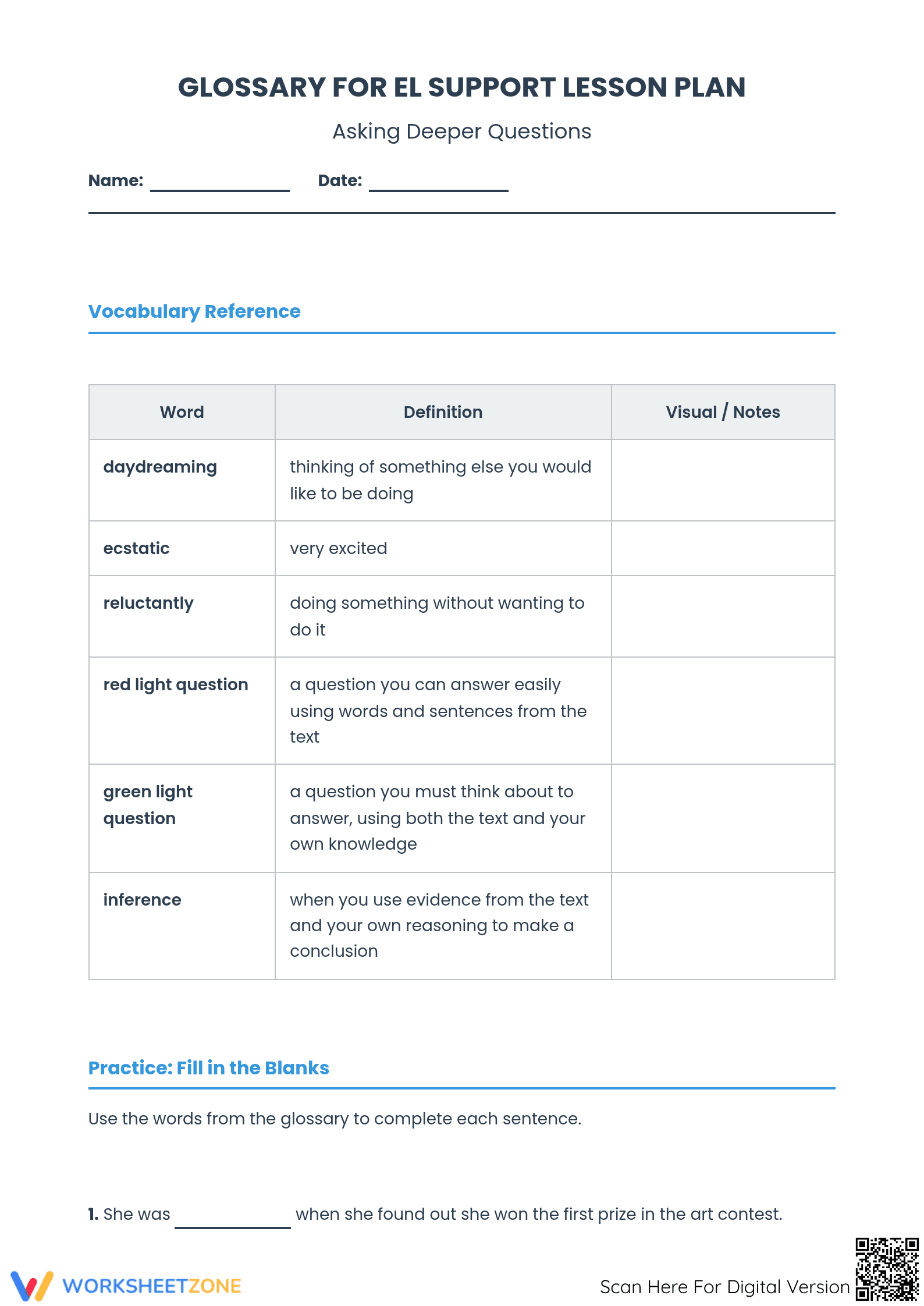
This reading comprehension worksheet helps fourth-grade students master the vocabulary needed to ask deeper questions about texts. By combining a clear glossary with targeted fill-in-the-blank practice, learners build the foundational language required to differentiate between simple recall and complex inferences when analyzing fiction.
At a Glance
- Grade: 4 · Subject: ELA
- Standard:
CCSS.ELA-LITERACY.RL.4.1— Refer to details and examples in a text- Skill Focus: Text Evidence Vocabulary
- Format: 2 pages · 6 problems · Answer key included · PDF
- Best For: Independent practice and EL support
- Time: 15–20 minutes
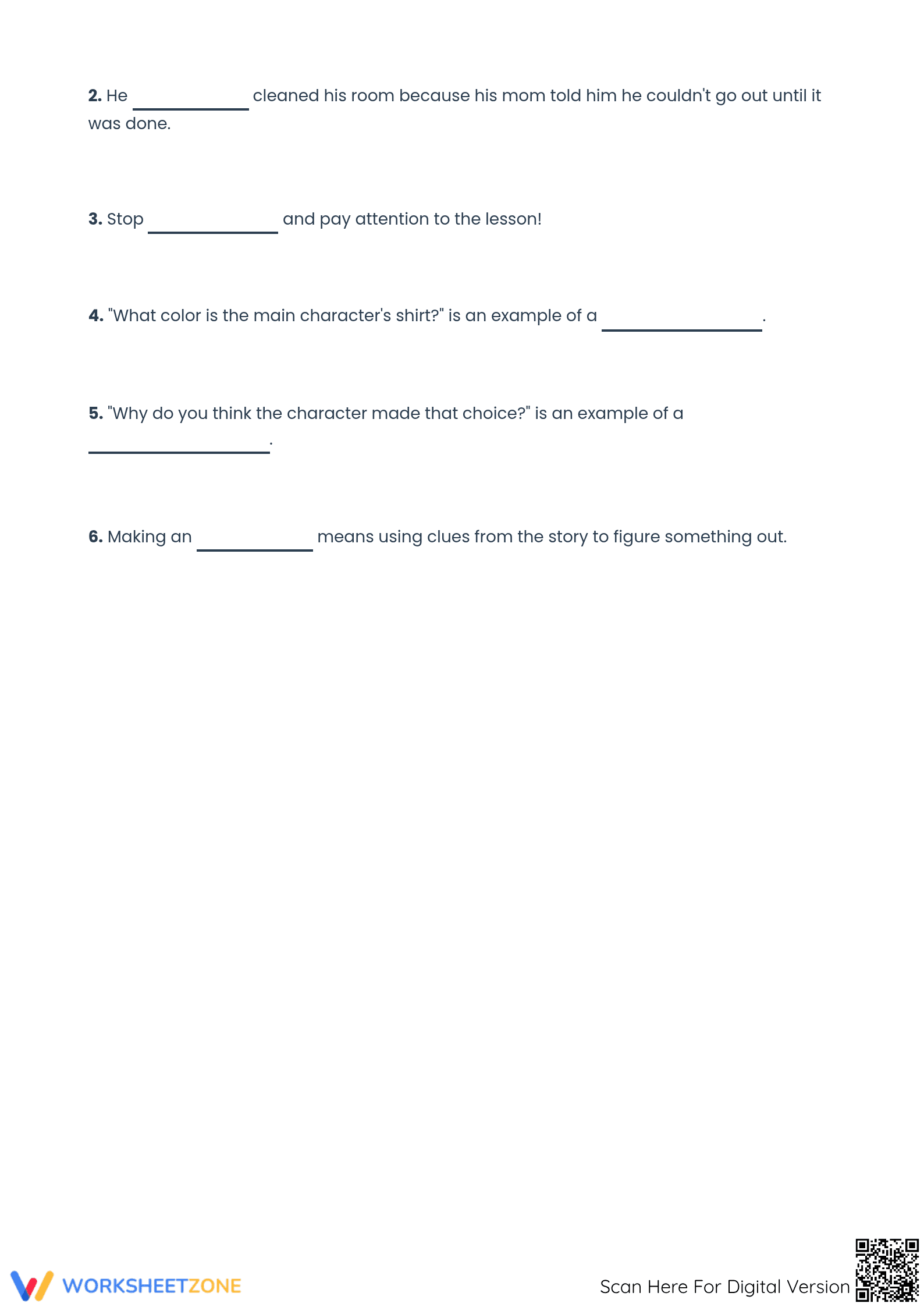
This resource features a two-page layout designed for immediate classroom use. The first section provides a structured vocabulary reference table containing six key terms, complete with definitions and space for visual notes. Following the glossary, students complete six fill-in-the-blank sentences that require them to apply the newly learned terminology in context. A complete answer key is provided to ensure accurate grading and quick feedback.
- Guided practice: Students begin by reviewing the provided glossary, which defines essential terms like "inference," "red light question," and "green light question."
- Supported practice: Learners can use the visual notes column to draw representations of each word, anchoring their understanding before moving to the questions.
- Independent practice: The six fill-in-the-blank problems require students to independently select the correct vocabulary word based on context clues.
This gradual-release approach ensures students have the necessary scaffolding before applying the concepts independently.
This material is aligned to primary standard CCSS.ELA-LITERACY.RL.4.1: Refer to details and examples in a text when explaining what the text says explicitly and when drawing inferences from the text. By mastering the vocabulary of questioning, students are better equipped to articulate their textual analysis. Both standard codes can be copied directly into lesson plans, IEP goals, or district curriculum mapping tools.
Teachers can introduce this worksheet before a whole-class novel study to establish a shared language for discussing the text. It also serves as an excellent independent activity during literacy centers. As a formative assessment tip, observe whether students can accurately distinguish between "red light" (literal) and "green light" (inferential) questions during subsequent group discussions. Most students will complete the reading and exercises within 15 to 20 minutes.
This resource is ideal for fourth-grade general education students and English Learners (EL) who benefit from explicit vocabulary instruction. The built-in glossary provides essential scaffolding for students reading below grade level. It pairs perfectly with any fiction passage or a direct instruction lesson on drawing conclusions and citing textual evidence.
Explicit vocabulary instruction is a critical component of reading comprehension, particularly when teaching students how to analyze literature and draw meaningful conclusions. According to Fisher & Frey (2014), providing students with the specific academic language needed to discuss texts significantly improves their ability to engage in higher-order thinking and collaborative discussions. This worksheet directly supports CCSS.ELA-LITERACY.RL.4.1 by helping students refer to details and examples in a text. When learners deeply understand terms like "inference" and can accurately differentiate between literal and inferential questions, they are much better prepared to articulate their reasoning during assessments. By integrating a structured reference glossary with targeted contextual practice, this resource effectively bridges the gap between basic vocabulary acquisition and applied literary analysis. Ultimately, this targeted approach ensures that all students have the foundational tools they need to succeed in complex reading tasks and future academic endeavors.


