


























Views
Downloads

Ghost Cup Knockdown Game — Printable Math Activity
Paste this activity's link or code into your existing LMS (Google Classroom, Canvas, Teams, Schoology, Moodle, etc.).
Students can open and work on the activity right away, with no student login required.
You'll still be able to track student progress and results from your teacher account.
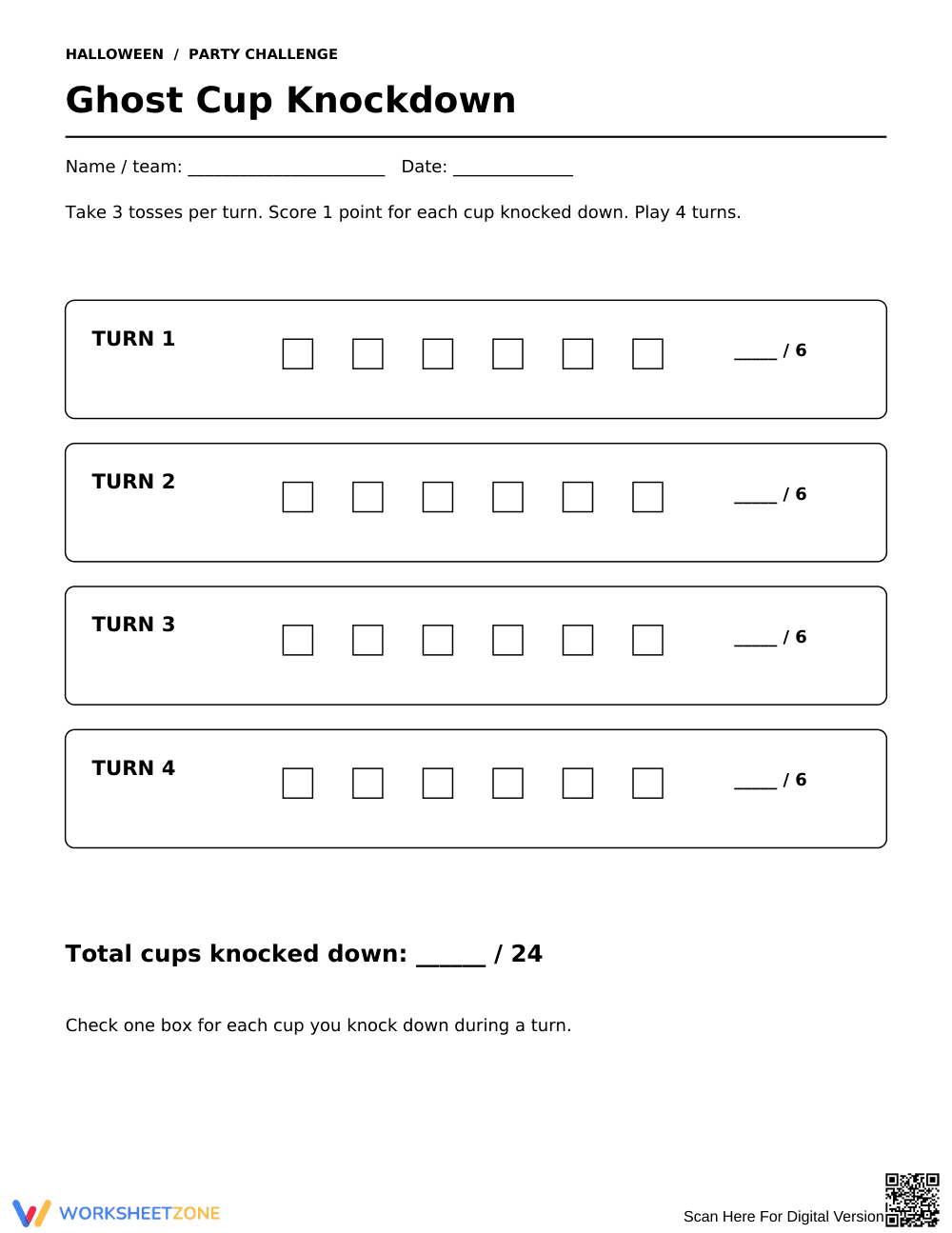
This hands-on Halloween math challenge helps elementary students practice one-to-one counting, tallying, and multi-step addition within 24 through an active tossing game. Students knock down labeled ghost cups, record individual turn scores across 4 rounds, and calculate their grand total on an organized tracking scorecard.
At a Glance
- Grade: K-5 · Subject: Math
- Standard:
CCSS.MATH.CONTENT.K.CC.B.4— Connect counting numbers to exact quantities using one-to-one object correspondence- Skill Focus: Counting, tallying, and addition within 24
- Format: 2 pages · 4 scoring rounds · Answer key included · PDF
- Best For: Fall math centers and classroom celebrations
- Time: 10–15 minutes
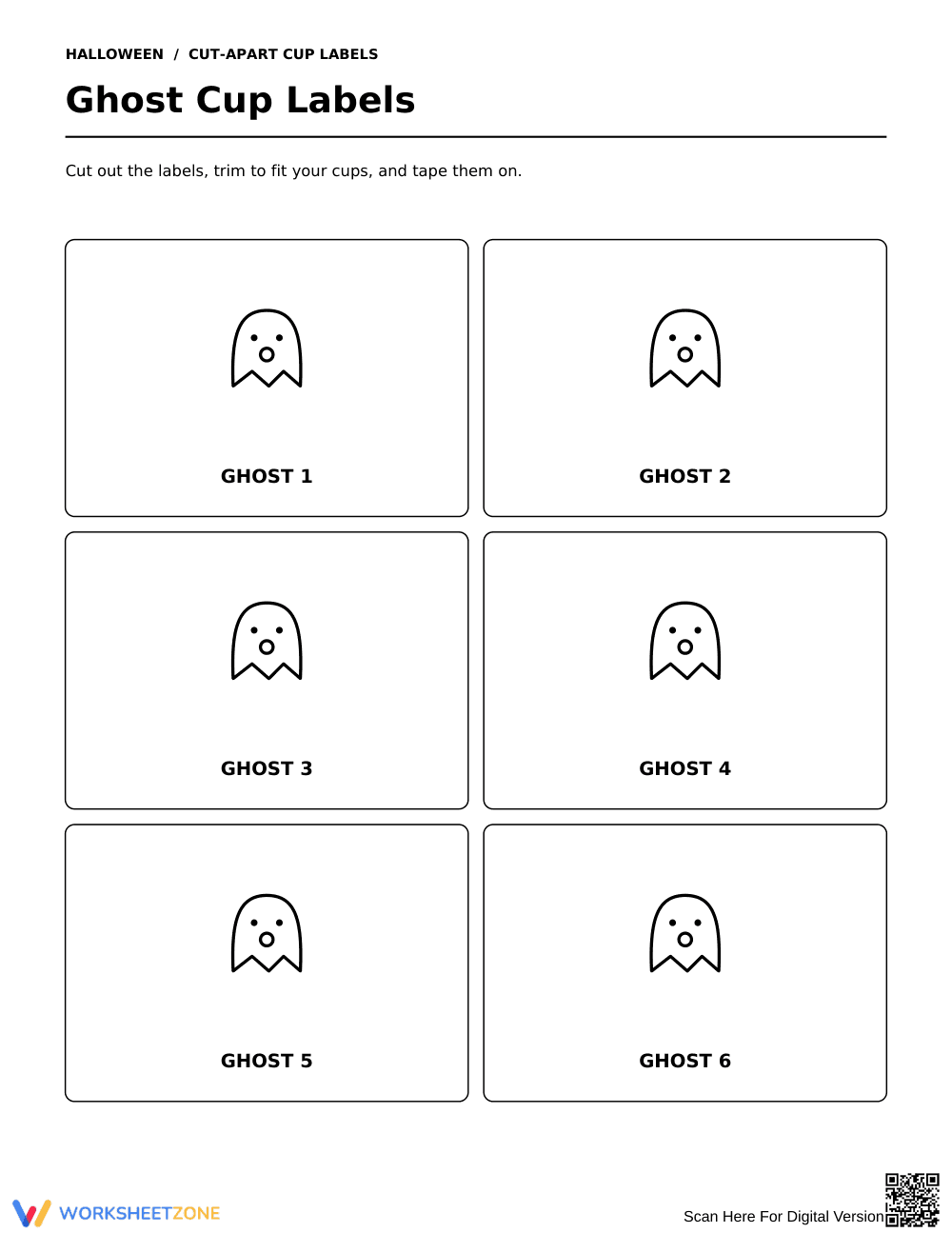
This printable resource features a structured player score sheet with checkboxes for 4 distinct tossing rounds, cut-apart numbered ghost labels for cup targets 1 through 6, and a comprehensive host guide. The host guide provides clear visual setup diagrams, scoring criteria, step-by-step game rules, and differentiated gameplay modifications for small groups or whole-class stations.
Zero-Prep Classroom Workflow
- Print (1 minute): Print one score tracker per student and a single ghost label sheet for each tossing station onto standard paper or cardstock.
- Distribute (1 minute): Tape labels onto six disposable cups, arrange them in a 3-2-1 pyramid, and hand students their tracking sheets with a pencil.
- Review (3 minutes): Explain the 3-toss rule, demonstrate how to check off fallen targets per turn, and verify final addition sums during station rotations.
With a total preparation time under 2 minutes, this physical math activity serves as a reliable station for guest teachers and holiday classroom events.
Standards Alignment
The primary standard addressed is CCSS.MATH.CONTENT.K.CC.B.4: Understand the relationship between numbers and quantities; connect counting to cardinality. In addition, this activity supports CCSS.MATH.CONTENT.1.OA.C.6 by requiring learners to demonstrate fluency for addition within 20 and calculate cumulative sums up to 24. Both standard codes can be copied directly into lesson plans, IEP goals, or district curriculum mapping tools.
How to Use It
Integrate this game during center rotations following direct instruction on addition strategies, or utilize it as a high-engagement seasonal reward station. For formative assessment, observe whether early learners count checkboxes one-by-one or use subitizing and mental addition to tally each round's sum. Expect stations to run for 10 to 15 minutes per student group.
Who It's For
This activity is designed for Kindergarten through Grade 5 learners needing physical reinforcement of addition and data recording. Adjust difficulty by moving toss lines closer for beginners or turning turns into cooperative group math challenges. Pair this station with base-ten blocks or a hundreds chart to scaffold cumulative addition for struggling learners.
According to Fisher & Frey (2014), structured physical games that integrate guided data recording provide high-yield formative feedback and strengthen peer mathematical discourse during cooperative learning routines. This active resource directly targets CCSS.MATH.CONTENT.K.CC.B.4 by establishing explicit one-to-one correspondence as elementary students track physical objects knocked down and translate those visual results into symbolic numeric totals. By completing 4 systematic rounds totaling up to 24 points, learners bridge kinesthetic play with foundational arithmetic practice. The accompanying recording sheet reinforces early data collection habits and allows teachers to immediately evaluate counting accuracy, number writing fluency, and multi-addend computation during small-group station rotations. Incorporating purposeful physical games ensures young mathematicians internalize the core relationship between physical quantities and written numbers while maintaining sustained engagement across diverse classroom learning environments.


