




























Views
Downloads
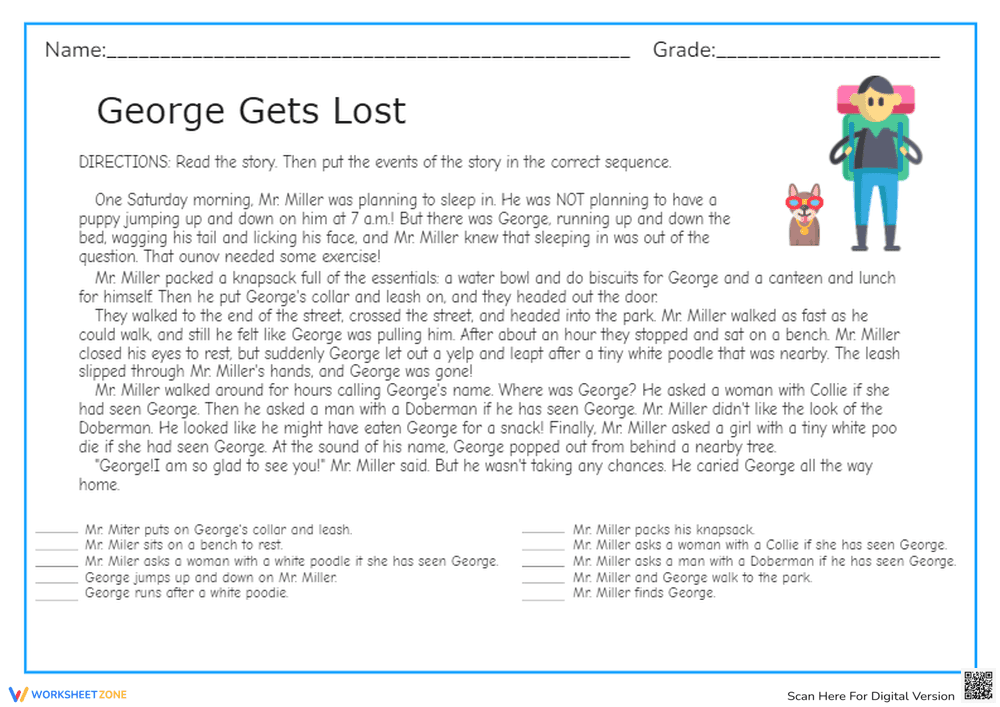

Grade 2 Story Sequencing — Printable No-Prep Worksheet

Paste this activity's link or code into your existing LMS (Google Classroom, Canvas, Teams, Schoology, Moodle, etc.).
Students can open and work on the activity right away, with no student login required.
You'll still be able to track student progress and results from your teacher account.
This reading comprehension worksheet helps early elementary students master story sequencing by ordering key events from a short narrative. Students read an engaging story about a lost dog, then chronologically sequence ten plot points. This targeted practice strengthens reading retention and builds foundational narrative structure skills.
At a Glance
- Grade: 2 · Subject: ELA
- Standard:
CCSS.ELA-LITERACY.RL.2.2— Recount stories and determine their central message- Skill Focus: Story Sequencing
- Format: 1 page · 10 problems · Answer key included · PDF
- Best For: Independent practice
- Time: 15–20 minutes
This single-page resource features an original short story titled "George Gets Lost," followed by a ten-item sequencing activity. Students read the text and review ten scrambled sentences representing major plot events. They must write the correct number next to each sentence to reconstruct the narrative timeline. A complete answer key is provided to ensure accurate grading and immediate student feedback.
This resource is designed for immediate classroom implementation with a streamlined workflow:
- Print (1 minute): Generate copies of the single-page story and question set.
- Distribute (1 minute): Hand out the assignment with no additional materials required.
- Review (3 minutes): Use the included answer key to quickly check student sequences.
Total teacher preparation time is under two minutes, making this an ideal, self-explanatory activity for emergency sub plans.
This activity aligns with CCSS.ELA-LITERACY.RL.2.2: "Recount stories, including fables and folktales from diverse cultures, and determine their central message, lesson, or moral." By ordering the events, students demonstrate their ability to recount the narrative accurately. It also supports general reading comprehension and attention to detail. Both standard codes can be copied directly into lesson plans, IEP goals, or district curriculum mapping tools.
Deploy this worksheet during independent reading blocks after direct instruction on narrative structure. Students can complete the tasks quietly while the teacher conducts small group sessions. Alternatively, use it as a formative assessment. Observe whether students refer back to the text to verify the order of events; this indicates strong self-monitoring skills. Expected completion time ranges from fifteen to twenty minutes.
This resource is primarily designed for first, second, and third-grade students developing their reading comprehension and sequencing abilities. The straightforward text and clear formatting make it accessible for on-level readers, while the ten-step sequence provides sufficient challenge to keep them engaged. Pair this worksheet with an anchor chart detailing transition words to provide additional scaffolding for students who need extra support.
Mastering narrative sequence is a critical component of early literacy development and foundational reading comprehension. This worksheet directly targets CCSS.ELA-LITERACY.RL.2.2, requiring students to recount stories and determine their central message by accurately ordering ten distinct plot events from a provided text. According to a 2024 report by EdReports, explicit practice with story sequencing significantly improves overall reading comprehension and narrative writing skills in primary grades. When students actively reconstruct a timeline, they move beyond basic decoding and engage in higher-order cognitive processing to understand cause and effect within a narrative. This specific activity provides the structured repetition necessary to solidify these essential literacy skills. By integrating this targeted sequencing task into regular reading instruction, educators can effectively monitor student progress, identify comprehension gaps early, and ensure mastery of narrative structures, ultimately fostering more confident and capable independent readers across all subject areas.


