




























Views
Downloads
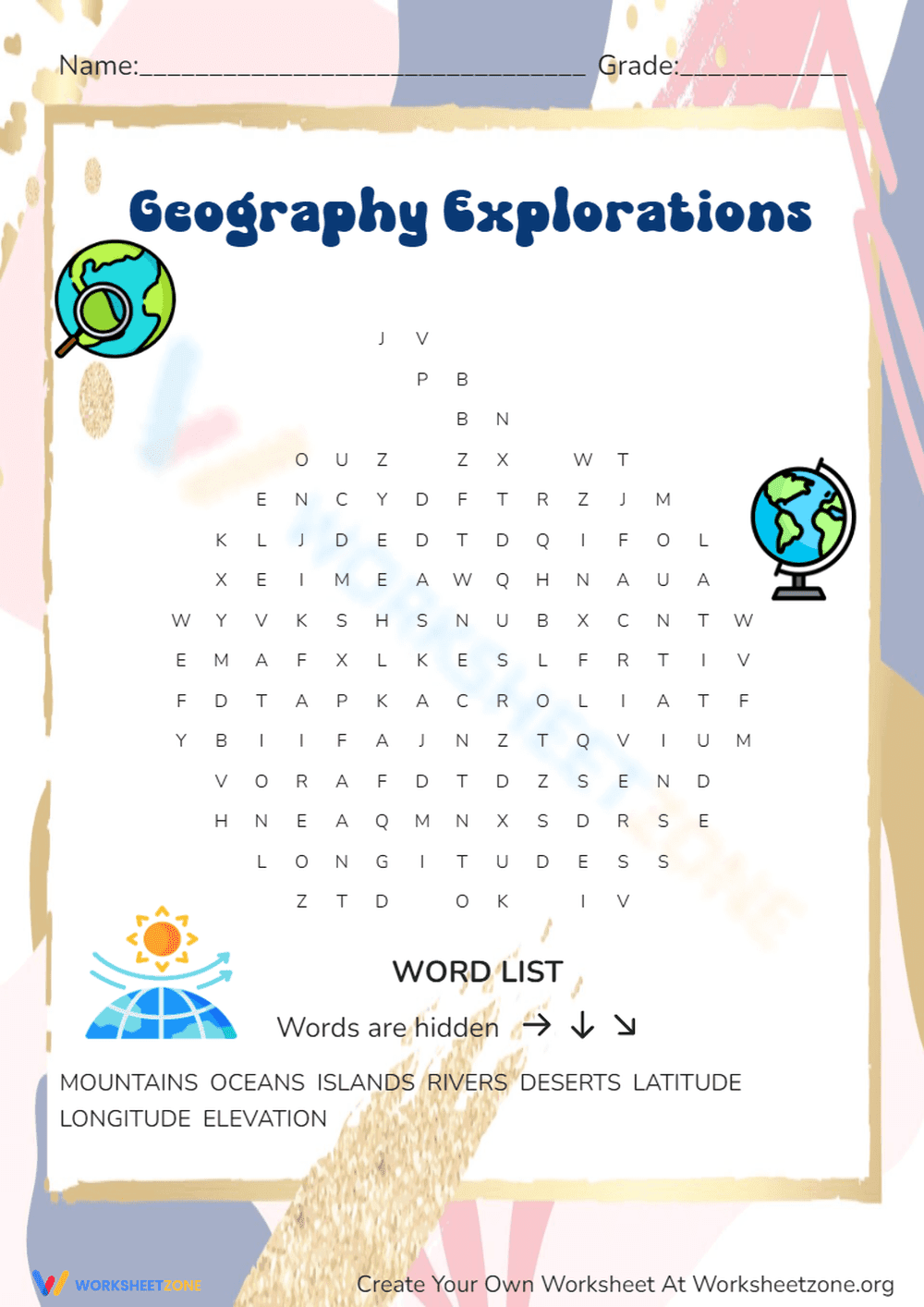

Geography Vocabulary Word Search | Grade 3 Printable

Paste this activity's link or code into your existing LMS (Google Classroom, Canvas, Teams, Schoology, Moodle, etc.).
Students can open and work on the activity right away, with no student login required.
You'll still be able to track student progress and results from your teacher account.
This geography vocabulary word search helps students recognize and spell essential domain-specific terms. By locating eight key geographical words within the puzzle grid, learners reinforce their understanding of physical landforms and mapping concepts. This straightforward activity builds academic language proficiency while keeping students engaged in independent practice.
At a Glance
- Grade: 3 · Subject: Social Studies
- Standard:
CCSS.ELA-LITERACY.L.3.6— Acquire and use domain-specific words- Skill Focus: Geography vocabulary recognition
- Format: 1 page · 8 problems · Answer key included · PDF
- Best For: Independent practice and morning work
- Time: 10–15 minutes
This single-page resource features a clear word search grid. Students find eight specific geography terms: mountains, oceans, islands, rivers, deserts, latitude, longitude, and elevation. A convenient word bank is provided at the bottom, complete with directional arrows indicating words are hidden horizontally, vertically, and diagonally. A complete answer key is included to facilitate quick grading.
This worksheet is designed for immediate classroom implementation with absolutely no teacher setup required.
- Print (1 minute): Simply download the PDF and print the required number of copies. The black-and-white text ensures low ink consumption.
- Distribute (1 minute): Hand out the worksheets during morning work, social studies centers, or as an early finisher activity.
- Review (1 minute): Use the provided answer key to quickly check student work or allow students to self-correct.
With a total teacher prep time of under two minutes, this resource is highly suitable for emergency sub plans or unexpected schedule changes.
This activity aligns with CCSS.ELA-LITERACY.L.3.6: Acquire and use accurately grade-appropriate conversational, general academic, and domain-specific words and phrases. It also supports foundational social studies standards regarding physical geography and map skills. Both standard codes can be copied directly into lesson plans, IEP goals, or district curriculum mapping tools.
Teachers can utilize this word search as an introductory activity before beginning a new unit on physical geography. It serves as an excellent hook to familiarize students with upcoming vocabulary. Alternatively, assign it as independent practice after direct instruction to reinforce spelling. While students work, teachers can conduct formative assessments by observing which students struggle to locate words, indicating a need for visual tracking support. Expected completion time ranges from ten to fifteen minutes.
This resource is primarily designed for third-grade students, though it is highly adaptable for second through fifth graders studying basic geography. For students requiring differentiation, teachers can highlight the first letter of each hidden word on their specific copy to reduce visual fatigue. This word search pairs perfectly with a direct instruction lesson on reading maps or an anchor chart displaying various physical landforms.
Integrating domain-specific vocabulary practice into daily classroom routines is absolutely essential for developing strong academic language proficiency. This resource directly targets CCSS.ELA-LITERACY.L.3.6, requiring students to acquire and use domain-specific words related to physical geography. According to a comprehensive EdReports 2024 analysis, students who consistently engage in targeted vocabulary exercises demonstrate significantly higher reading comprehension scores when encountering complex informational texts. Word searches provide a low-stakes, highly engaging format for repeated exposure to new terminology, which actively aids in orthographic mapping and long-term memory retention. By actively searching for specific terms like latitude, longitude, and elevation, young learners reinforce their visual memory of the spelling patterns associated with these geographical concepts. This foundational word recognition serves as a critical stepping stone before students are asked to apply these terms in higher-order analytical writing or complex map-reading tasks.


