


























Views
Downloads

Function Representations Worksheet | Grade 8 Math Ready
Paste this activity's link or code into your existing LMS (Google Classroom, Canvas, Teams, Schoology, Moodle, etc.).
Students can open and work on the activity right away, with no student login required.
You'll still be able to track student progress and results from your teacher account.
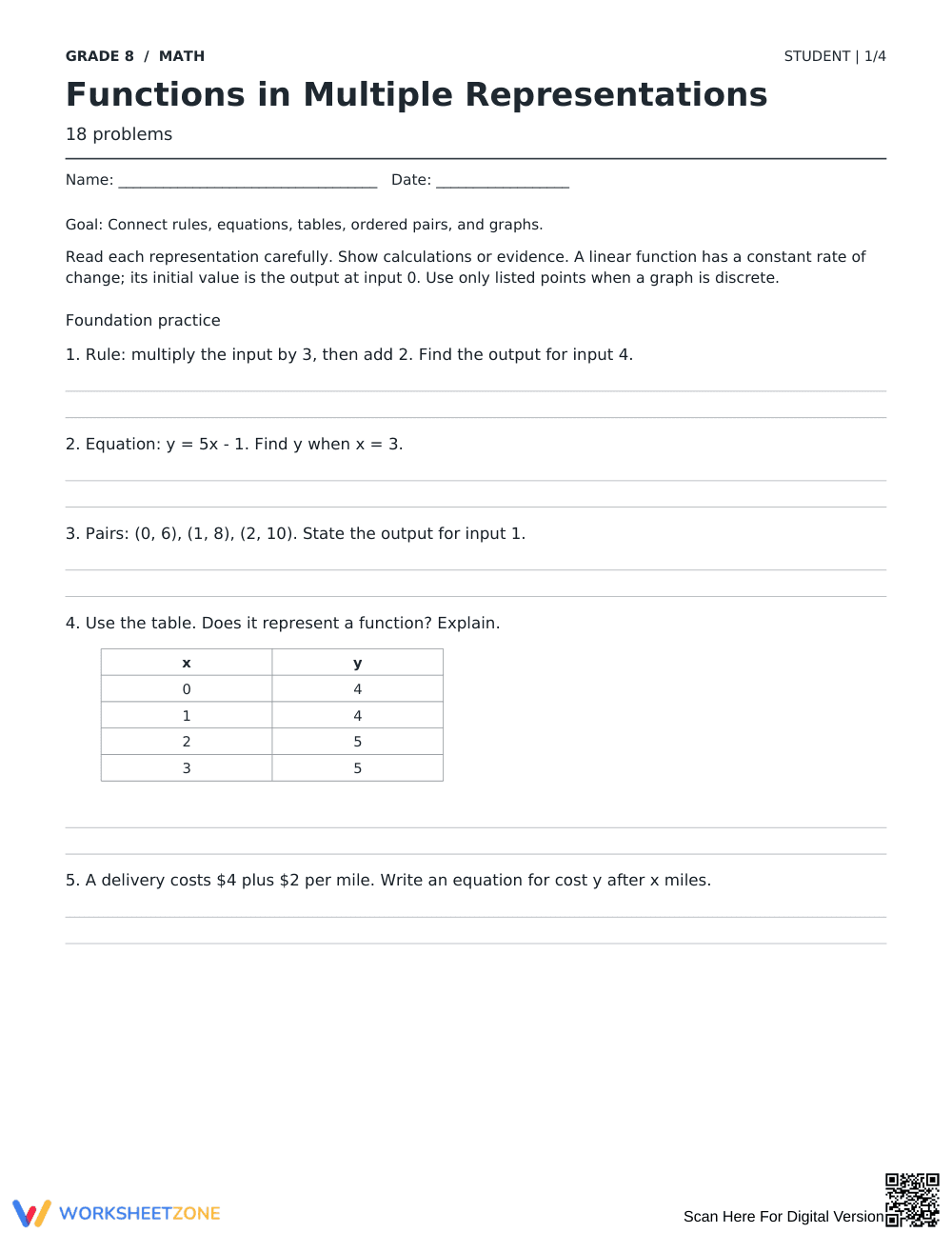
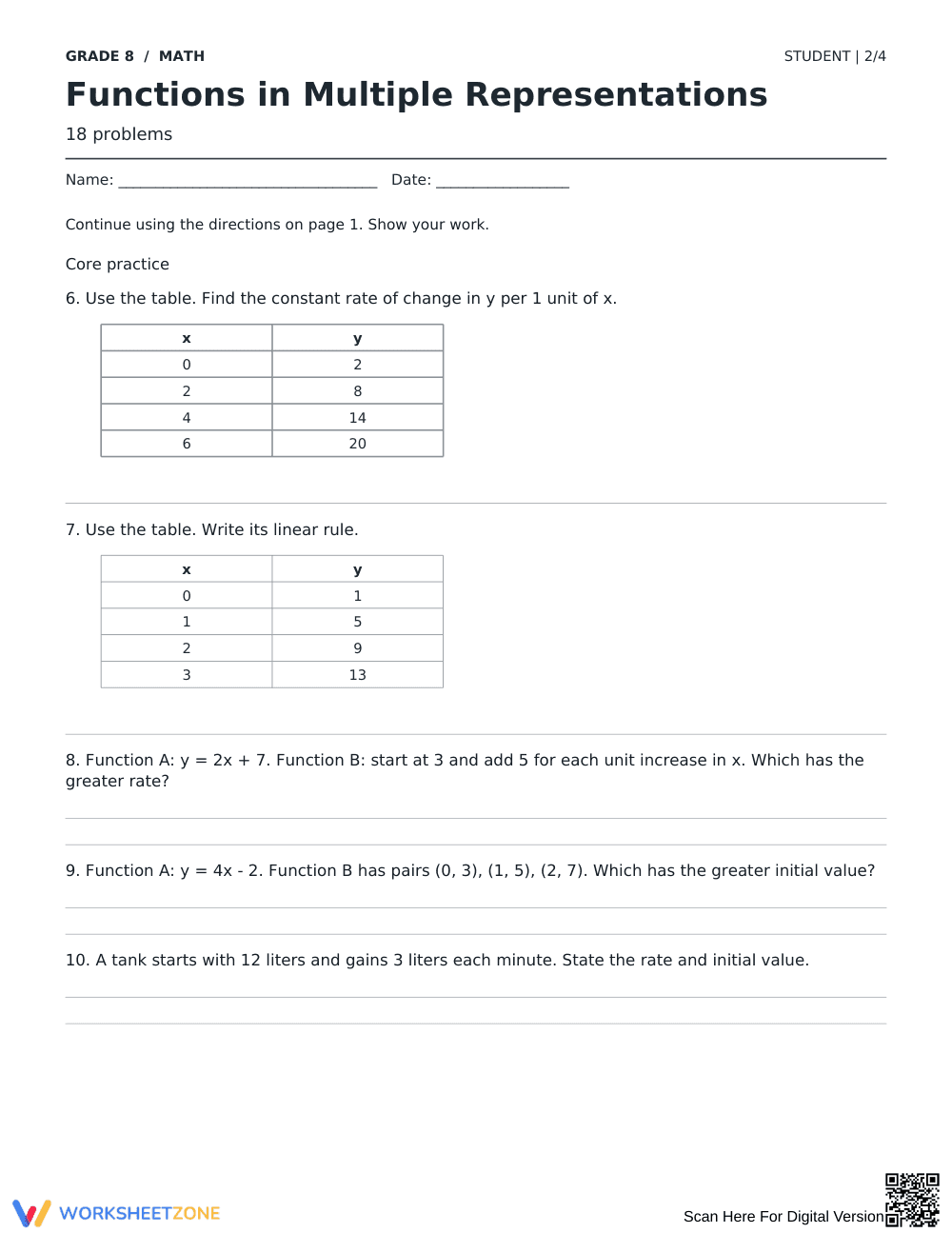
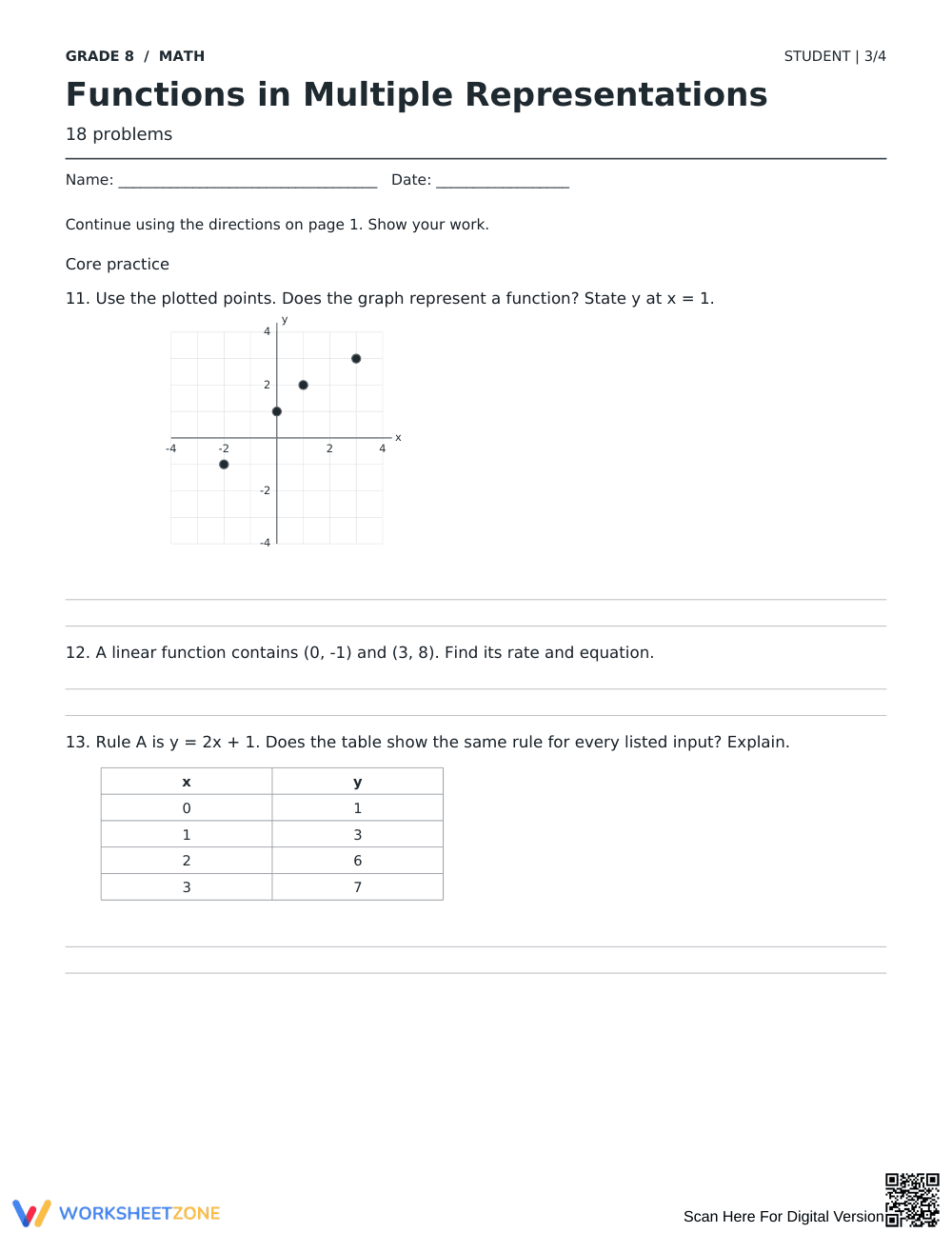
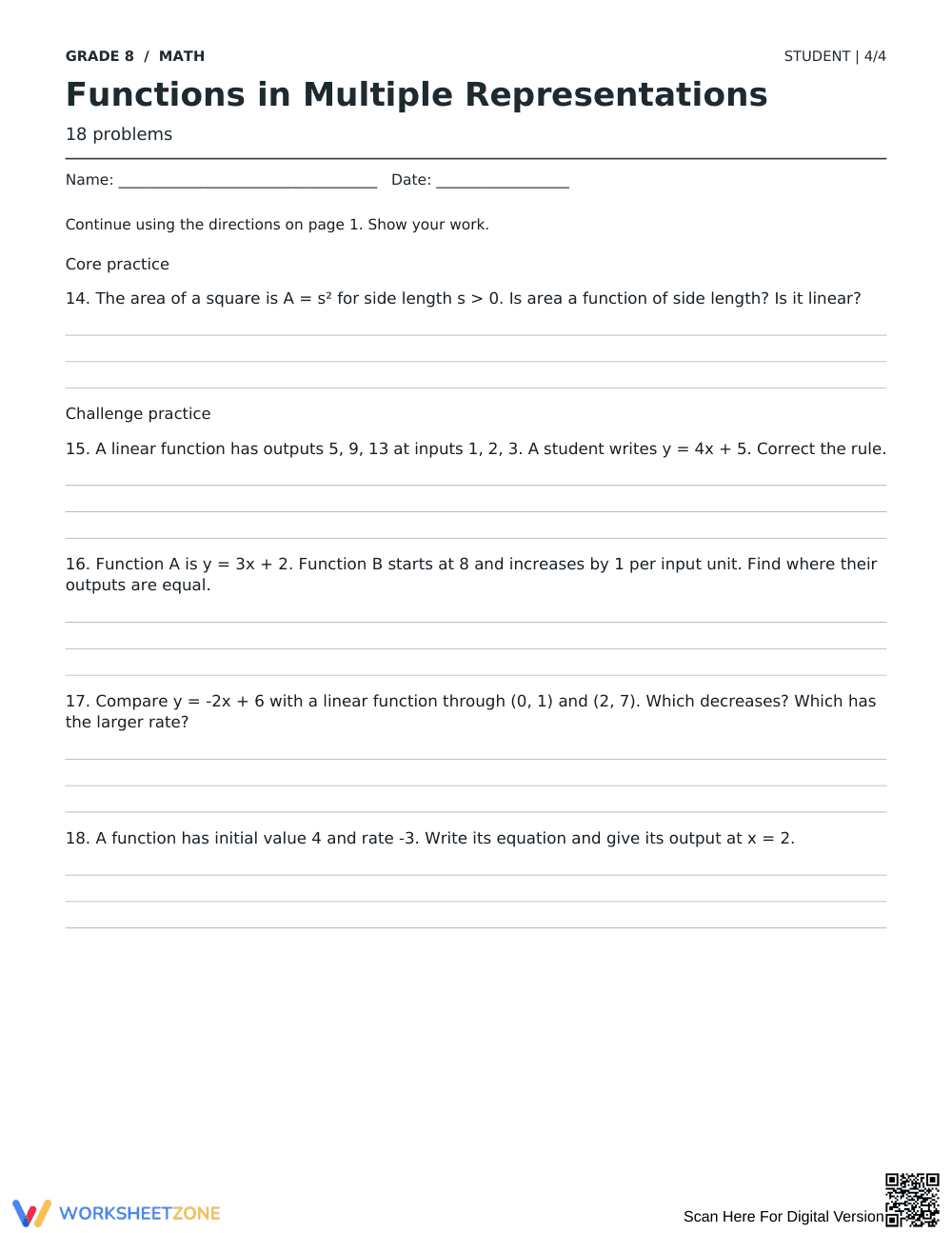
This Grade 8 math worksheet helps students analyze and connect linear functions across equations, tables, graphs, and verbal rules. Through 18 targeted exercises, learners determine function validity, calculate rates of change, identify initial values, and compare diverse representations to build algebraic fluency.
At a Glance
- Grade: 8 · Subject: Math
- Standard:
CCSS.MATH.CONTENT.8.F.A.2— Compare properties of two functions represented in different ways- Skill Focus: Connecting function representations
- Format: 4 pages · 18 problems · Answer key included · PDF
- Best For: Independent practice or unit review
- Time: 30–45 minutes
What's Inside
This 4-page printable provides 18 structured problems covering verbal rules, equations, coordinate pairs, tables, and discrete graphs. A 2-page answer key includes step-by-step solutions and a 54-point scoring guide allocating credit for accurate computation and mathematical justification.
Skill Progression
- Foundation practice (Problems 1–5): Guided items evaluating outputs from rules, equations, ordered pairs, and real-world costs.
- Core practice (Problems 6–14): Supported tasks calculating rate of change, finding linear rules, comparing rates and initial values, and analyzing graphs.
- Challenge practice (Problems 15–18): Independent problems correcting student errors, solving intersection points, and handling negative rates.
This sequence follows a gradual-release model, shifting students from routine evaluation to complex multi-step analysis.
Standards Alignment
Aligned to `CCSS.MATH.CONTENT.8.F.A.2`, this resource requires students to compare properties of two functions across distinct formats. It also supports `CCSS.MATH.CONTENT.8.F.B.4` by modeling linear relationships and determining initial values and rates of change. Both standard codes can be copied directly into lesson plans, IEP goals, or district curriculum mapping tools.
How to Use It
Use this packet during mid-unit practice or after direct instruction on linear models. Circulate during Core Practice to monitor how students calculate rates from non-consecutive table values. The activity takes 30 to 45 minutes and works well for individual practice or paired review.
Who It's For
This worksheet serves Grade 8 math students and Algebra 1 learners needing review with representations. Striving learners benefit from completing the Foundation items first, especially when paired with a linear equations anchor chart.
Mastering function representations is a vital middle school mathematics milestone defined by CCSS.MATH.CONTENT.8.F.A.2, which requires students to compare properties of functions across algebraic, graphical, numerical, and verbal forms. Research by Fisher & Frey (2014) emphasizes that a structured gradual release of responsibility fosters durable problem-solving capacity in mathematics. By guiding learners through scaffolded tiers—transitioning from basic input-output identification to comparative multi-model analysis and error correction—students internalize the core relationship between slope and initial value. This 18-problem Grade 8 worksheet provides deliberate practice that helps eighth graders bridge concrete tables and abstract linear equations. Utilizing such aligned resources ensures students develop the conceptual fluency and analytical reasoning essential for high school algebra success.


