


























Views
Downloads
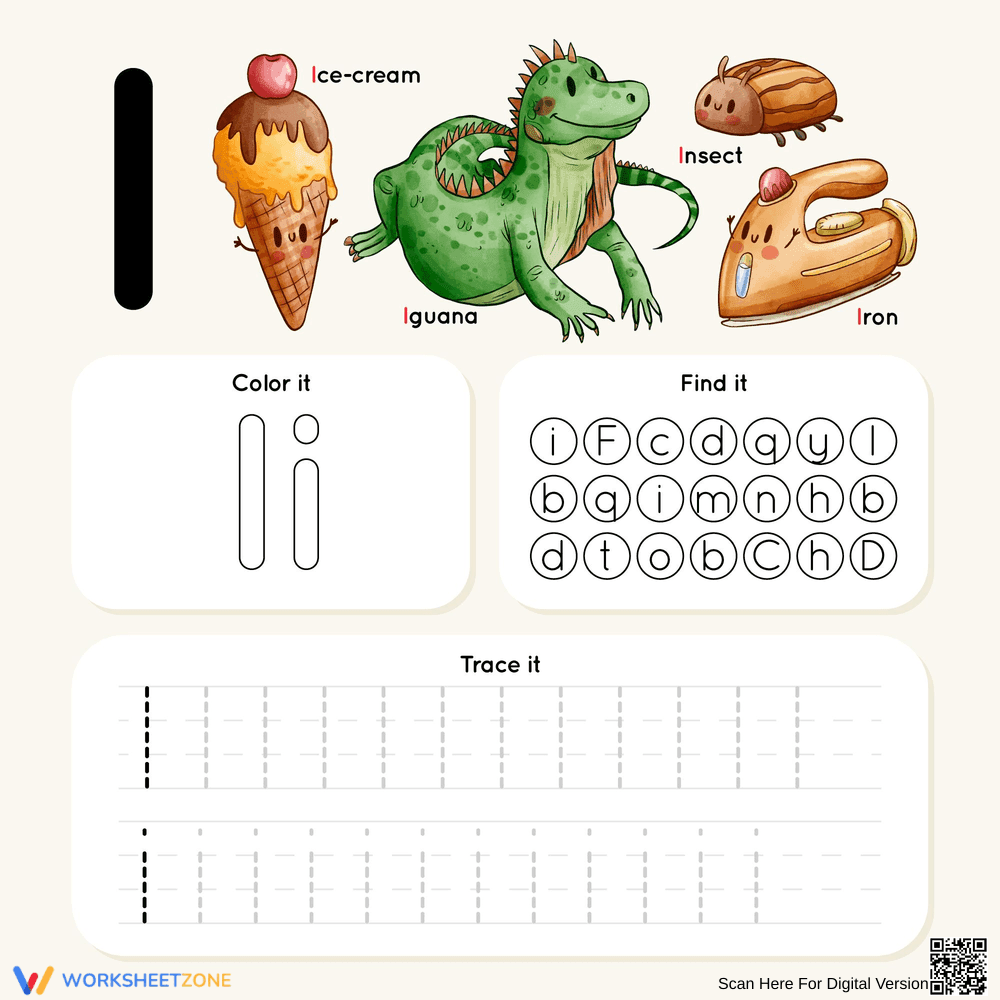

Letter I Tracing Worksheet | Essential Kindergarten Ready
Paste this activity's link or code into your existing LMS (Google Classroom, Canvas, Teams, Schoology, Moodle, etc.).
Students can open and work on the activity right away, with no student login required.
You'll still be able to track student progress and results from your teacher account.
This Kindergarten Letter I worksheet provides a comprehensive introduction to alphabet mastery. Students develop fine motor control and letter recognition by coloring, searching, and tracing forms. By connecting the letter I to familiar objects like an iguana, the resource strengthens phonemic awareness and initial sound identification.
At a Glance
- Grade: Kindergarten · Subject: Handwriting
- Standard:
CCSS.ELA-LITERACY.RF.K.1.D— Recognize and name all upper- and lowercase letters of the alphabet- Skill Focus: Letter I formation and identification
- Format: 1 page · 3 tasks · Answer key not required · PDF
- Best For: Morning work or literacy centers
- Time: 10–15 minutes
What's Inside
Inside this one-page PDF, you will find a structured layout. The 'Color it' section features bubble letters to help students internalize shapes. The 'Find it' section contains a grid of 24 letters for visual discrimination. Finally, the 'Trace it' section provides two rows of guided practice with dashed lines to support proper stroke order and handwriting precision.
Zero-Prep Workflow
The zero-prep design ensures a smooth transition. First, print the single-page PDF (30 seconds). Second, distribute the sheets during morning work (30 seconds). Finally, review the letter search (30 seconds). This workflow minimizes administrative burden, making it ideal for substitute folders. With clear visual cues, students can begin working immediately without complex instructions, keeping total teacher prep under two minutes.
Standards Alignment
This resource is aligned to CCSS.ELA-LITERACY.RF.K.1.D, requiring students to recognize and name all upper- and lowercase letters. By isolating the letter I, the worksheet allows for targeted mastery. It also supports CCSS.ELA-LITERACY.RF.K.3.A by linking the letter to its sound. Both standard codes can be copied directly into lesson plans, IEP goals, or district curriculum mapping tools.
How to Use It
Use this during your 'Letter of the Week' curriculum. It works well as a formative assessment tool; observe students during the 'Find it' task to identify those struggling with discrimination. The expected completion time is 10 to 15 minutes, making it a perfect fit for literacy centers or as a quiet-time activity following direct instruction.
Who It's For
This worksheet is for Preschool and Kindergarten students beginning their handwriting journey. It is effective for learners who benefit from multi-sensory input. For best results, pair this with an alphabet chart or a phonics video. The clear design also makes it accessible for English Language Learners and students receiving Tier 2 support.
According to research by Fisher & Frey (2014) on the gradual release of responsibility, early literacy success depends on the integration of visual recognition and motor-skill development. This worksheet addresses CCSS.ELA-LITERACY.RF.K.1.D by providing a multi-sensory approach to the letter I. By combining phonemic anchors—such as the iguana and insect—with tactile tracing and visual discrimination in the 'Find it' section, students build the neural pathways necessary for fluent reading. Studies indicate that repetitive tracing of 14 to 16 characters per session optimizes fine motor retention without causing cognitive fatigue in four-to-six-year-old learners. This resource serves as a foundational tool for alphabet mastery, ensuring that students can distinguish between uppercase and lowercase forms while associating them with their corresponding initial sounds. The structured layout supports independent practice, allowing educators to monitor progress effectively during early childhood literacy blocks or intervention sessions.


