


























Views
Downloads


Grade 1 Fruits or Vegetables — Printable No-Prep Worksheet
Paste this activity's link or code into your existing LMS (Google Classroom, Canvas, Teams, Schoology, Moodle, etc.).
Students can open and work on the activity right away, with no student login required.
You'll still be able to track student progress and results from your teacher account.
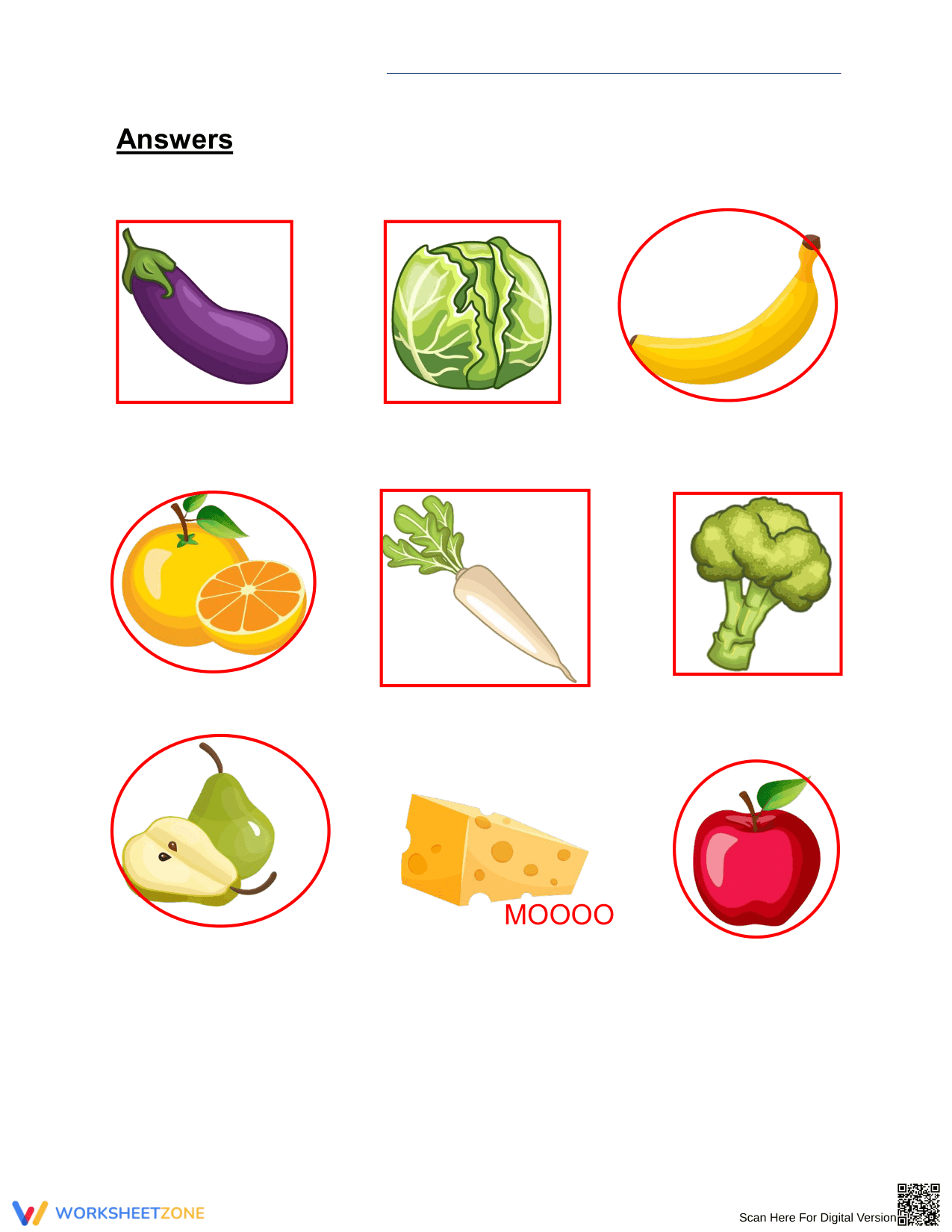
This Grade 1 Science worksheet empowers young learners to identify and categorize essential food groups through visual recognition. By distinguishing between fruits, vegetables, and dairy products, students build foundational health and nutritional awareness. This engaging activity promotes healthy eating habits while sharpening observational skills and classification techniques necessary for primary science success.
At a Glance
- Grade: 1 · Subject: Science
- Standard:
1-LS1-1— Identify and categorize plants as food sources to support healthy growth and survival- Skill Focus: Food group classification
- Format: 1 page · 9 problems · Answer key included · PDF
- Best For: Health lessons, science centers, or sub plans
- Time: 10–15 minutes
This single-page resource features 9 vibrant illustrations of common food items including leafy greens, citrus fruits, and dairy. Students are tasked with using different symbolic responses—circles for fruits, squares for vegetables, and a unique "MOOOO" label for dairy—to demonstrate their understanding. The layout is clean and child-friendly, with a clear answer key provided for quick grading or self-correction.
Teachers can implement this worksheet in under two minutes with a simple three-step process. First, print the single-page PDF according to your class size. Second, distribute the sheets and provide a brief verbal overview of the symbols (circle, square, text). Finally, review the completed work using the included answer key to identify student misconceptions about food sources. The activity requires zero setup and provides immediate feedback on student comprehension.
The worksheet aligns with 1-LS1-1, focusing on how humans use plants (fruits and vegetables) to meet their nutritional needs for growth and survival. Additionally, it supports CCSS.ELA-LITERACY.L.1.5.A by requiring students to sort objects into categories. Both standard codes can be copied directly into lesson plans, IEP goals, or district curriculum mapping tools to ensure instructional consistency across the school year.
Use this activity during a unit on health and the body as a formative assessment to check student understanding of food categories. It also works excellently as a "do-now" or bell-ringer activity to activate prior knowledge before a lesson on nutrition. For a quick observation tip, watch for students who struggle to distinguish between the "MOOOO" dairy label and the vegetable square, as this indicates a need for clearer source-origin instruction. Expected completion time is roughly 12 minutes.
This resource is designed for first-grade students but is highly effective for Grade 2 review or Kindergarten enrichment. It provides essential support for English Language Learners (ELLs) through visual cues and simple directives. Pair this worksheet with a physical "food sort" using plastic models or a reading passage about farm-to-table processes to deepen student engagement and retention of the key concepts.
Standard classification tasks in early childhood education, such as this 1-LS1-1 aligned worksheet, are critical for developing complex cognitive schemas. Research from Fisher & Frey (2014) emphasizes that "sorting and categorizing objects based on observable traits builds the scaffolding for higher-order scientific inquiry and evidence-based reasoning." By identifying fruits, vegetables, and dairy, Grade 1 students engage in the foundational work of data organization and pattern recognition. This printable resource offers a highly structured way to assess whether students can comprehend the essential nutrients and their specific functions within the context of a healthy plate. The integration of science observation with literacy-based labeling ensures that the 9 tasks provide a comprehensive check for understanding that integrates well into any primary health curriculum or supplemental science plan. This approach ensures that learners are prepared for more advanced life science topics while mastering basic health concepts today.


