


























Views
Downloads
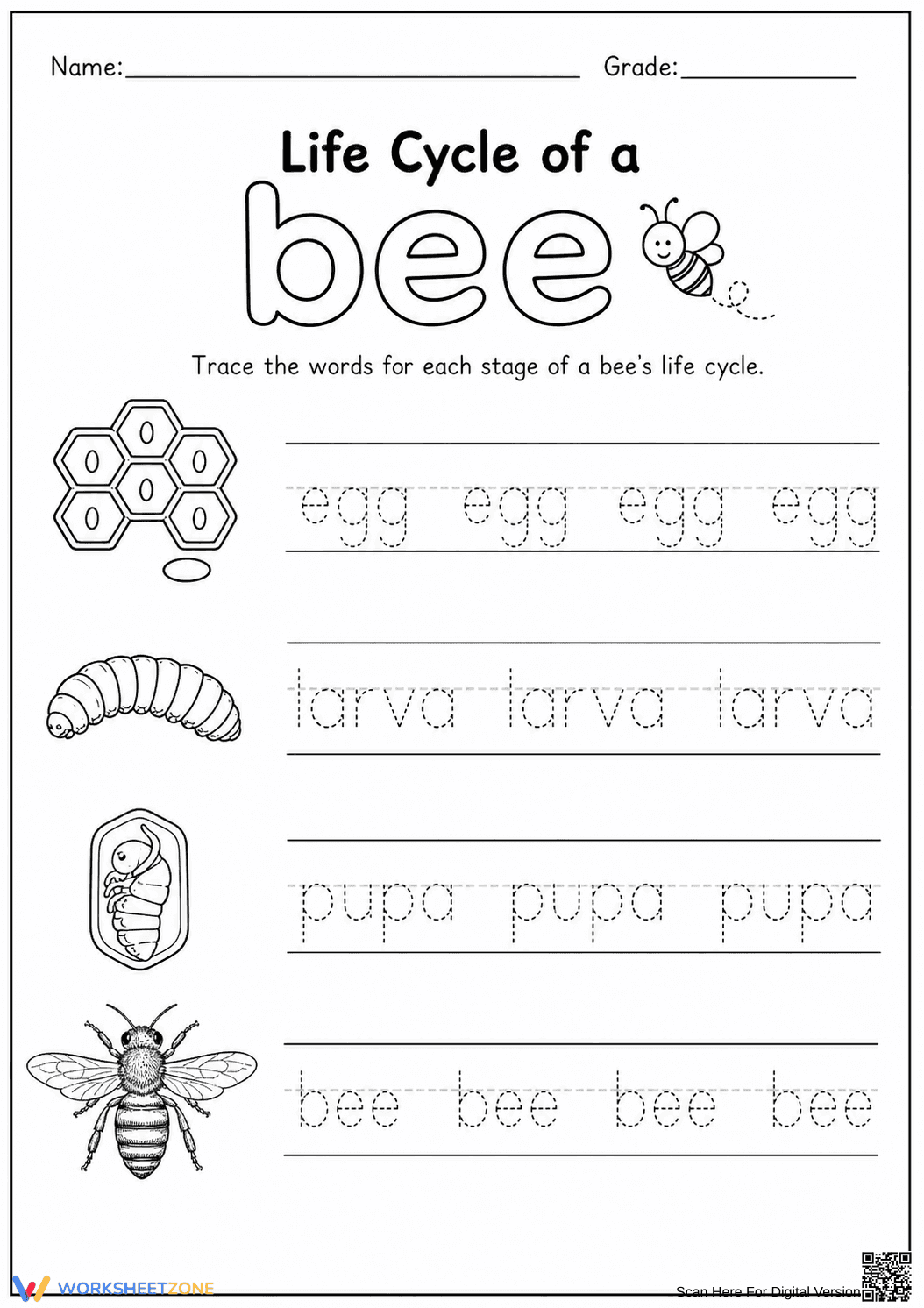

Grade 1 Bee Life Cycle — Printable No-Prep Worksheet
Paste this activity's link or code into your existing LMS (Google Classroom, Canvas, Teams, Schoology, Moodle, etc.).
Students can open and work on the activity right away, with no student login required.
You'll still be able to track student progress and results from your teacher account.
This Grade 1 science worksheet helps students master essential bee life cycle vocabulary while practicing their handwriting. By tracing the four key developmental stages—egg, larva, pupa, and adult bee—young learners reinforce fine motor skills and internalize biological sequences simultaneously.
At a Glance
- Grade: 1 · Subject: Science
- Standard:
1-LS1-2— Determine patterns in offspring development- Skill Focus: Bee life cycle vocabulary and tracing
- Format: 1 page · 14 problems · No answer key needed · PDF
- Best For: Morning work or science centers
- Time: 10–15 minutes
This single-page PDF features four distinct sections corresponding to the honeybee's metamorphosis. Each section includes a high-quality scientific illustration of the specific stage paired with dotted-line tracing fonts. Students will complete 14 total tracing tasks across primary-ruled lines, ensuring proper letter height and spacing. The clear layout makes it an ideal tool for early elementary handwriting development without requiring an answer key.
The zero-prep workflow for this resource is designed for maximum efficiency in busy classrooms. First, print the single-page PDF in under 30 seconds. Second, distribute the sheets to students during your science block or as a calm transition activity. Finally, review the stages of the bee life cycle as a whole group using the visual cues provided on the page. Total teacher preparation time is less than two minutes, making it highly suitable for emergency sub plans.
This resource aligns with 1-LS1-2, focusing on the patterns of growth and development in organisms. It also supports foundational literacy by requiring students to print lowercase letters legibly. Both standard codes can be copied directly into lesson plans, IEP goals, or district curriculum mapping tools.
Use this worksheet during the independent practice phase of a science lesson on insects or pollinators. It serves as an excellent formative assessment to check if students can identify the correct sequence of metamorphosis while maintaining neat handwriting. For a quick observation tip, watch for correct pencil grip and letter formation as students move from tracing "egg" to "bee." Expected completion time ranges from 10 to 15 minutes.
This worksheet is designed for Grade 1 and Grade 2 students, including English Language Learners who benefit heavily from the direct visual-to-word association. It pairs naturally with a non-fiction read-aloud about pollinators or a classroom anchor chart showing the honeybee's life stages in a circular diagram.
According to the RAND AIRS 2024 report, integrating literacy tasks like handwriting with core content-area subjects like science significantly improves long-term vocabulary retention in early childhood education. This worksheet directly addresses the 1-LS1-2 standard by providing the necessary linguistic scaffolding for students to determine patterns in offspring development. By tracing specific terms such as "larva" and "pupa," students move beyond simple visual recognition to the active physical production of scientific language. Research indicates that this type of guided, multimodal practice is essential for moving young students toward independent mastery of complex biological cycles. This resource provides a structured, highly focused 15-minute intervention that reinforces both fine motor control and foundational life science knowledge, making it a versatile, evidence-based, and highly effective addition to any primary classroom curriculum.


