



























Free Tiger Habitats Word Search | Grades 2–3 Science
Paste this activity's link or code into your existing LMS (Google Classroom, Canvas, Teams, Schoology, Moodle, etc.).
Students can open and work on the activity right away, with no student login required.
You'll still be able to track student progress and results from your teacher account.
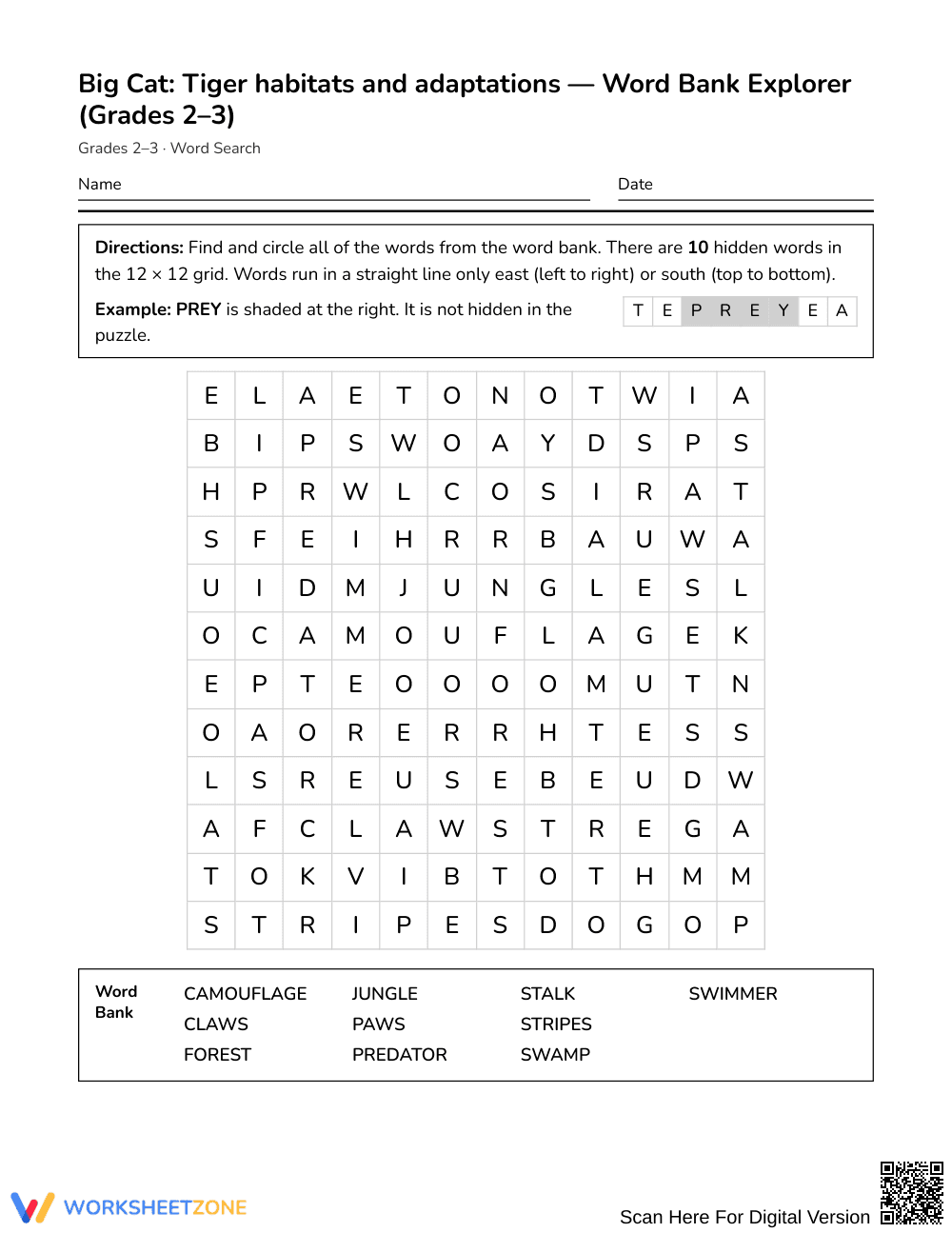
Students explore tiger habitats and adaptations while sharpening their vocabulary through a fun, printable word search. By locating ten key terms, learners reinforce spelling, meaning, and contextual understanding of concepts such as camouflage, jungle, and predator, preparing them for deeper discussions in the animal adaptations unit.
At a Glance
- Grade: Grades 2–3 · Subject: Science
- Standard:
Not standards-assessed — vocabulary enrichment for animal unit- Skill Focus: tiger habitats and adaptations vocabulary
- Format: 1 printable page · 10 hidden words · Answer key included · PDF file
- Best For: quick, engaging vocabulary practice during the animal adaptations unit
- Time: 5–10 minutes of focused daily searching
The activity consists of a 12 × 12 grid where words run eastward and southward. An alphabetical word bank lists ten target terms—CAMOUFLAGE, CLAWS, FOREST, JUNGLE, PAWS, PREDATOR, STALK, STRIPES, SWAMP, SWIMMER—without clues, letting learners rely on context clues from the unit. An answer key on a separate page shows the completed grid.
- Print: Open the PDF and print the single-page puzzle (≈30 seconds).
- Distribute: Hand the sheets to students and give a quick oral reminder (≈30 seconds).
- Review: After completion, collect the pages and use the answer key for instant feedback (≈30 seconds).
Total teacher preparation time stays under two minutes, making this activity perfect for a sub‑plan or a quick fill‑in during a lesson.
This word search supports vocabulary enrichment related to tiger habitats and adaptations but is not tied to any specific state or district standard. It serves as a supplemental activity to reinforce key terminology introduced in the Animal Adaptations unit.
Use Case 1: Before a lesson on animal habitats, hand out the word search as a warm‑up. Observe which terms students locate quickly; those missed can be highlighted during the upcoming instruction.
Use Case 2: After a video on tiger adaptations, use the puzzle for independent practice. Collect the completed grids and note accuracy rates to gauge vocabulary retention, typically taking 5–10 minutes.
Designed for Grades 2–3 learners in a Science class, this activity reinforces key vocabulary for all students. While the puzzle itself is level‑appropriate, teachers can pair it with an anchor chart of tiger adaptations or a short documentary clip to deepen understanding.
Research shows that focused word‑study activities boost young learners’ vocabulary retention and comprehension. Fisher & Frey (2014) highlight that when students actively search for and spell target terms, they create stronger mental connections, leading to higher recall in later assessments. This printable word search gives Grades 2–3 students ten essential words about tiger habitats and adaptations—such as CAMOUFLAGE, JUNGLE, and PREDATOR—allowing them to practice spelling, meaning, and contextual usage in an engaging format. The activity’s quick, zero‑prep design supports immediate reinforcement after direct instruction, aligning with best practices for formative vocabulary enrichment. By integrating this puzzle into the Animal Adaptations unit, teachers can efficiently assess students’ grasp of key terminology while maintaining high motivation and participation. The visual grid also aids spatial memory, a factor noted by NAEP (2022) as beneficial for early readers. Moreover, the inclusion of an answer key enables instant feedback, supporting the formative loop recommended in evidence‑based instruction.


