





























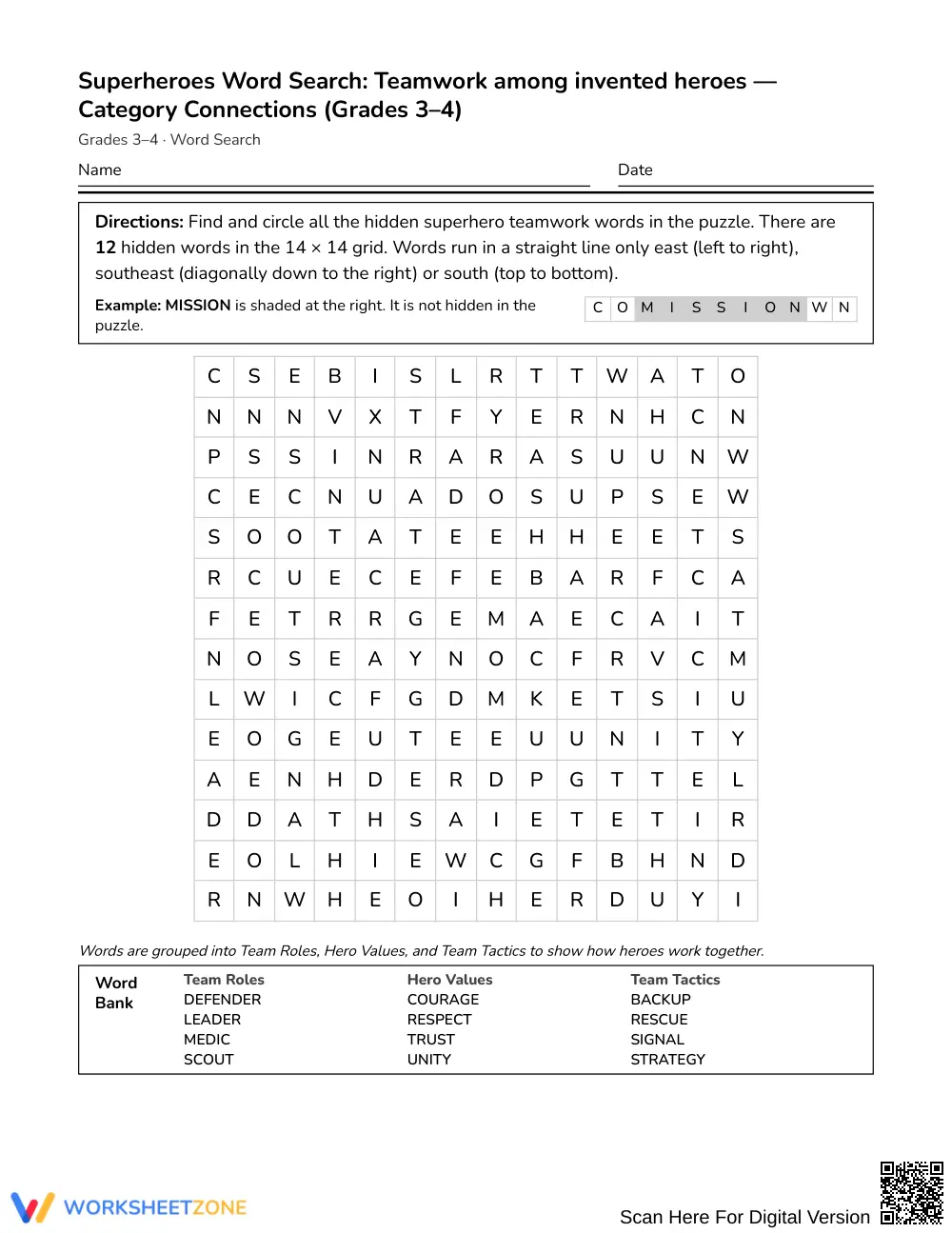


Free Teamwork Word Search | Grades 3–4 Behavior Worksheets

Paste this activity's link or code into your existing LMS (Google Classroom, Canvas, Teams, Schoology, Moodle, etc.).
Students can open and work on the activity right away, with no student login required.
You'll still be able to track student progress and results from your teacher account.
This Grades 3–4 word search introduces students to cooperative teamwork through the exciting lens of invented superheroes. Learners identify essential collaboration vocabulary to explore how team roles, shared values, and strategic actions combine to solve collective challenges. By connecting cooperative concepts to heroic adventures, students build meaningful social-emotional vocabulary that strengthens peer interaction.
At a Glance
- Grade: Grades 3–4 elementary · Subject: Behavior Worksheets and Social Skills
- Standard: Not standards-assessed — vocabulary enrichment and character building
- Skill Focus: Teamwork, mutual trust, and positive collaboration among invented heroes
- Format: 1 student page · 12 hidden words · 3-page answer key included · Printable PDF
- Best For: Social-emotional learning instruction, morning meetings, calm transitions, and team building
- Time: 15–20 minutes of focused puzzle work
This 1-page printable activity features 12 hidden words organized into three distinct thematic categories: Team Roles, Hero Values, and Team Tactics. Rather than searching an unstructured list, students see how words like LEADER, TRUST, and STRATEGY connect to cooperative group dynamics. A comprehensive 3-page answer key provides clear solution maps for rapid checking.
The puzzle is built on an accessible 14 x 14 letter grid tailored for intermediate elementary searchers. Words run in three specific directions: horizontally from left to right (East), vertically downward (South), and diagonally downward (Southeast). Students reference a categorized word bank that clusters terms under Team Roles, Hero Values, and Team Tactics, reinforcing meaningful vocabulary connections as they search.
This worksheet is designed purely for vocabulary enrichment and social-emotional development; it is not aligned to a formal academic content standard. Teachers can integrate the activity into guidance lessons, advisory periods, or classroom community meetings focused on positive group behavior and conflict prevention.
Introduce this word search before direct instruction on cooperative learning to activate prior knowledge about collaboration, or assign it during a wrap-up period following a group project. During the 15 to 20 minute completion window, circulate to observe which category concepts students discuss, noting whether they understand how roles like DEFENDER or tactics like BACKUP translate into classroom partnership.
This resource is crafted for Grades 3–4 learners who benefit from engaging social skills practice. Differentiate by encouraging students to highlight distinct categories in different colors or by pairing emerging readers with peer partners. Pair this activity naturally with a classroom anchor chart illustrating teamwork norms or a read-aloud about working together.
Designed for Grades 3–4 classrooms, this behavioral vocabulary enrichment activity centers on teamwork among invented heroes to strengthen social communication and cooperative peer problem-solving. While this print-ready resource is not tied to a state standard, it delivers targeted vocabulary practice through 12 thematic terms grouped into roles, values, and tactics. According to Fisher & Frey (2014), purposeful exposure to domain-specific vocabulary within engaging, low-stakes formats reinforces comprehension and transfers directly to collaborative classroom discussions. Students scan a 14 by 14 letter grid using horizontal, vertical, and diagonal word paths, building visual scanning stamina while internalizing prosocial concepts like trust, unity, and mutual respect. The included 3-page answer key supports rapid verification by teachers, making the single-page puzzle a dependable instructional tool for social-emotional learning blocks, counseling groups, and morning meetings that build inclusive, highly supportive learning environments.


