





























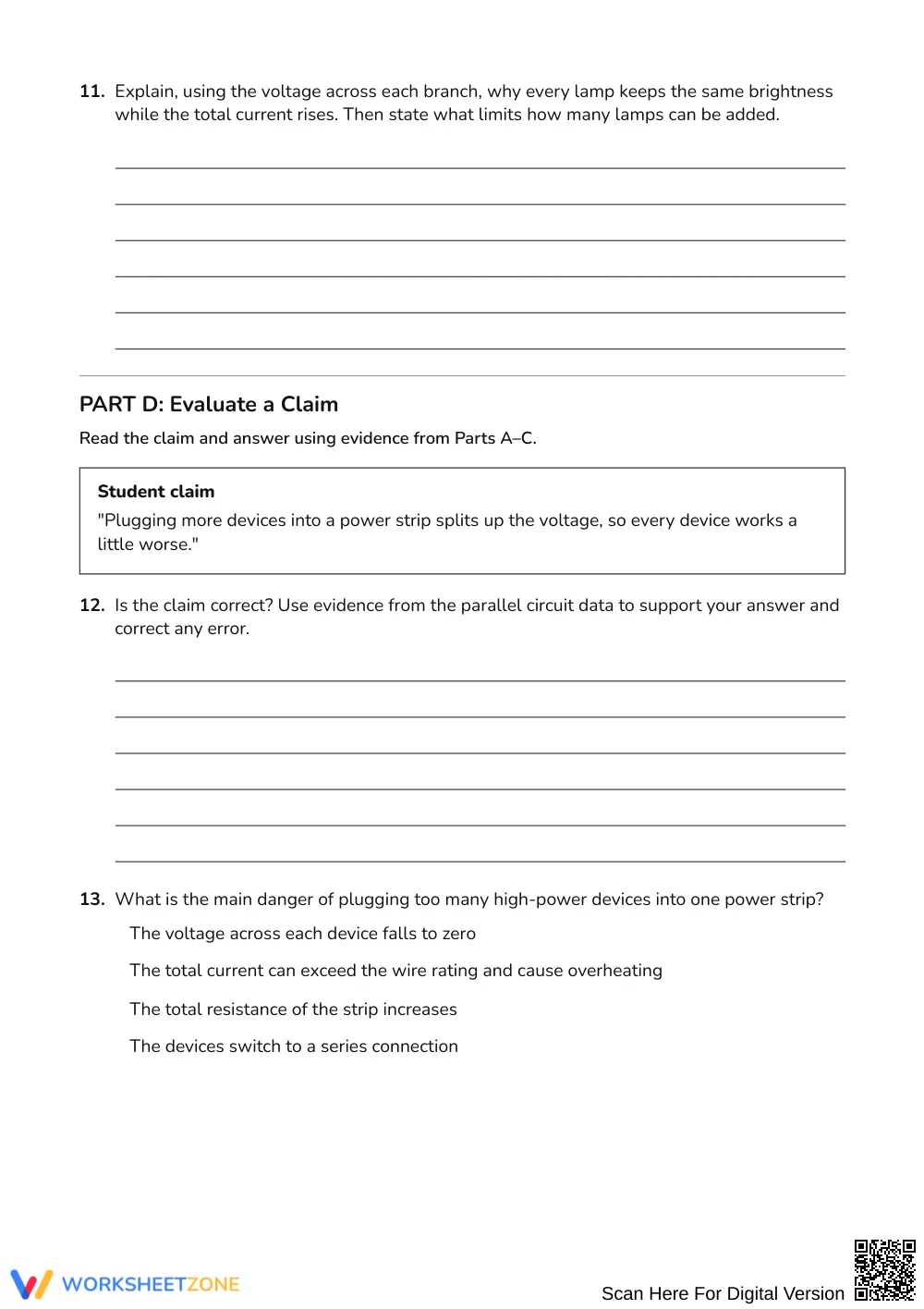


Free Parallel Circuit RealWorld Worksheet|Grade 8–12 Science

Paste this activity's link or code into your existing LMS (Google Classroom, Canvas, Teams, Schoology, Moodle, etc.).
Students can open and work on the activity right away, with no student login required.
You'll still be able to track student progress and results from your teacher account.
This 4‑page worksheet guides Grade 8‑12 science students through 28 real‑world parallel‑circuit problems, helping them predict current flow, calculate power, and justify safety decisions. By the end, learners can confidently explain why parallel wiring protects devices and how to size fuses for everyday appliances.
At a Glance
- Grade: 8–12 · Subject: Science
- Standard:
— Analyze and apply parallel‑circuit concepts in authentic contexts- Skill Focus: Real‑World Application
- Format: 4 pages · 28 problems · Answer key included · PDF
- Best For: Inquiry labs, homework, or test prep
- Time: 30–45 minutes
What’s Inside – The packet contains four pages of mixed‑format tasks: data‑analysis tables, multiple‑choice predictions, short‑answer explanations, and a final claim‑evaluation. A worked example opens Part A, a word bank supports Part C, and answer keys are provided on a separate back‑to‑back page.
- Guided practice (8 scaffolded items) – students complete a worked example and use a sentence frame to describe current paths.
- Supported practice (10 items) – multiple‑choice and short‑answer questions that remove the frame but keep a word bank.
- Independent practice (10 items) – open‑ended claim evaluation and fuse‑sizing calculations requiring full written justification.
These steps follow the classic I Do, We Do, You Do release model, moving students from teacher‑led demonstration to autonomous reasoning.
Standards Alignment – `` Students analyze parallel‑circuit diagrams, calculate equivalent resistance, and explain how voltage remains constant across branches. Supporting standards reinforce scientific reasoning and quantitative problem solving. Both standard references can be copied directly into lesson plans, IEP goals, or district curriculum mapping tools.
How to Use It – Before a unit on electric circuits, use the opening data‑analysis (Part A) as a quick diagnostic to gauge prior knowledge. During lab work, assign Part C as a think‑pair‑share activity, then collect responses for formative assessment. After direct instruction, have students complete Part D as a summative check; observe whether they correctly refute the voltage‑splitting myth.
Who It’s For – Ideal for high‑school students who need concrete, real‑life contexts for abstract circuit ideas. The worksheet’s layered scaffolds serve both struggling learners and those ready for deeper analysis. Pair it with a short video on household wiring or an anchor chart of the reciprocal resistance formula for added reinforcement.
Research shows that authentic, problem‑based tasks improve transfer of physics concepts to everyday situations (Fisher & Frey, 2014). This worksheet aligns with that evidence, offering 28 carefully sequenced items that require students to interpret data, justify reasoning, and evaluate claims. By connecting parallel‑circuit theory to camper‑van power systems, power strips, and holiday‑light strings, the activity mirrors real‑world engineering challenges. The inclusion of an answer key supports immediate feedback, a practice linked to higher achievement in NAEP assessments. Teachers who assign this resource can expect students to demonstrate stronger conceptual understanding and greater confidence applying circuit principles outside the classroom.


