



























Free Juneteenth Civic Word Search | Grades 6–7 Civics
Paste this activity's link or code into your existing LMS (Google Classroom, Canvas, Teams, Schoology, Moodle, etc.).
Students can open and work on the activity right away, with no student login required.
You'll still be able to track student progress and results from your teacher account.
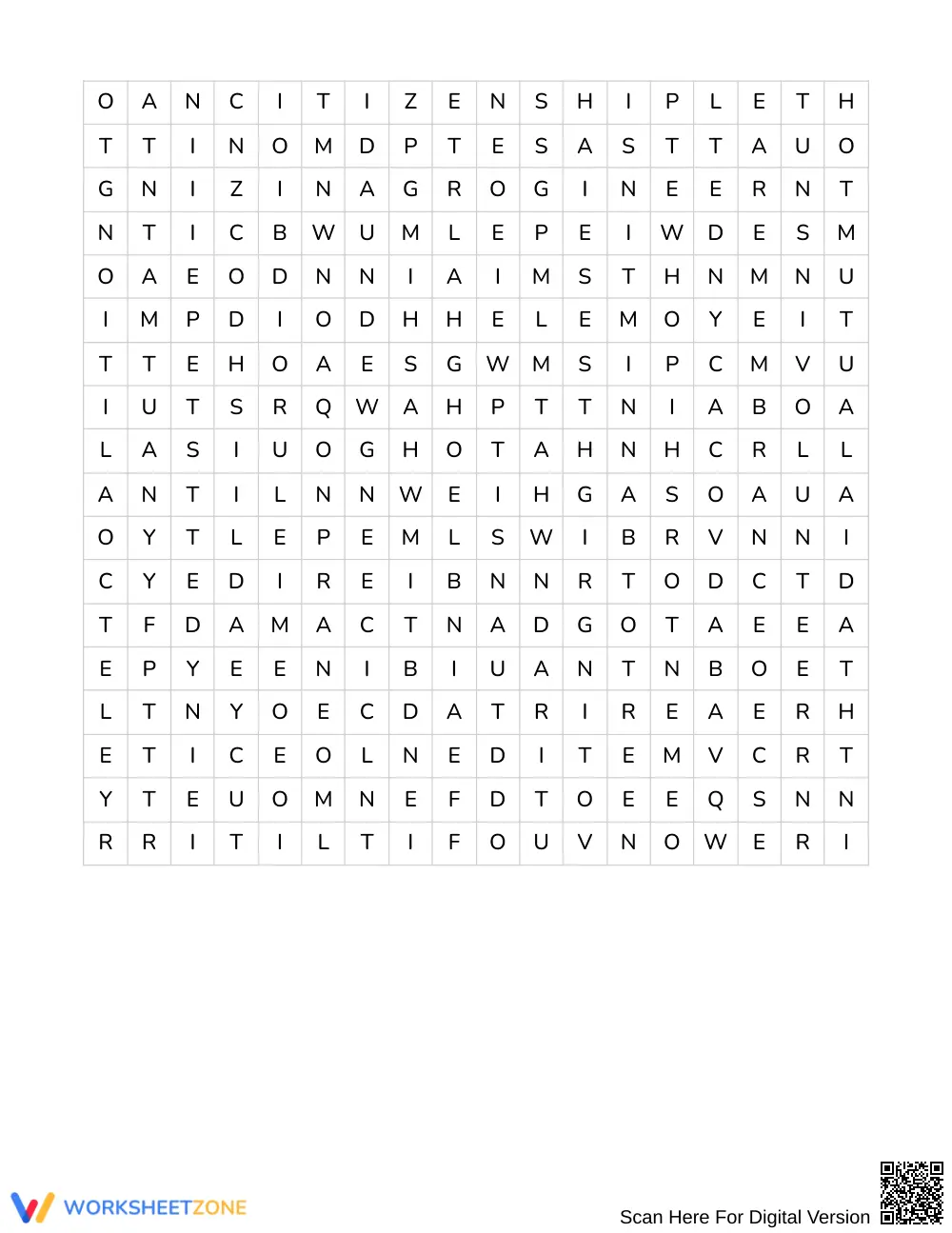
The Juneteenth Civic Word Search engages Grades 6–7 Social Studies learners in a focused vocabulary activity that reinforces community service and civic participation concepts while they hunt for 16 hidden words. The puzzle also encourages careful reading of clues and strengthens spelling accuracy.
At a Glance
- Grade: Grades 6–7 · Subject: Social Studies (Middle school)
- Standard:
Not standards-assessed — vocabulary enrichment(focuses on civic-related terms)- Skill Focus: community service and civic participation vocabulary for learners
- Format: 3 pages · 16 words · Answer key included · PDF (clear layout)
- Best For: interactive quick vocabulary review or enrichment activity in class or remote learning
- Time: 10–15 minutes (per group)
The activity consists of a single 18 × 18 word search grid printed across three pages. Each of the 16 target terms is paired with a concise clue that defines the civic concept. An answer key on the final page shows the correct word locations.
Students read each clue, locate the corresponding term in the grid, and circle it. Words may run horizontally, vertically, or diagonally in any of the eight directions (N, NE, E, SE, S, SW, W, NW). No word bank is provided, so learners rely on the clues alone.
This word search is designed purely for vocabulary enrichment and does not align to any state or national standard. It serves as a flexible tool to deepen understanding of civic terminology without formal assessment requirements.
Use the puzzle as a warm‑up before a lesson on community service, allowing students to activate prior knowledge while you introduce new content. Alternatively, employ it as a quick exit ticket after a civic‑engagement discussion; collect completed grids to gauge vocabulary retention in 10‑15 minutes.
The activity targets Grades 6–7 Social Studies learners who are building civic vocabulary. It works well alongside a Juneteenth history lesson or an anchor chart of community‑service terms, providing a focused, independent practice opportunity.
Vocabulary‑rich word searches like this Juneteenth Civic activity support middle‑school learners in consolidating key civic concepts while promoting spelling accuracy and contextual understanding. Research shows that focused, clue‑based puzzles enhance word retention and engagement (Fisher & Frey, 2014). By integrating 16 targeted terms such as ADVOCACY, ENGAGEMENT, and SOLIDARITY, the search reinforces the community service and civic participation skill focus without requiring formal standards alignment. The 18 × 18 grid and eight‑directional search format provide a moderate challenge appropriate for Grades 6–7, encouraging independent problem‑solving. Teachers can quickly deploy the PDF, print the three‑page packet, and use the answer key for immediate feedback, making the resource ready for classroom or remote instruction. This approach aligns with evidence‑based practices that link active vocabulary work to deeper civic understanding. Such activities also foster collaborative discussion when students compare findings, supporting social‑emotional growth alongside academic goals.


