


























Views
Downloads



Free Interaction Changes Worksheet | Grade 9 English I
Paste this activity's link or code into your existing LMS (Google Classroom, Canvas, Teams, Schoology, Moodle, etc.).
Students can open and work on the activity right away, with no student login required.
You'll still be able to track student progress and results from your teacher account.
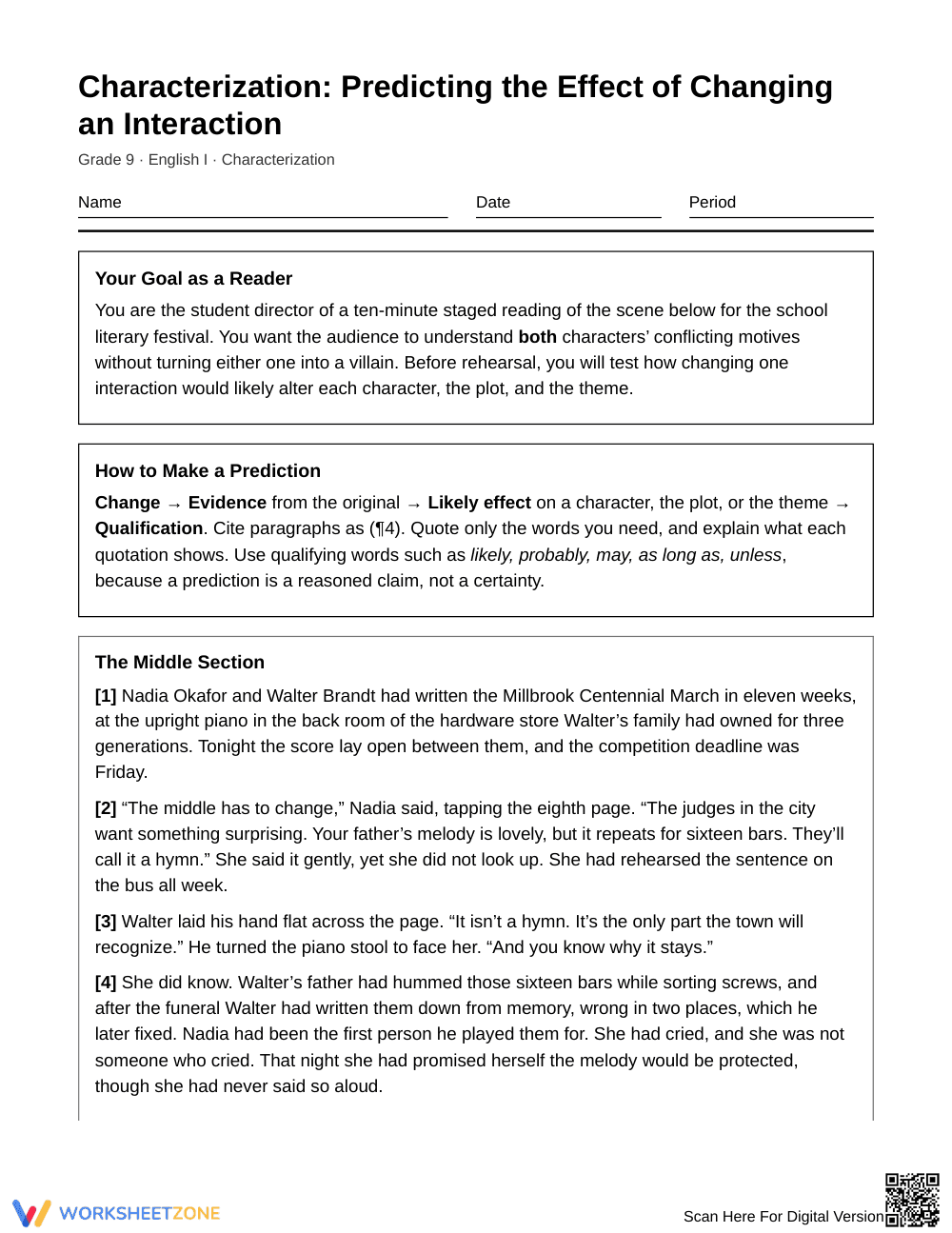
Students practice predicting how changing a single interaction between characters would alter a character, the plot, or the theme. Using an original scene about two musicians, they anchor each prediction in quoted evidence and add a qualification, building the reasoning skills behind RL.9-10.3.
At a Glance
- Grade: 9 · Subject: English I
- Standard:
RL.9-10.3— Analyze how complex characters interact and develop, advancing the plot or theme- Skill Focus: Predicting effects of changed interactions
- Format: 6 pages · 10 problems · Answer key included · PDF
- Best For: Close reading practice in characterization units
- Time: 45–60 minutes
What's Inside
The worksheet opens with a student-director scenario and a four-step prediction method: change, evidence, likely effect, qualification. A numbered eight-paragraph scene, “The Middle Section,” follows. Three parts then ask students to identify textual constraints, apply them to six altered interactions, and defend a directing decision with a revision of their own. The 6 pages include a 3-page answer key with model reasoning for every task.
Skill Progression
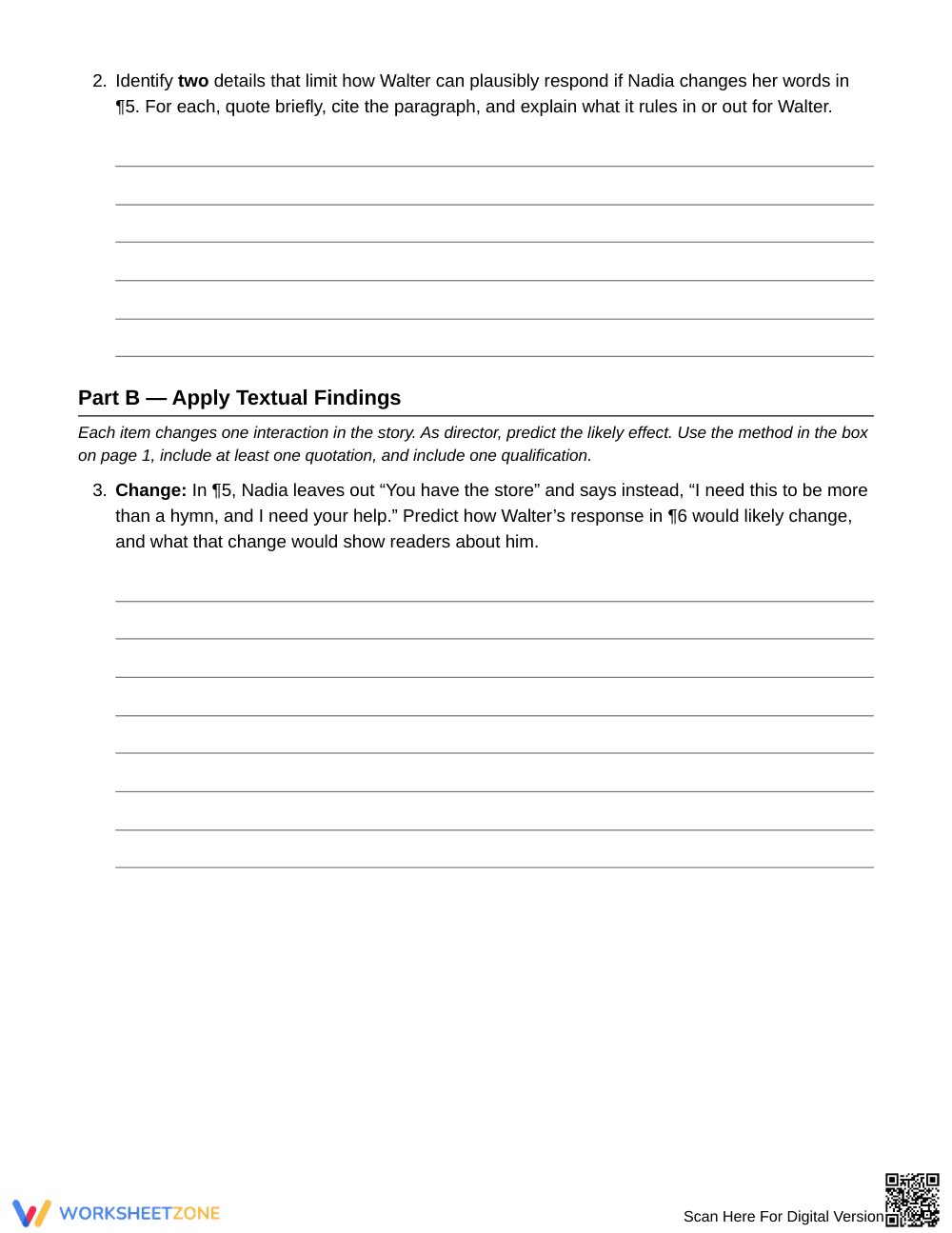
- Guided practice (Part A, 2 tasks): Students choose a constraint on Nadia's character and name two details that limit Walter's possible responses, quoting and citing paragraphs.
- Supported practice (Part B, 6 tasks): Each task changes one interaction. Students use the method box to predict effects on a character, the plot, or the theme.
- Independent practice (Part C, 2 tasks): Students choose between two altered interactions, then rewrite ¶6 and justify the revision with evidence from at least two paragraphs.
This sequence follows gradual release: I Do through the method box, We Do through the constraint tasks, You Do through the decision and rewrite.
Standards Alignment
RL.9-10.3 — Analyze how complex characters (for example, those with multiple or conflicting motivations) develop over the course of a text, interact with other characters, and advance the plot or develop the theme. The standard code can be copied directly into lesson plans, IEP goals, or district curriculum mapping tools.
How to Use It
- After direct instruction: Assign Parts A and B as independent practice once students have studied motive and conflict. Save Part C for a second sitting or homework.
- During a workshop block: Have partners compare Part B predictions, then discuss which qualifying words made a claim more defensible.
For formative assessment, watch whether students quote only the words they need and explain what each quotation shows. Expect 45–60 minutes for the full set.
Who It's For
Designed for Grade 9 English I students working on literary analysis. Students who need support can begin with Part A and the method box, while stronger writers can focus on the Part C rewrite. It pairs well with a short lesson on conflicting motivation or an anchor chart on characterization.
RL.9-10.3 asks Grade 9 and 10 students to analyze how complex characters with conflicting motives develop, interact with others, and advance the plot or theme. This worksheet teaches that skill by having students predict how changing one interaction in a short scene would alter a character, the plot, or the theme, then support the prediction with a quotation, a paragraph citation, and a qualifying word. Fisher & Frey (2014) describe gradual release of responsibility, in which learners move from modeled to guided to independent work, as a reliable way to build such reasoning, and the three parts here move in a similar direction. Students must use qualifying language such as likely or unless, which keeps predictions reasoned rather than absolute. The resource includes 10 tasks across 6 pages, with a 3-page answer key, and fits a 45–60 minute class period in a characterization unit.


