
































Free Food Art & Community Word Search | Grades 7–8 ELA

Paste this activity's link or code into your existing LMS (Google Classroom, Canvas, Teams, Schoology, Moodle, etc.).
Students can open and work on the activity right away, with no student login required.
You'll still be able to track student progress and results from your teacher account.
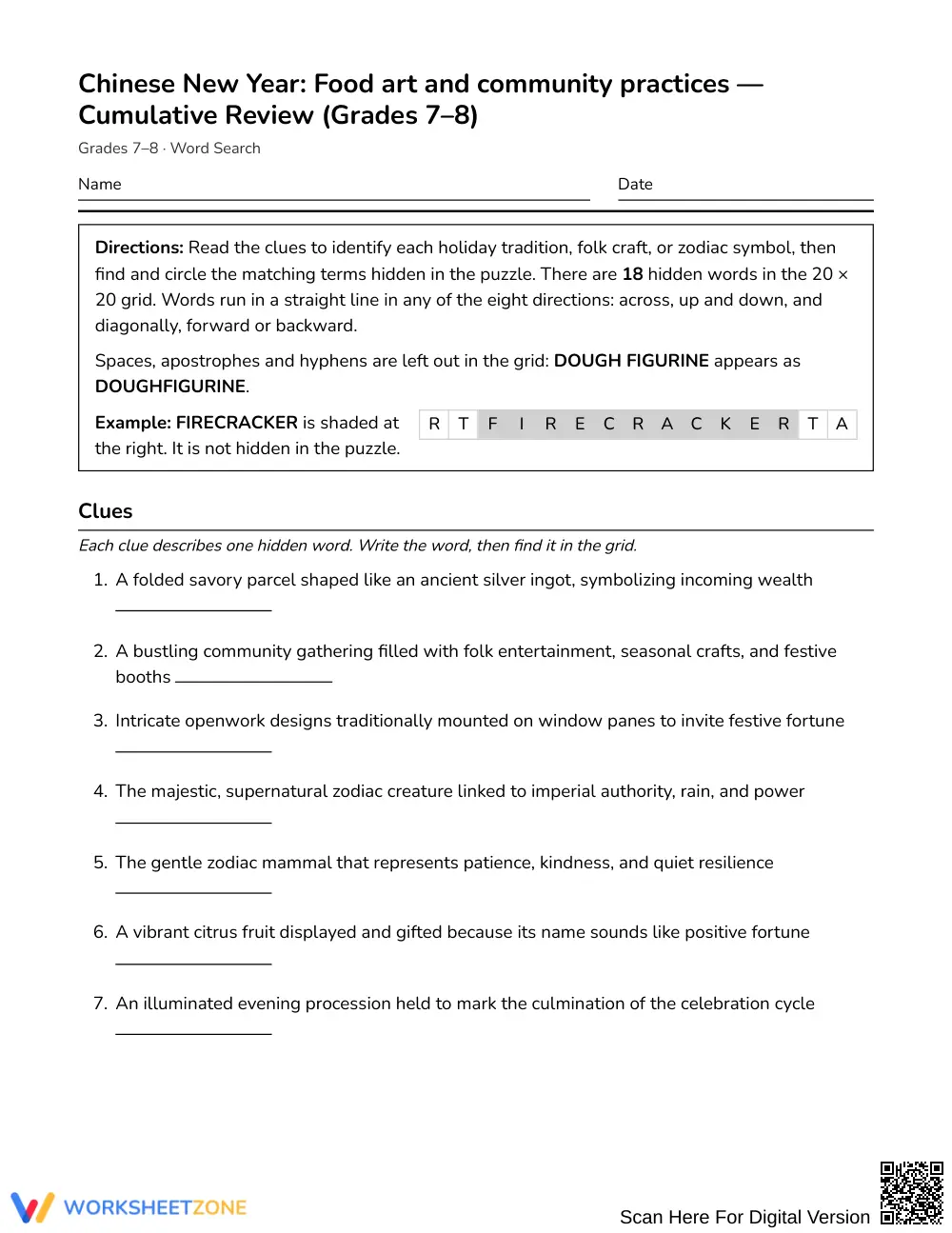
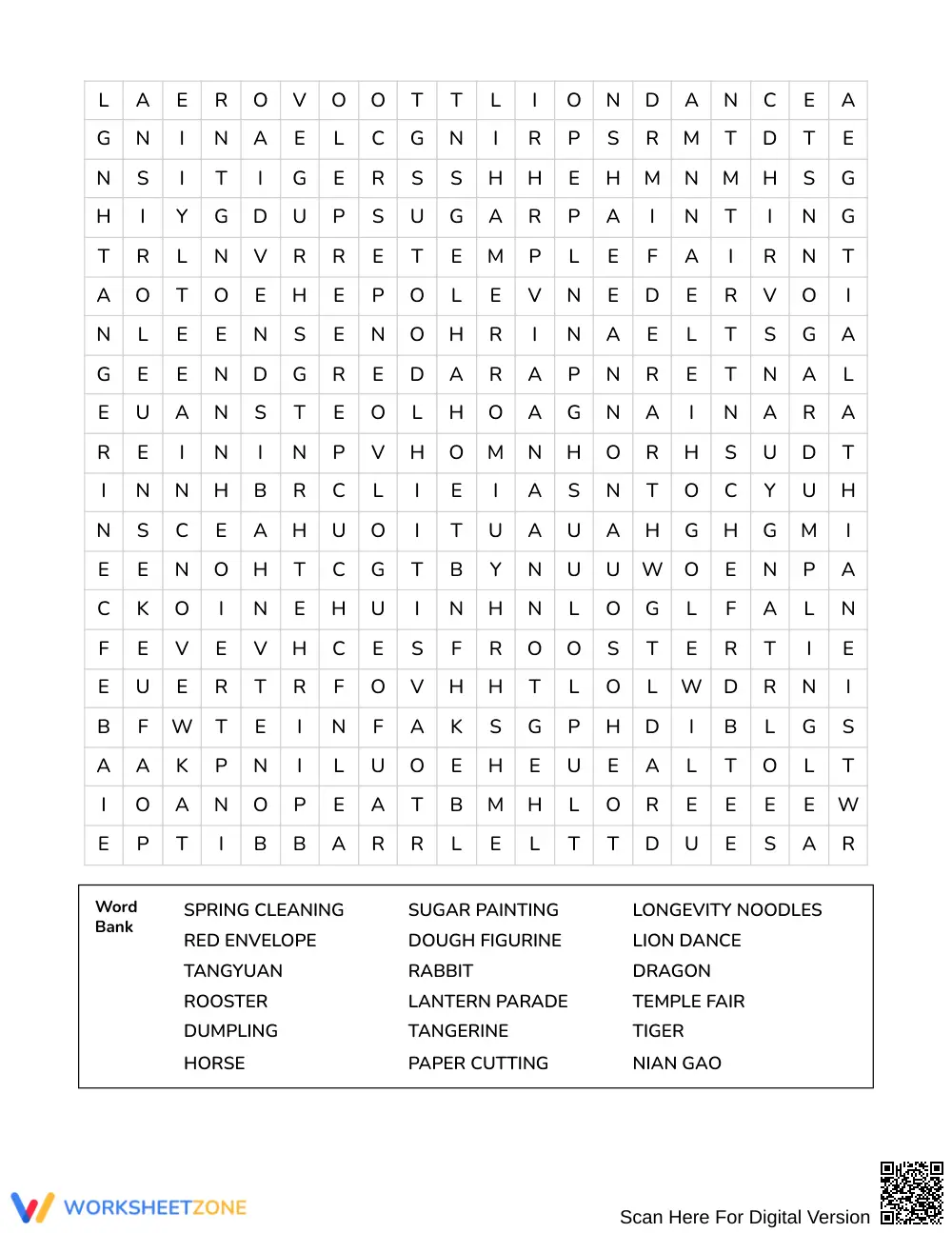
Students work through Chinese New Year vocabulary with this engaging word search. By locating terms related to food art and community practices, learners reinforce spelling, meaning, and cultural connections while enjoying a puzzle format that promotes independent practice and quick recall.
At a Glance
- Grade: Grades 7–8 · Subject: English Language Arts
- Standard:
Not standards-assessed — vocabulary enrichment— students explore Chinese New Year vocabulary and related customs- Skill Focus: food art and community practices
- Format: 3 pages of puzzle layout, 18 hidden words, answer key included, printable PDF
- Best For: quick cultural review activity for language arts enrichment
- Time: 10–15 minutes of focused, independent practice
What's Inside
The activity consists of a 20 × 20 grid that runs words in all eight directions—N, NE, E, SE, S, SW, W, NW. Eighteen culturally rich terms are hidden, each supported by a clear clue. A shuffled word bank appears on the answer key page, making self‑check quick and reliable.
Zero‑Prep Workflow
- Print the 3‑page PDF (under 30 seconds).
- Distribute the sheets and answer key to students (about 1 minute).
- After completion, collect the puzzles and quickly review answers using the provided key (2 minutes). Total teacher prep stays under 2 minutes.
Standards Alignment
This word search is designed for vocabulary enrichment and is not aligned to any specific state or district standard. It simply offers cultural exposure and spelling practice.
How to Use It
Before a unit on world celebrations, hand out the puzzle as a warm‑up to activate prior knowledge of Chinese New Year customs. Observe students as they locate words, noting quick recognition as a formative cue. During a cultural arts lesson, use the completed word search for a quick exit ticket: ask learners to write one sentence explaining a chosen term, reinforcing comprehension.
Who It's For
Grades 7–8 English Language Arts learners benefit from this activity, especially those studying cultural vocabulary or preparing for holiday‑styled projects. No differentiation is required, but teachers can pair it with a Chinese New Year video or an anchor chart on zodiac symbols for added context.
Research shows that engaging, context‑rich word activities boost vocabulary retention for middle‑school learners (Fisher & Frey, 2014). This Chinese New Year word search aligns with that evidence by immersing Grades 7–8 students in authentic cultural terminology while practicing spelling and meaning. The puzzle’s eight‑direction layout and clue‑driven format encourage active decoding, a strategy linked to deeper lexical processing. By integrating food art and community practices, the activity supports cross‑curricular connections between language arts and social studies, fostering both linguistic and cultural competence. Teachers can confidently assign this resource as a quick, low‑prep reinforcement tool, knowing it reflects proven instructional practices that enhance word knowledge and cultural awareness. Studies also indicate that puzzle‑based tasks increase student motivation and provide immediate feedback, allowing teachers to gauge understanding in real time. The inclusion of a shuffled word bank on the answer key further supports self‑assessment, making the activity suitable for both classroom and remote learning environments.


