































Free Europe Capitals Word Search | Grades 7–8 Social Studies

Paste this activity's link or code into your existing LMS (Google Classroom, Canvas, Teams, Schoology, Moodle, etc.).
Students can open and work on the activity right away, with no student login required.
You'll still be able to track student progress and results from your teacher account.
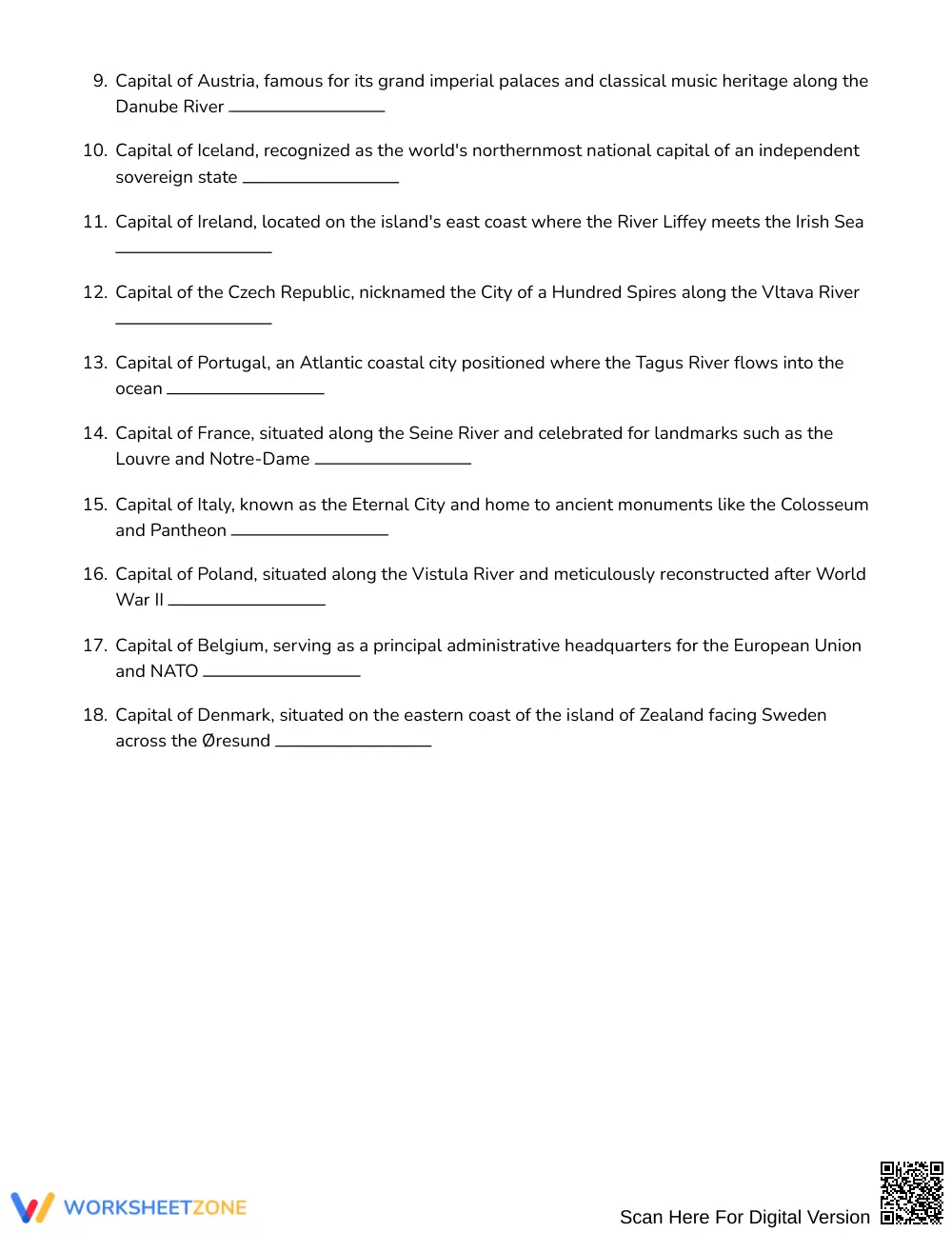
This Grades 7–8 European capitals word search reinforces European geography by challenging students to identify 18 capital cities using descriptive geographic clues before locating them in a grid. Learners review key landmarks, river systems, and regional features while reinforcing spatial recall and foundational social studies vocabulary across the European continent.
At a Glance
- Grade: Grades 7–8 · Subject: Social Studies Geography
- Standard: Not standards-assessed — targeted vocabulary enrichment
- Skill Focus: Identifying European capital names from regional and landmark clues
- Format: 3 student pages · 18 hidden words · 4 answer key pages · PDF
- Best For: European geography review, bell ringers, sub plans, and fast finishers
- Time: 20–30 minutes
This 3-page printable activity features 18 clues describing national capitals across Western, Eastern, Northern, and Southern Europe. Rather than providing a basic list of terms, the worksheet requires students to read each clue—incorporating prominent rivers, architecture, and historical contexts—to determine the correct capital. A comprehensive 4-page answer key provides clear grid solutions for effortless checking.
The puzzle features an expansive 20-by-20 letter grid containing all 18 hidden capital names arranged in eight possible orientations: North, Northeast, East, Southeast, South, Southwest, West, and Northwest. The word bank is presented in shuffled order alongside rich cultural and physical clues, requiring students to deduce each capital before scanning horizontally, vertically, or diagonally across the letter matrix.
This social studies activity serves as vocabulary enrichment and cumulative content review rather than formal standards-based assessment. While not aligned to a specific Common Core or state performance standard, the activity directly supports regional geography literacy, spatial awareness, and informational reading comprehension across middle school social studies curricula.
Teachers can incorporate this word search as an engaging mid-unit checkpoint after direct instruction on European nations, prompting students to connect physical landmarks with political capitals. Alternatively, assign it as a collaborative partner challenge or independent sub plan. To check understanding formatively, observe whether students deduce capital names independently from clues before hunting across the grid. The activity takes approximately 20 to 30 minutes to complete.
This resource is designed for Grade 7 and Grade 8 social studies students studying regional world geography. For learners requiring additional support, educators can provide an atlas or labeled political map of Europe to assist with unfamiliar clues. For advanced learners, challenge them to name the bordering countries for each capital found. It pairs naturally with an introductory lecture or political wall map of Europe.
Vocabulary acquisition and spatial recall in middle school social studies require active retrieval rather than passive rote memorization. According to Fisher & Frey (2014), structured vocabulary tasks that integrate contextual clues with visual and spatial search mechanisms deepen student retention of specialized academic language. This Grades 7–8 European geography word search operationalizes this pedagogical principle by requiring students to analyze descriptive physical, cultural, and political clues to identify 18 European capitals before locating them across a 20-by-20 grid. By embedding historical landmarks, river systems, and geographic coordinates into the clue structure, the resource bridges informational text analysis with regional geographic literacy. Students synthesize regional knowledge across Western, Northern, Southern, and Eastern Europe while exercising orthographic scanning in all eight compass directions. The self-checking design and included answer key provide an effective, zero-prep formative tool for reinforcing essential continental geography vocabulary.


