































Free Europe Capitals Word Search | Grades 6–7 Social Studies

Paste this activity's link or code into your existing LMS (Google Classroom, Canvas, Teams, Schoology, Moodle, etc.).
Students can open and work on the activity right away, with no student login required.
You'll still be able to track student progress and results from your teacher account.
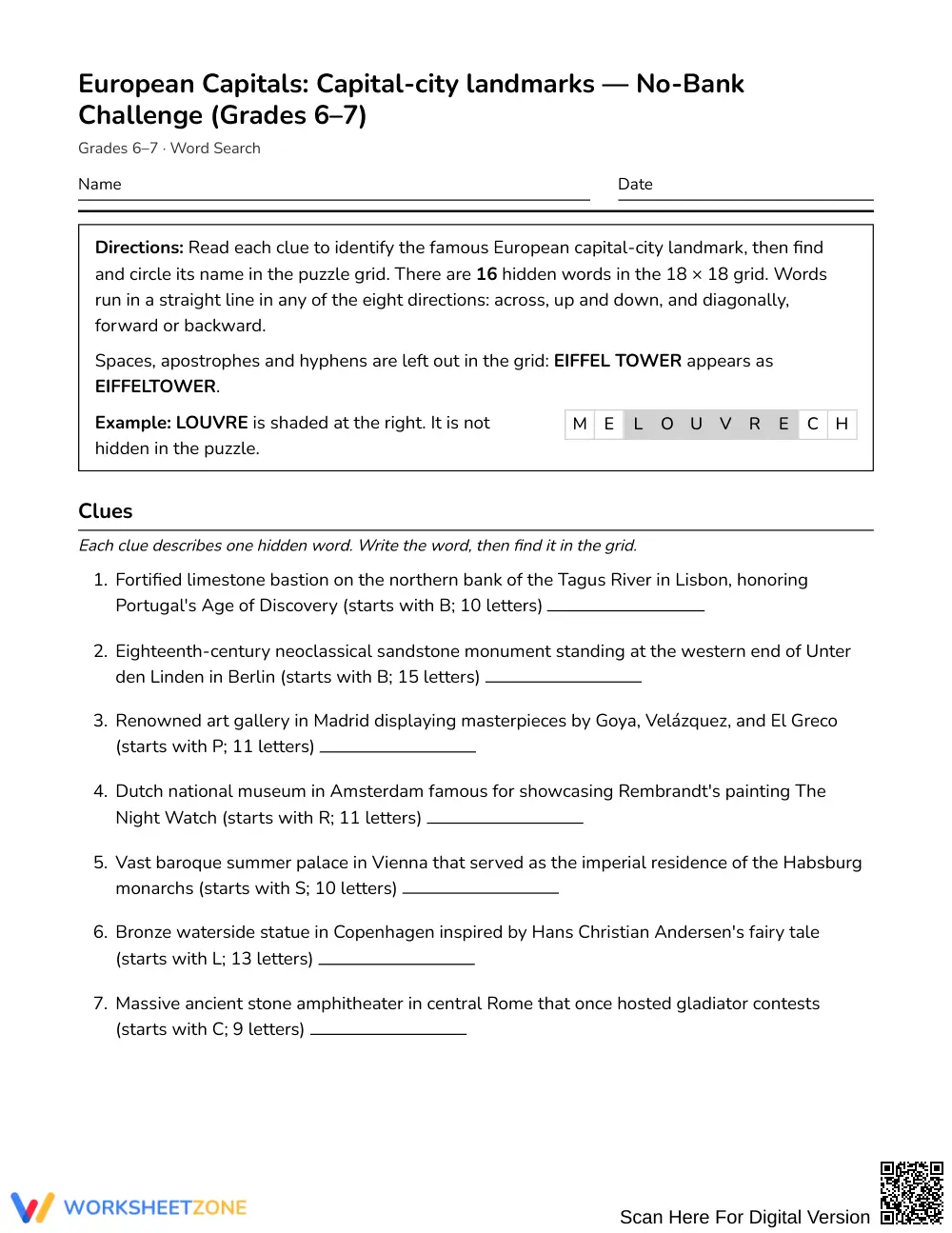
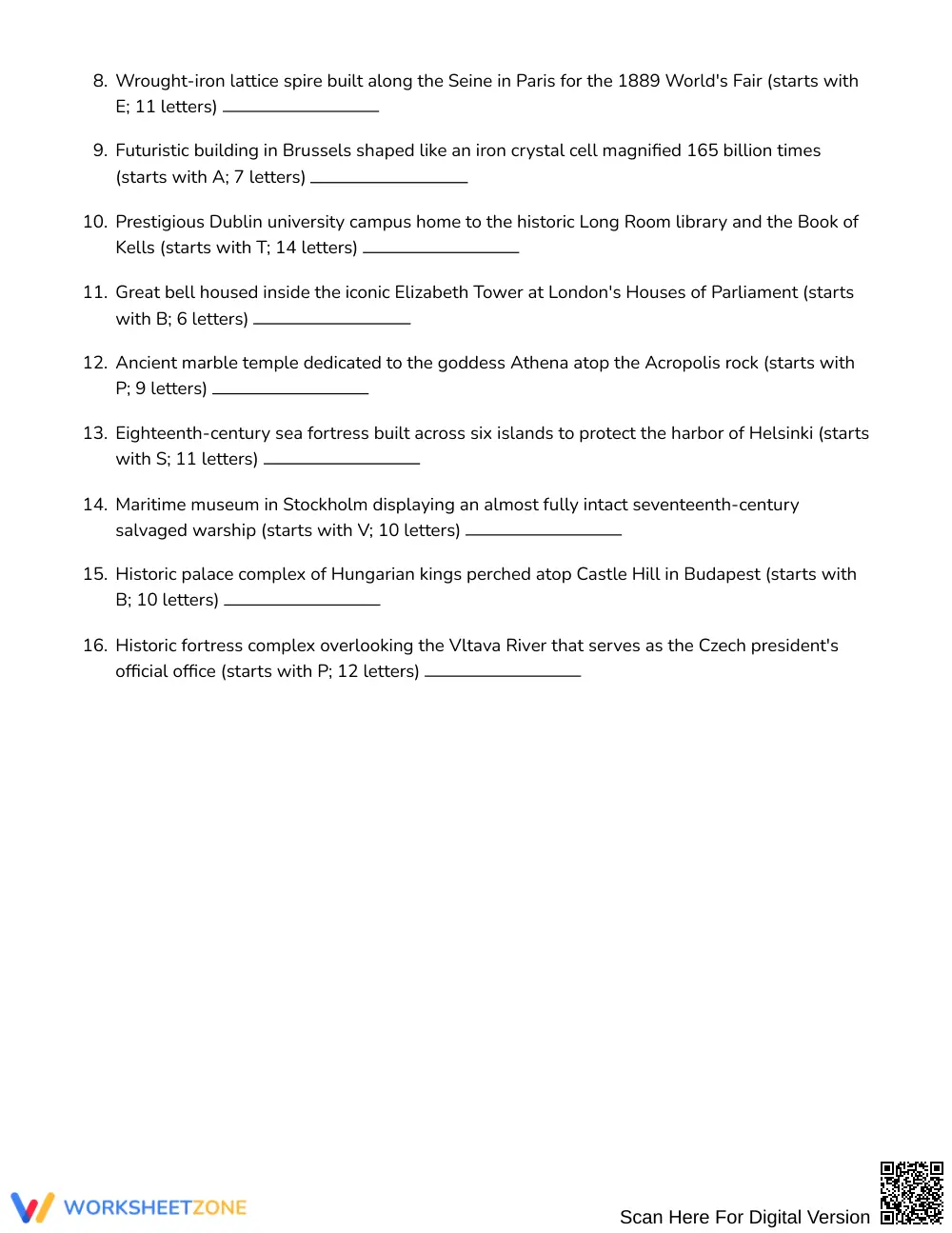
This Grades 6–7 geography word search reinforces knowledge of European capital-city landmarks through an engaging clue-solving challenge. Students read 16 descriptive historical clues, deduce the landmark and capital city, and locate each term within an 18 by 18 puzzle grid. It provides rigorous vocabulary review with zero teacher preparation.
At a Glance
- Grade: Grades 6–7 middle school · Subject: Social Studies
- Standard: Not standards-assessed — vocabulary enrichment and landmark identification
- Skill Focus: European capital-city landmarks and architecture
- Format: 3 pages · 16 hidden words · Full answer key included · PDF
- Best For: Geography unit review, fast finishers, and substitute lesson plans
- Time: 20–30 minutes
What's Inside
This 3-page printable resource challenges middle school learners to locate 16 notable landmarks scattered across Europe. Unlike standard puzzles, this activity omits a word bank to boost critical inquiry. Instead, students read 16 curated clues highlighting architectural styles, geographic settings, and cultural histories—such as Rome's Colosseum, Madrid's Prado Museum, and Stockholm's Vasa Museum. A comprehensive 4-page answer key clearly marks word placements for rapid checking.
How the Puzzle Works
Students search an 18 by 18 letter grid where 16 landmark names are hidden in all eight directions: north, northeast, east, southeast, south, southwest, west, and northwest. Because no word bank is supplied, learners must read each descriptive prompt, identify the target site, and track letter sequences forwards, backwards, and diagonally. This multi-directional layout demands careful visual scanning and rewards persistent spatial analysis.
Standards Alignment
This resource serves as targeted vocabulary enrichment and cultural geography practice. It is not aligned to a specific state or national standard. Teachers can integrate the activity into broader world geography or European history units to reinforce regional literacy and spatial awareness alongside core curriculum standards.
How to Use It
Deploy this word search during independent seatwork after introducing European physical and political geography, or assign it as an engaging review station. During work time, observe whether students identify landmarks directly from clues or need support cross-referencing European capitals on a reference map. The complete activity takes between 20 and 30 minutes to finish.
Who It's For
Designed specifically for Grades 6–7 social studies students, this puzzle supports middle schoolers exploring European geography and world cultures. Pair this activity with an unlabeled political map of Europe, prompting students to pin each landmark to its correct nation and capital city after completing the grid search.
Vocabulary enrichment activities that integrate informational clues with spatial retrieval strengthen middle school students' retention of content-area knowledge. According to Fisher & Frey (2014), purposeful vocabulary acquisition across social studies curricula depends on active processing, where students connect descriptive text features to domain-specific terminology rather than relying on passive memorization. This Grades 6–7 capital-city landmarks word search operationalizes that instructional principle by omitting an overt word bank. Students must synthesize historical and geographical clues—referencing architectural landmarks such as the Parthenon, Colosseum, and Schonbrunn—before scanning the 18 by 18 letter grid across eight directional orientations. Research underscores that contextualized clue-solving deepens cognitive engagement and spatial reasoning simultaneously. Educators can utilize this no-prep vocabulary resource during geography units to assess conceptual recall, reinforce European capital associations, and promote collaborative problem-solving among diverse middle school learners without requiring pre-teaching or extensive classroom setup.


