




























Views
Downloads



Free Elements & Compounds Word Search | Grades 7–8 Science

Paste this activity's link or code into your existing LMS (Google Classroom, Canvas, Teams, Schoology, Moodle, etc.).
Students can open and work on the activity right away, with no student login required.
You'll still be able to track student progress and results from your teacher account.
Students work through a focused vocabulary challenge that reinforces their ability to distinguish elements, compounds, and mixtures. By locating 18 key chemistry terms in a 20 × 20 grid, learners solidify definitions while practicing spatial reasoning, preparing them for deeper classification work later in the unit.
At a Glance
- Grade: Grades 7–8 · Subject: Science
- Standard:
Not standards-assessed — vocabulary enrichment— students identify and define key chemistry terms- Skill Focus: distinguishing elements, compounds and mixtures
- Format: 3 pages · 18 words · Answer key included · PDF
- Best For: vocabulary enrichment during chemistry unit, as a quick review activity for small groups or individual practice
- Time: 10–15 minutes
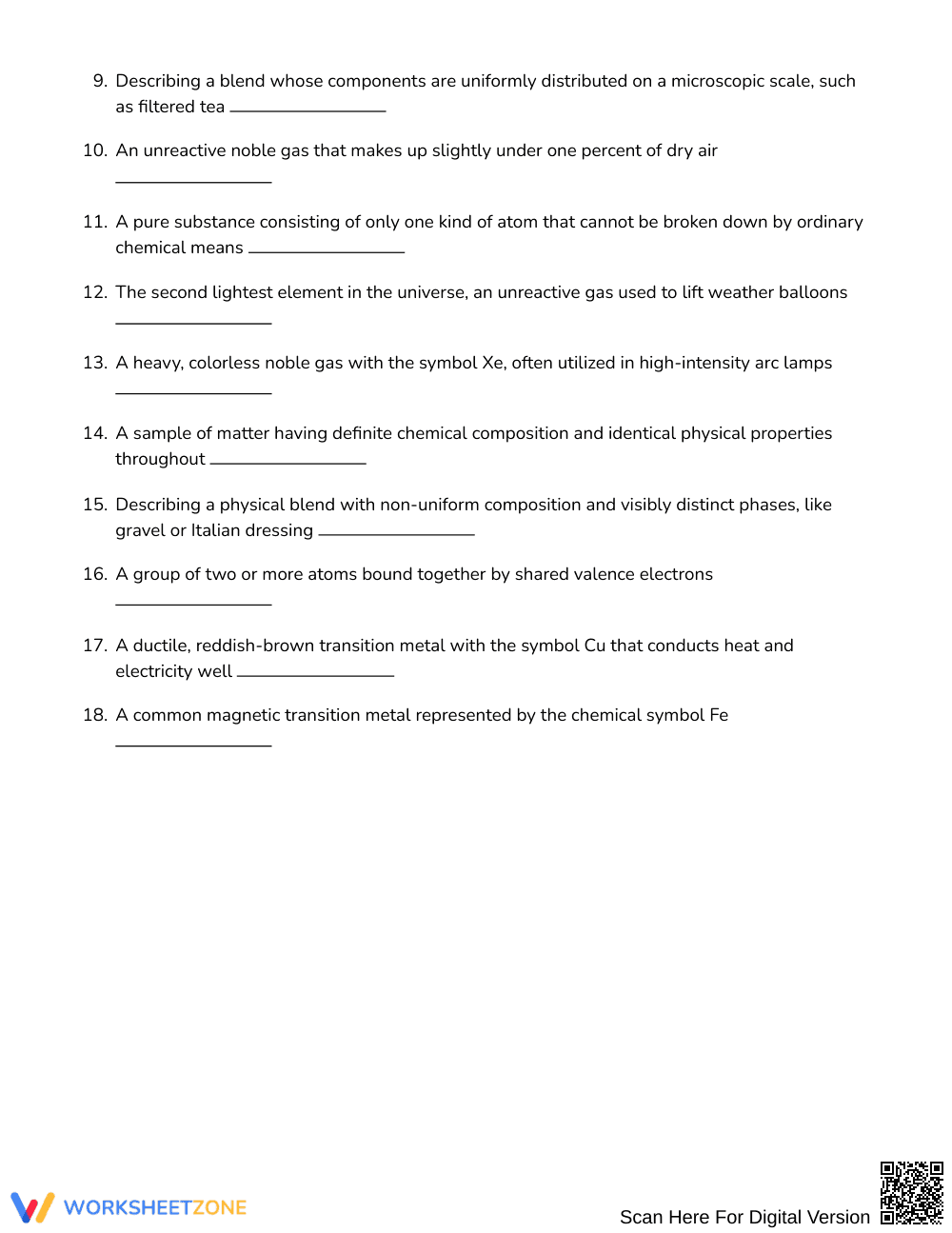
Inside the three‑page packet you’ll find a single 20 × 20 word search grid printed on the first page, a shuffled word bank and eight‑direction clue list on the second, and a separate answer‑key page that highlights each hidden term. The puzzle runs in all compass directions—N, NE, E, SE, S, SW, W, NW—encouraging thorough scanning and reinforcing the chemistry vocabulary presented in the unit.
Zero‑Prep Workflow
- Print: Open the PDF and print the three pages (under 30 seconds per copy).
- Distribute: Hand the word search and clue sheet to each learner; the answer key stays with the teacher (1–2 minutes).
- Review: After completion, quickly scan the answer key to confirm accuracy (1 minute). Total teacher prep stays under two minutes.
The activity fits neatly into a 10‑minute sub‑plan or can serve as a quick exit ticket.
Standards Alignment
Because this resource is designed solely for vocabulary enrichment, it is not aligned to any specific state or national standard. It complements the Classifying Matter unit by reinforcing key terminology without formal assessment requirements.
How to Use It
Pre‑lesson warm‑up: Before introducing the classification of matter, give students the word search to activate prior knowledge of element, compound, and mixture terminology. Observe which words are missed to inform immediate reteaching.
Post‑lesson review: After a lab or direct instruction, use the puzzle as a formative check; collect completed grids and note patterns of errors, then discuss correct definitions in a brief class debrief. Each session typically lasts 10–15 minutes.
Who It's For
Designed for Grades 7–8 science learners tackling the Classifying Matter unit. The activity works for whole‑class, small‑group, or individual practice and pairs naturally with a periodic‑table anchor chart or a teacher‑led lesson on matter classification.
Vocabulary‑focused puzzles like this word search have been shown to boost retention of scientific terminology. By engaging learners in active search, the activity aligns with research indicating that retrieval practice enhances long‑term memory (Fisher & Frey, 2014). The eight‑direction format also supports visual‑spatial processing, a key component of effective science instruction. While not tied to a formal standard, the task directly targets the skill of distinguishing elements, compounds, and mixtures—an essential foundation for later chemistry concepts. Studies in middle‑school science classrooms report that word‑search tasks improve engagement and allow teachers to quickly gauge vocabulary mastery (EdReports, 2024). Additionally, the shuffled word bank encourages repeated exposure, reinforcing spelling and conceptual connections. When paired with a brief discussion of each term, the activity can serve as a bridge between factual recall and deeper conceptual understanding.


