





























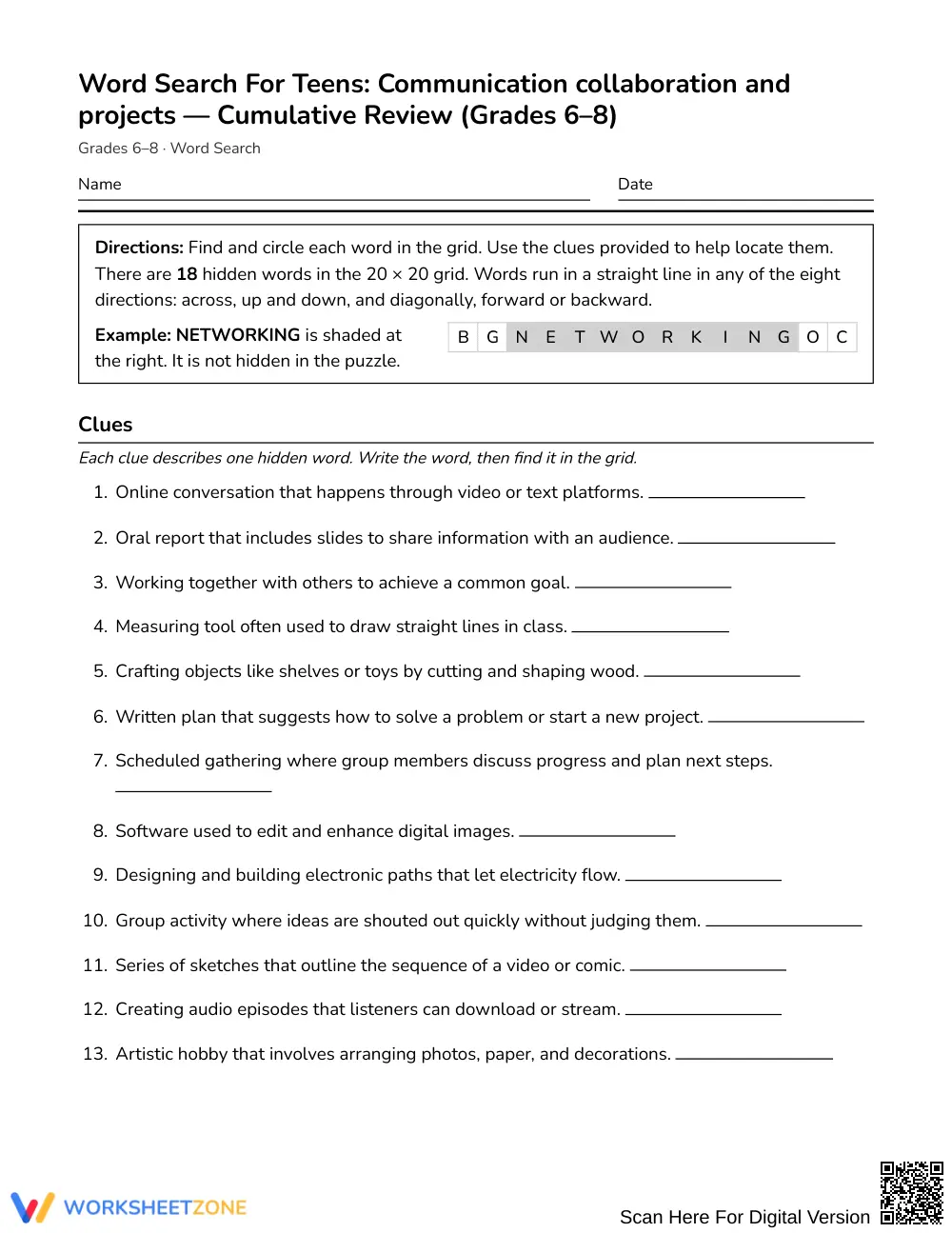


Free Collaboration & Projects Word Search | Grades 6–8 ELA

Paste this activity's link or code into your existing LMS (Google Classroom, Canvas, Teams, Schoology, Moodle, etc.).
Students can open and work on the activity right away, with no student login required.
You'll still be able to track student progress and results from your teacher account.
Students work through a focused vocabulary activity that reinforces key terms related to communication, collaboration, and project work. By completing the word search they practice spelling, pattern recognition, and contextual understanding, preparing them for real‑world group projects and presentations in class.
At a Glance
- Grade: Grades 6–8 · Subject: English Language Arts
- Standard:
Not standards-assessed — vocabulary enrichment; students locate and correctly spell each target word in the grid— students locate and correctly spell each target word in the grid- Skill Focus: communication, collaboration, and project‑based vocabulary
- Format: 3 printable pages · 18 hidden words · answer key included · ready‑to‑print PDF
- Best For: quick vocabulary enrichment activity for middle‑school learners
- Time: approximately 10–15 minutes of focused classroom work
Inside the 3‑page packet you’ll find a 20 × 20 letter grid, a shuffled word bank of 18 key terms, and clear clues for each entry. The puzzle runs in all eight directions—north, northeast, east, southeast, south, southwest, west, and northwest—so students must scan horizontally, vertically, and diagonally. An answer key on the final page lets teachers verify results quickly.
- Grid size: a 20 × 20 square provides ample space for 18 hidden words.
- Directions: words may appear horizontally, vertically, or diagonally in any of the eight compass directions (N, NE, E, SE, S, SW, W, NW).
- Word bank: the list of terms is shuffled each time, encouraging students to rely on clues rather than order.
- Clues: each term includes a brief definition or real‑world context to support vocabulary acquisition.
Because this activity is designed solely for vocabulary enrichment, it is not tied to any specific state or district standard. Teachers can freely incorporate it into any unit that addresses communication, collaboration, or project‑based language without worrying about compliance.
Use it as a warm‑up before a collaborative project lesson: students spend 5–7 minutes finding words, then discuss how each term relates to their upcoming work. Alternatively, employ it as a quick exit ticket after a presentation unit, allowing the teacher to gauge retained vocabulary while students reflect on the language they used.
Designed for Grades 6–8 English Language Arts learners, this search supports both emerging and confident readers. No differentiation levels are built in, but teachers can adjust difficulty by timing or by providing additional scaffolds such as a glossary. Pair it with a project‑planning anchor chart for seamless integration.
Word searches like this one provide an engaging, low‑stakes way for middle‑school learners to reinforce spelling and contextual meaning of key terms. By requiring students to locate and correctly spell communication‑related vocabulary, the activity supports the skill of decoding and reinforces semantic networks, a practice shown to improve retention (Fisher & Frey, 2014). The shuffled word bank and clue‑based approach encourage active reading and independent problem solving, aligning with research that highlights the benefits of purposeful practice for vocabulary growth. Although not tied to a formal standard, the puzzle serves as a practical tool for teachers aiming to embed language development within project‑based units, offering immediate feedback through the included answer key. Teachers can also use the activity to introduce collaborative discussion, prompting students to share how each term might appear in real project scenarios, thereby linking vocabulary to authentic communication practice.


