





























Paste this activity's link or code into your existing LMS (Google Classroom, Canvas, Teams, Schoology, Moodle, etc.).
Students can open and work on the activity right away, with no student login required.
You'll still be able to track student progress and results from your teacher account.


Free Break-Apart Multiplication Worksheet | Grade 3 Math

Paste this activity's link or code into your existing LMS (Google Classroom, Canvas, Teams, Schoology, Moodle, etc.).
Students can open and work on the activity right away, with no student login required.
You'll still be able to track student progress and results from your teacher account.
This Grade 3 math worksheet helps students use the break-apart multiplication strategy to find harder products from known facts. Learners split larger factors into familiar parts, apply the distributive property across 27 structured tasks, and decode a harvest-themed riddle to check their own accuracy.
At a Glance
- Grade: 3 · Subject: Math
- Standard:
3.OA.B.5— Break apart larger multiplication facts using known smaller facts- Skill Focus: Break-apart strategy for harder multiplication facts
- Format: 2 pages · 27 problems · Answer key included · PDF
- Best For: Independent multiplication strategy practice
- Time: 20–30 minutes
What's Inside
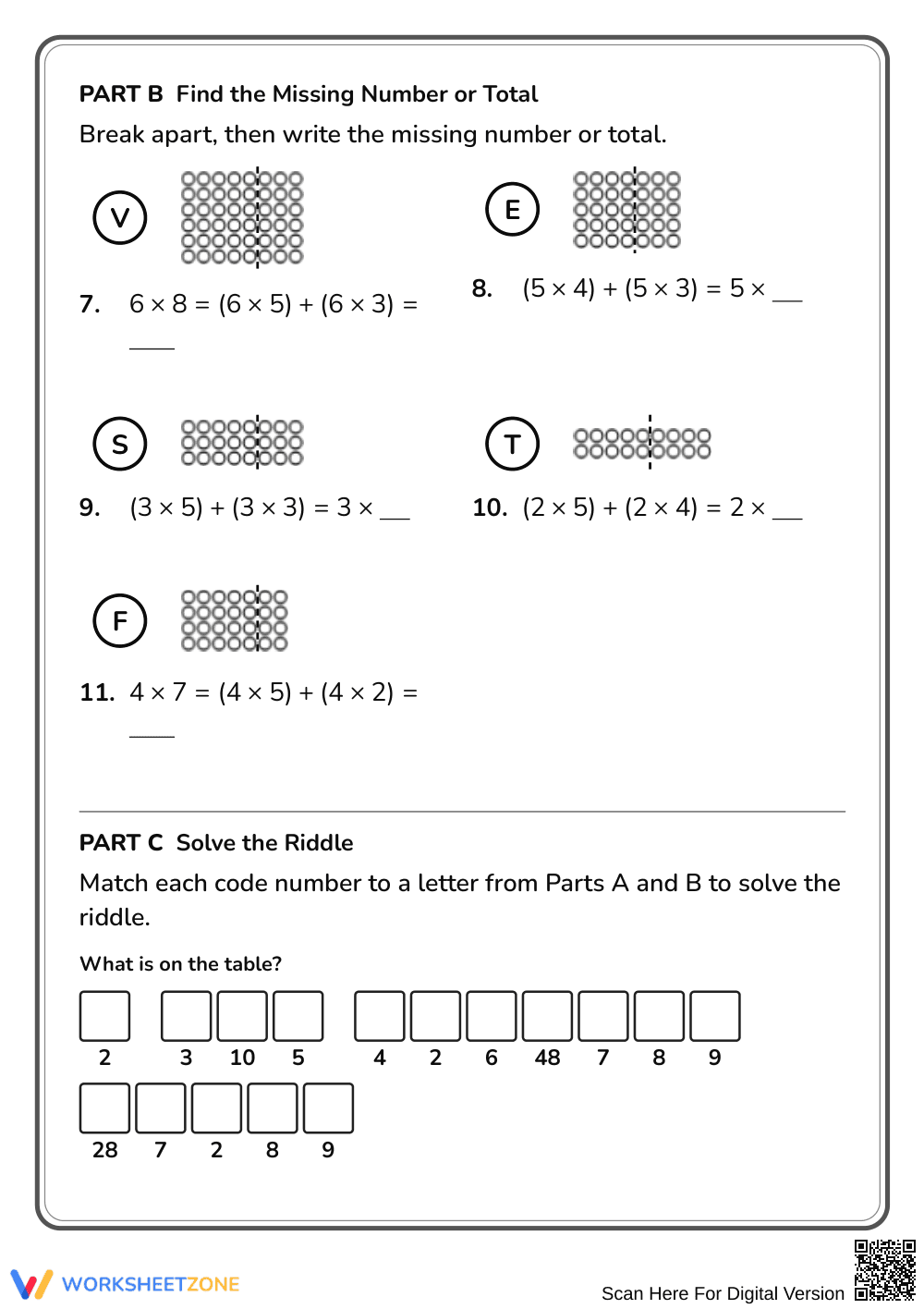
This 2-page PDF includes 27 tasks organized into three parts plus a 2-page answer key. Part A uses roll tray arrays to guide factor splitting, Part B builds equation fluency with missing numbers and totals, and Part C turns solutions into a self-checking riddle.
Skill Progression
- Guided practice (Part A): Array-supported equations prompt students to split one factor into two known facts and fill in missing numbers.
- Supported practice (Part B): Equations remove visual arrays, asking learners to complete decomposed expressions and calculate final products.
- Independent practice (Part C): Riddle-matching tasks require students to transfer accurate products from Parts A and B to decode the hidden phrase.
This sequence follows an I Do, We Do, You Do gradual-release structure.
Standards Alignment
Aligned to 3.OA.B.5, which requires Grade 3 students to apply properties of operations—specifically the distributive property—as strategies to multiply and divide. This practice also supports 3.OA.C.7 by building fluency with multiplication within 100. Both standard codes can be copied directly into lesson plans, IEP goals, or district curriculum mapping tools.
How to Use It
Assign this worksheet during or after direct instruction on the distributive property, either for independent seatwork or math centers. While circulating, watch whether students split the larger factor into friendly facts like fives and twos rather than guessing. Most learners complete all 27 tasks in 20 to 30 minutes.
Who It's For
Designed for Grade 3 students developing multiplication fluency beyond basic facts. Struggling learners can model arrays with counters before writing equations, while early finishers can create their own break-apart riddle clues. Pair this activity with a distributive property anchor chart for ongoing visual reference.
Aligned to Grade 3 standard 3.OA.B.5, this multiplication worksheet teaches students how to use the break-apart strategy with known facts to find harder products. By decomposing unfamiliar factors into manageable parts across 27 structured tasks and a self-checking riddle, learners strengthen conceptual understanding of the distributive property alongside computational fluency. According to Fisher & Frey (2014), structured gradual release from guided modeling to independent application helps elementary students internalize problem-solving strategies and transfer them to new contexts. The two-page format moves systematically from array-supported equations to abstract expressions and code-breaking application, giving teachers clear visibility into where students need additional scaffolding. With a complete two-page answer key included, educators can implement targeted Grade 3 multiplication practice immediately, monitor mastery of 3.OA.B.5, and support learners as they transition from visual arrays to mental math strategies.


