































Free Biogeochemical Cycles Worksheet | Grade 9‑12 Science

Paste this activity's link or code into your existing LMS (Google Classroom, Canvas, Teams, Schoology, Moodle, etc.).
Students can open and work on the activity right away, with no student login required.
You'll still be able to track student progress and results from your teacher account.
Students complete a comprehensive assessment of biogeochemical cycles, analyzing carbon, nitrogen, and phosphorus pathways and interpreting real-world data to demonstrate mastery of cycle processes and human impacts. Through guided questions, data calculations, and written explanations that connect scientific concepts to environmental consequences.
At a Glance
- Grade: Grades 9‑12 · Subject: Science
- Standard:
— Students analyze carbon, nitrogen, and phosphorus cycles, explain human influences, and interpret atmospheric data (approx 15‑word description) quick- Skill Focus: Biogeochemical cycles cumulative assessment
- Format: 4 pages · 21 problems · Answer key included · PDF available
- Best For: Quick End‑of‑unit review and mastery testing
- Time: 30–45 minutes
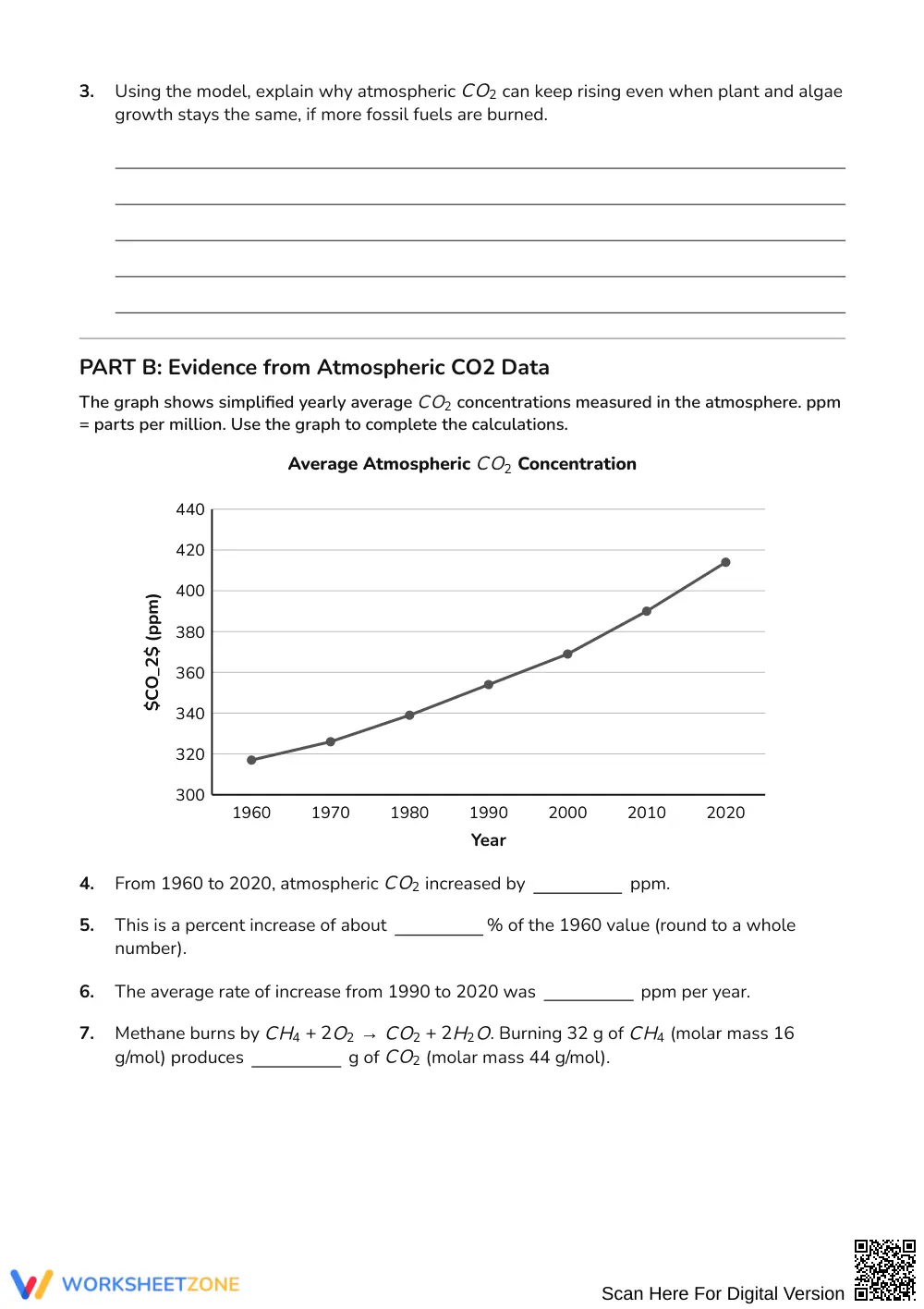
Inside the four‑page packet you’ll find three parts: a carbon‑cycle model with fill‑in and multiple‑choice items, a data‑driven carbon‑dioxide graph analysis, and nitrogen‑plus‑phosphorus cycle tables with short‑answer prompts. A comprehensive answer key follows each section for teacher quick grading.
- Guided practice (7 problems) – students work with a partially completed carbon‑cycle diagram and word bank.
- Supported practice (7 problems) – data‑graph calculations and table completion with sentence frames.
- Independent practice (7 problems) – full‑sentence explanations for nitrogen and phosphorus cycles without scaffolds.
The tasks follow an I Do, We Do, You Do release model to build confidence.
This worksheet aligns with the NGSS high‑school Earth and Human Activity standards that require students to model how matter cycles through ecosystems and evaluate human impacts on those cycles. It also supports cross‑cutting concepts of energy and matter flow.
Use it as a closing activity after a unit on Earth systems: have students complete Part A in small groups to reinforce model‑building, then collect Part B responses for a quick formative check. Alternatively, assign the full packet as homework the night before a unit test; collect the answer key to spot misconceptions and adjust review.
Designed for high‑school juniors and seniors in science courses, the worksheet meets the needs of mixed‑ability classes. The built‑in word banks and sentence frames support struggling learners, while the extension questions in Part C challenge advanced students. Pair it with a classroom anchor chart on cycle diagrams.
Citation Capsule: This Grade 9‑12 Science assessment targets students’ ability to analyze biogeochemical cycles and articulate human influences, a skill emphasized in national science standards. Research shows that cumulative assessments that blend model interpretation with data analysis improve conceptual retention (Fisher & Frey, 2014). The carbon‑cycle model and atmospheric CO₂ graph provide concrete contexts that align with evidence‑based practices for deepening systems thinking. By requiring explanations of nitrogen fixation and phosphorus runoff, the worksheet supports interdisciplinary connections highlighted in recent NGSS evaluations. Teachers can confidently assign this resource, knowing it reflects proven instructional strategies and prepares students for high‑stakes examinations. The inclusion of 21 targeted tasks ensures ample practice, and the answer key allows immediate feedback, which research links to increased student motivation (EdReports, 2024). Overall, the worksheet exemplifies a balanced approach to knowledge application and skill development.


