
































Free Biogeochemical Cycle Worksheet | Grade 9‑12 Science

Paste this activity's link or code into your existing LMS (Google Classroom, Canvas, Teams, Schoology, Moodle, etc.).
Students can open and work on the activity right away, with no student login required.
You'll still be able to track student progress and results from your teacher account.
This 4‑page worksheet guides high‑school students through a complete, safe investigation of biogeochemical cycles, helping them formulate testable questions, identify variables, make predictions, and interpret evidence.
At a Glance
- Grade: 9‑12 · Subject: Science
- Standard:
— Design and evaluate investigations of natural processes- Skill Focus: Investigation design, variable control, data analysis
- Format: 4 pages · 21 problems · Answer key included · PDF
- Best For: Inquiry‑based labs, formative assessment
- Time: 30–45 minutes
What's Inside
The packet contains three parts (Design, Analyze, Extend) with clear headings, a worked example, sentence frames for predictions, and a word bank for scientific terminology. All 21 tasks are numbered, and the answer key spans the final 4 pages for quick grading.
Skill Progression
- Guided practice (7 tasks): Students follow a worked example to write a testable question and label variables.
- Supported practice (7 tasks): Students choose comparison jars, predict outcomes, and justify reasoning using provided sentence frames.
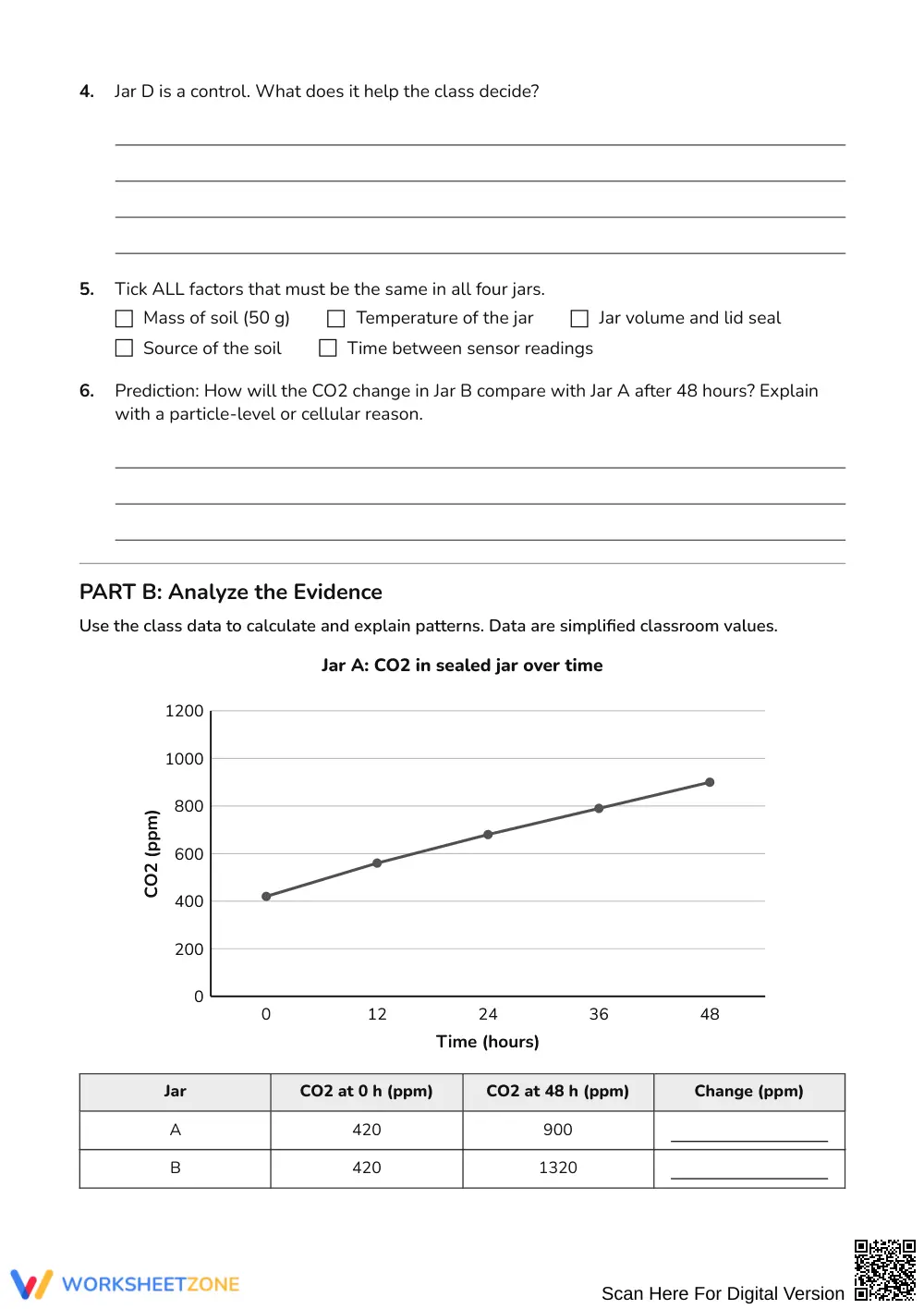
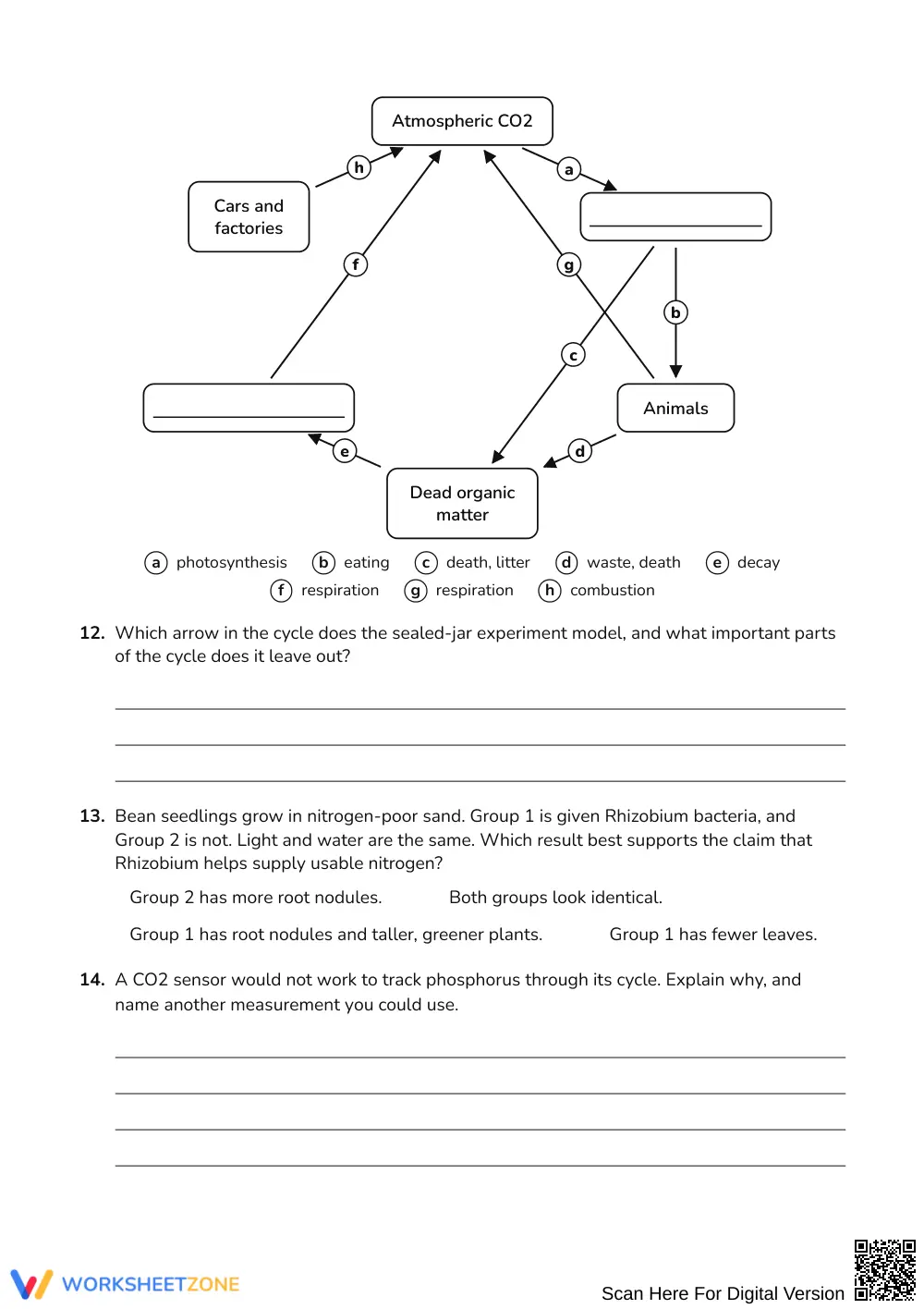
- Independent practice (7 tasks): Students analyze raw data, calculate rates, and connect findings to the carbon cycle without scaffolds.
This three‑stage release mirrors the classic I Do, We Do, You Do model, ensuring confidence builds before full independence.
Standards Alignment
Students will design safe investigations, control variables, and draw evidence‑based conclusions about natural processes. This aligns with state science standards that require learners to plan and evaluate investigations of ecosystems and cycles. Both statements can be copied directly into lesson plans, IEP goals, or district curriculum mapping tools.
How to Use It
• Before a unit on the carbon cycle: Hand out Part A as an entry‑point activity to activate prior knowledge and generate curiosity. Observe students’ question‑writing as a quick formative check.
• During lab work: Use Part B after data collection to guide students through calculation and interpretation, then discuss findings in a whole‑class debrief. Expect completion in 30–45 minutes.
Who It's For
This resource is ideal for 9‑12 science students who have basic lab safety training. It supports mixed‑ability groups; stronger learners can tackle the extension questions in Part C, while emerging readers benefit from the word bank and sentence frames. Pair it with a short video on the carbon cycle or an anchor chart of the major biogeochemical pathways.
Research in science education demonstrates that explicit scaffolding of inquiry steps significantly improves students' capacity to construct valid empirical explanations (Fisher and Frey, 2014). When secondary learners receive guided prompts to identify independent variables, comparison groups, and measurable outcomes, they build stronger conceptual understanding of complex natural systems. Structured sentence frames and targeted vocabulary supports help bridge the gap between initial observation and rigorous scientific reasoning. Furthermore, educational research confirms that breaking multifaceted laboratory tasks into sequential stages reduces extraneous cognitive load, allowing students to focus mental effort on core analytical skills (Sweller, 2011). By leading learners from guided modeling toward autonomous interpretation, this classroom resource reinforces essential experimental competencies. High school students develop the confidence and technical precision required to formulate testable hypotheses, interpret ecological data sets accurately, and connect classroom observations directly to broader environmental cycles across aquatic and terrestrial ecosystems.


