































Free African Lakes Word Search | Grades 6–7 Social Studies

Paste this activity's link or code into your existing LMS (Google Classroom, Canvas, Teams, Schoology, Moodle, etc.).
Students can open and work on the activity right away, with no student login required.
You'll still be able to track student progress and results from your teacher account.
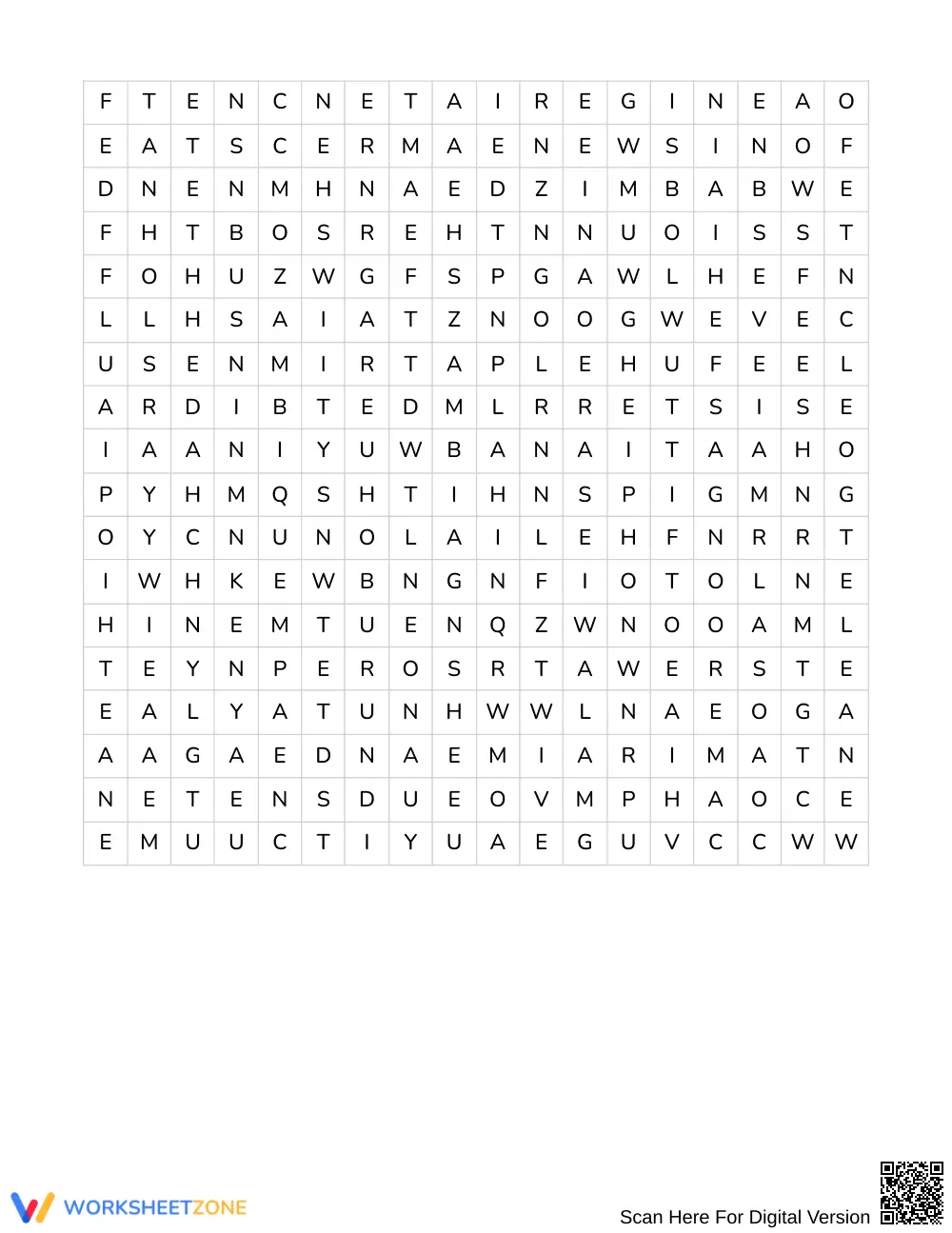
This printable word search lets Grades 6–7 Social Studies learners practice geographic vocabulary by locating sixteen African countries that border major lakes, reinforcing map-reading skills while providing a fun, self-contained activity.
At a Glance
- Grade: Grades 6–7 · Subject: Social Studies
- Standard:
Not standards-assessed — vocabulary enrichment— students expand geographic vocabulary and lake-region knowledge- Skill Focus: countries bordering major African lakes
- Format: 3 printable pages · 16 hidden words · Answer key included · PDF ready
- Best For: quick vocabulary enrichment activity in a geography unit
- Time: 5–10 minutes
Inside you’ll find a single 18 × 18 grid where country names run in all eight compass directions (north, northeast, east, southeast, south, southwest, west, northwest). Each clue describes a nation’s specific lake relationship, prompting learners to consider geographic features before searching. The full answer key on a separate page displays the completed grid with highlighted solution paths for rapid checking.
Zero-Prep Workflow:
- Print the 3-page PDF (under 30 seconds).
- Distribute the search and clue sheet to students (10-15 seconds).
- After completion, use the answer key to review quickly (under 30 seconds).
This activity is not aligned to any state or national standard; it serves purely as vocabulary enrichment for learners exploring African geography.
How to Use It:
- Before a lesson on African lakes, give the search as a warm-up to activate prior knowledge.
- During a geography unit, use it as a quick formative check; observe which clues students struggle with to inform subsequent instruction.
- Assign it as an independent fast-finisher task for learners who complete mapping assignments early.
- Have partners read the lake clues aloud and verify country borders using an atlas before circling names.
Who It’s For:
Designed for Grades 6–7 Social Studies students, this word search works well alongside a physical map of African lakes or an anchor chart of East African Rift Valley features. It supports visual and kinesthetic learners by connecting textual geographic clues with letter-finding patterns, providing a natural pairing that deepens regional context.
Research shows that short, focused word-search activities boost retention of factual content while keeping learners engaged (Fisher & Frey, 2014). By integrating clear clues with a visual puzzle, students practice reading comprehension, spatial reasoning, and geographic terminology in a single, low-stakes task. The sixteen-word count offers enough challenge to reinforce learning without overwhelming emerging readers, and the immediate feedback from the answer key supports self-assessment, a key component of effective vocabulary instruction. Furthermore, cognitive research indicates that linking orthographic word recognition with conceptual geographical clues strengthens memory pathways and enhances long-term recall of regional facts. Middle school learners gain confidence as they decode clues about lake locations and scan the grid systematically. This dual-processing approach bridges spatial analysis and vocabulary development, ensuring that geography concepts remain durable, accessible, and meaningful across future classroom discussions.


