


























Views
Downloads

Printable Franklin is Lost Comp Check | Grade 1-3 ELA
Paste this activity's link or code into your existing LMS (Google Classroom, Canvas, Teams, Schoology, Moodle, etc.).
Students can open and work on the activity right away, with no student login required.
You'll still be able to track student progress and results from your teacher account.
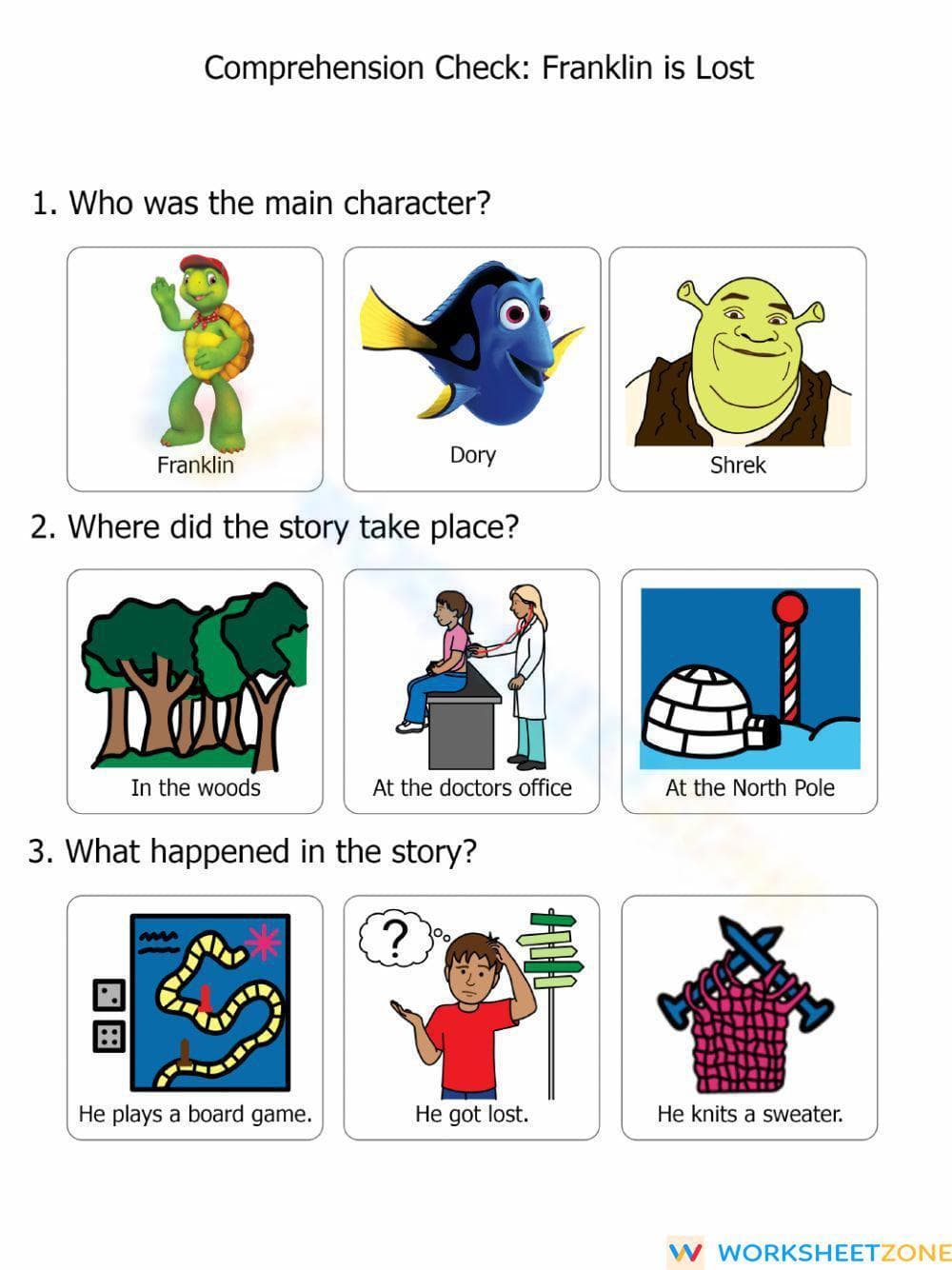
This Franklin is Lost comprehension check helps Grade 1 students demonstrate their understanding of key story elements. By identifying the main character, setting, and primary conflict through visual cues, learners solidify their grasp of narrative structure. This worksheet provides a quick, effective way to gauge student listening or reading comprehension after engaging with the story.
At a Glance
- Grade: 1 · Subject: English Language Arts
- Standard:
CCSS.ELA-LITERACY.RL.1.3— Describe characters, settings, and major events in a story using key details.- Skill Focus: Story Elements (Character, Setting, Plot)
- Format: 1 page · 3 problems · Answer key included · PDF
- Best For: Post-reading assessment or quick comprehension check
- Time: 5–10 minutes
This single-page PDF features three clear multiple-choice questions accompanied by vibrant illustrations. Students select from three visual options to identify "Franklin" as the main character, the "woods" as the setting, and the core event of getting lost. The large images and simple text make it accessible for early readers or as a guided listening activity for younger students.
The zero-prep workflow for this activity involves three simple steps: Print (30 seconds), Distribute (1 minute), and Review (2 minutes). The total teacher preparation time for this activity is under two minutes, making it an ideal choice for a busy morning meeting or a sudden substitute teacher plan. Because the questions are highly visual, students can often complete the tasks independently once the instructions are provided.
This resource is aligned with CCSS.ELA-LITERACY.RL.1.3, which requires students to describe characters, settings, and major events in a story. By isolating these three distinct elements, the worksheet ensures that students are focusing on the foundational components of literary analysis. This standard code can be copied directly into lesson plans, IEP goals, or district curriculum mapping tools.
Use this worksheet immediately following a read-aloud session as a formative assessment to check for general understanding. As students work, observe if they can distinguish between the actual story characters and familiar pop-culture figures like Shrek. This activity typically takes 5 to 10 minutes to complete, providing instant feedback on the class's retention of the story's details.
This resource is designed for Kindergarten through Grade 3 students, with heavy scaffolding through visual options for emerging readers. It pairs naturally with a physical or digital copy of "Franklin is Lost" by Paulette Bourgeois. It is particularly helpful for English Language Learners (ELLs) who benefit from the image-heavy response format to demonstrate their knowledge.
According to the RAND AIRS 2024 report on early literacy interventions, visual scaffolding in comprehension assessments significantly improves the accuracy of data gathered from emerging readers. This worksheet utilizes that principle by pairing standard CCSS.ELA-LITERACY.RL.1.3 with distinct illustrations for character, setting, and plot identification. By reducing the decoding burden, the activity focuses purely on the cognitive task of story recall and narrative sequencing. Research from Fisher & Frey (2014) emphasizes that "checking for understanding" through these targeted prompts allows educators to identify gaps in listening comprehension before they transition into more complex independent reading tasks. The use of familiar foils alongside story-specific images helps verify that students are truly recalling the text rather than just recognizing common tropes. This printable resource serves as a reliable evidence-based tool for measuring foundational literary skills in a classroom setting, ensuring that students meet grade-level benchmarks for story analysis.


