




























Views
Downloads

Printable Fractions to Decimals Worksheet | Grade 6-7 Math

Paste this activity's link or code into your existing LMS (Google Classroom, Canvas, Teams, Schoology, Moodle, etc.).
Students can open and work on the activity right away, with no student login required.
You'll still be able to track student progress and results from your teacher account.
Help students master the essential bridge between rational number representations with this comprehensive fractions to decimals worksheet. Designed for Grade 6 and Grade 7 learners, this resource provides a structured pathway to mathematical fluency. By practicing conversion techniques across three distinct difficulty levels, students build the confidence needed for advanced algebraic operations and real-world financial literacy applications.
At a Glance
- Grade: 6–7 · Subject: Decimals
- Standard:
CCSS.MATH.CONTENT.7.NS.A.2.D— Convert fractions and mixed numbers into their equivalent decimal forms.- Skill Focus: Rational Number Conversion
- Format: 4 pages · 16 problems · Answer key included · PDF
- Best For: Independent practice and skill reinforcement
- Time: 25–35 minutes
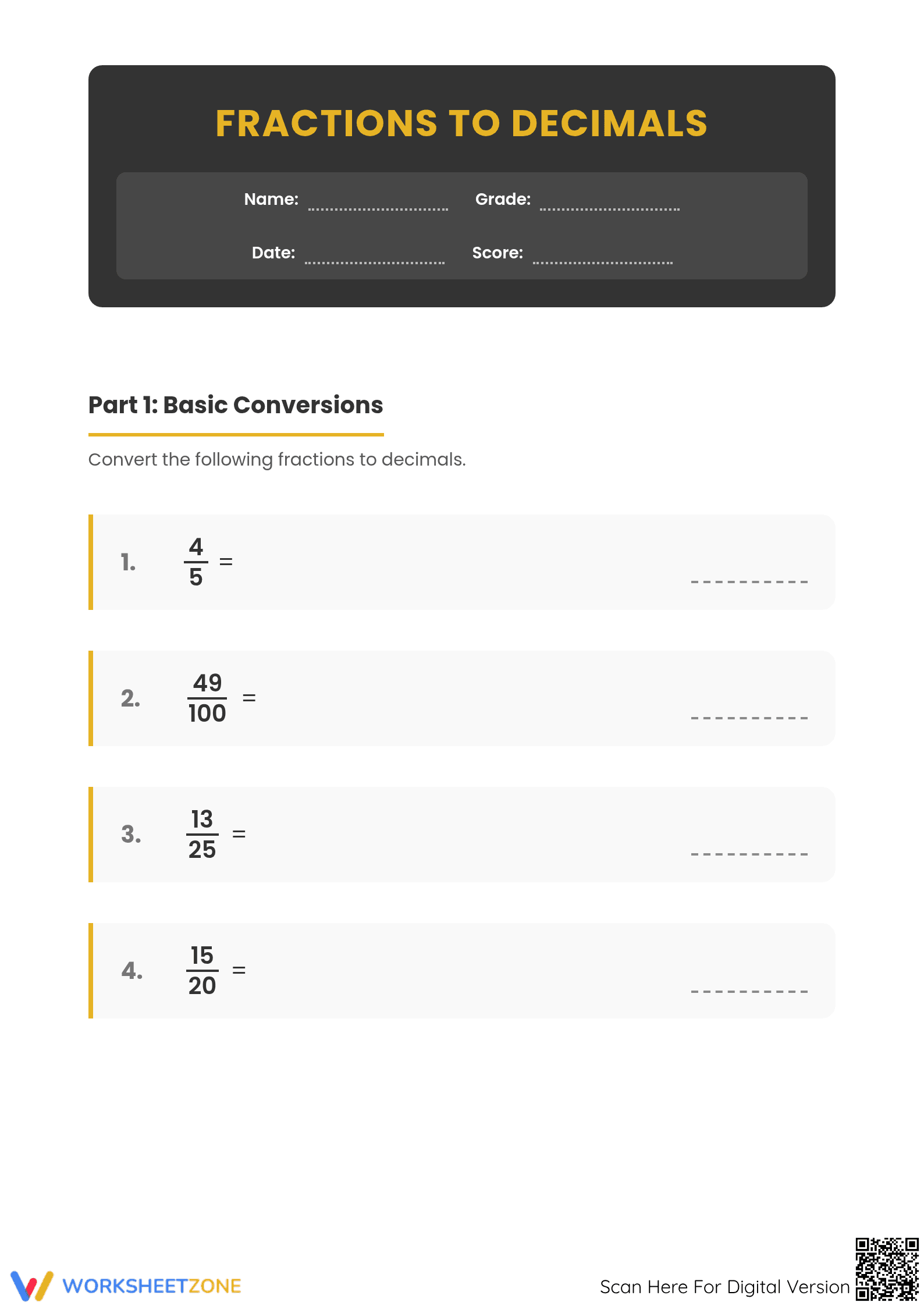
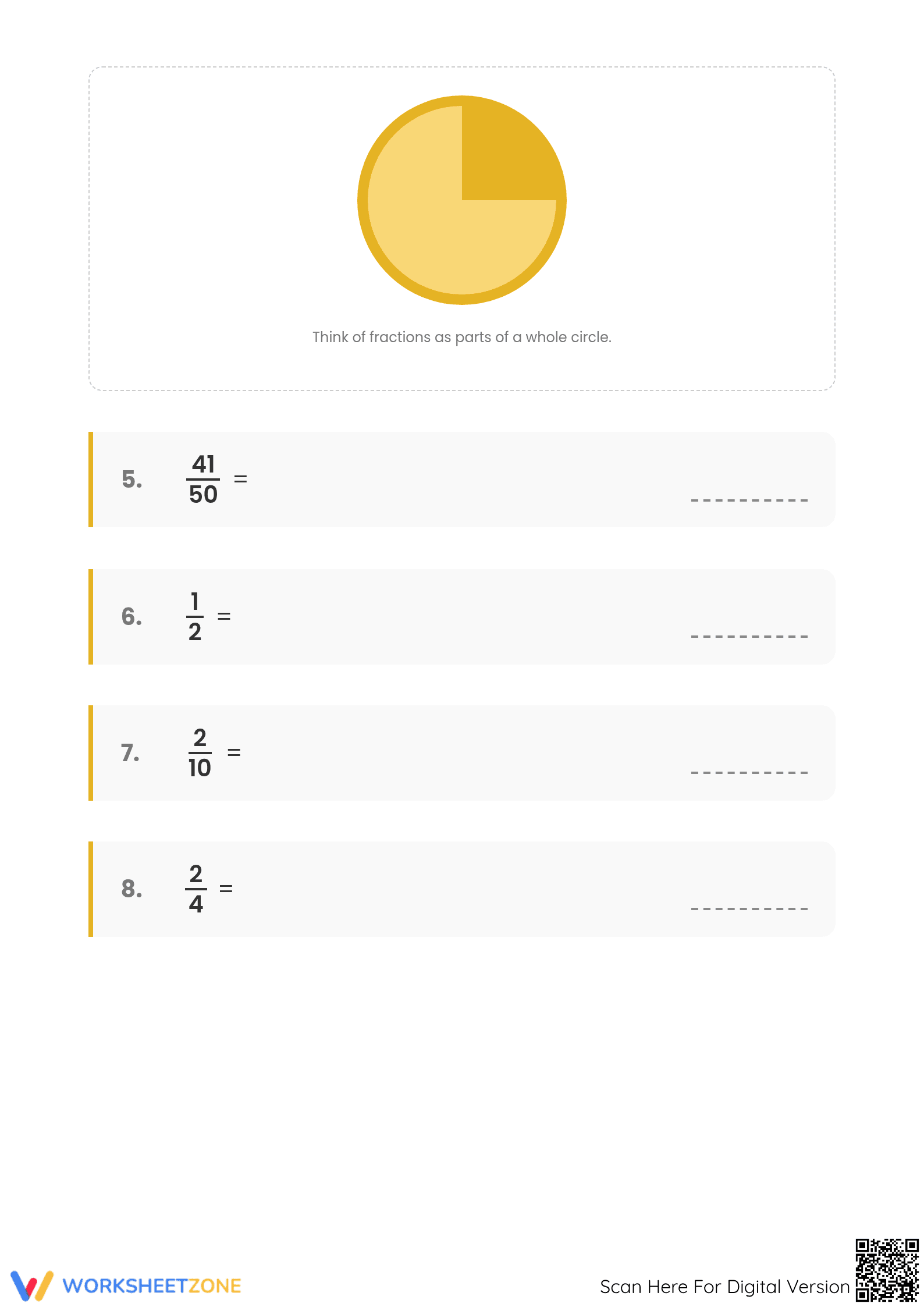
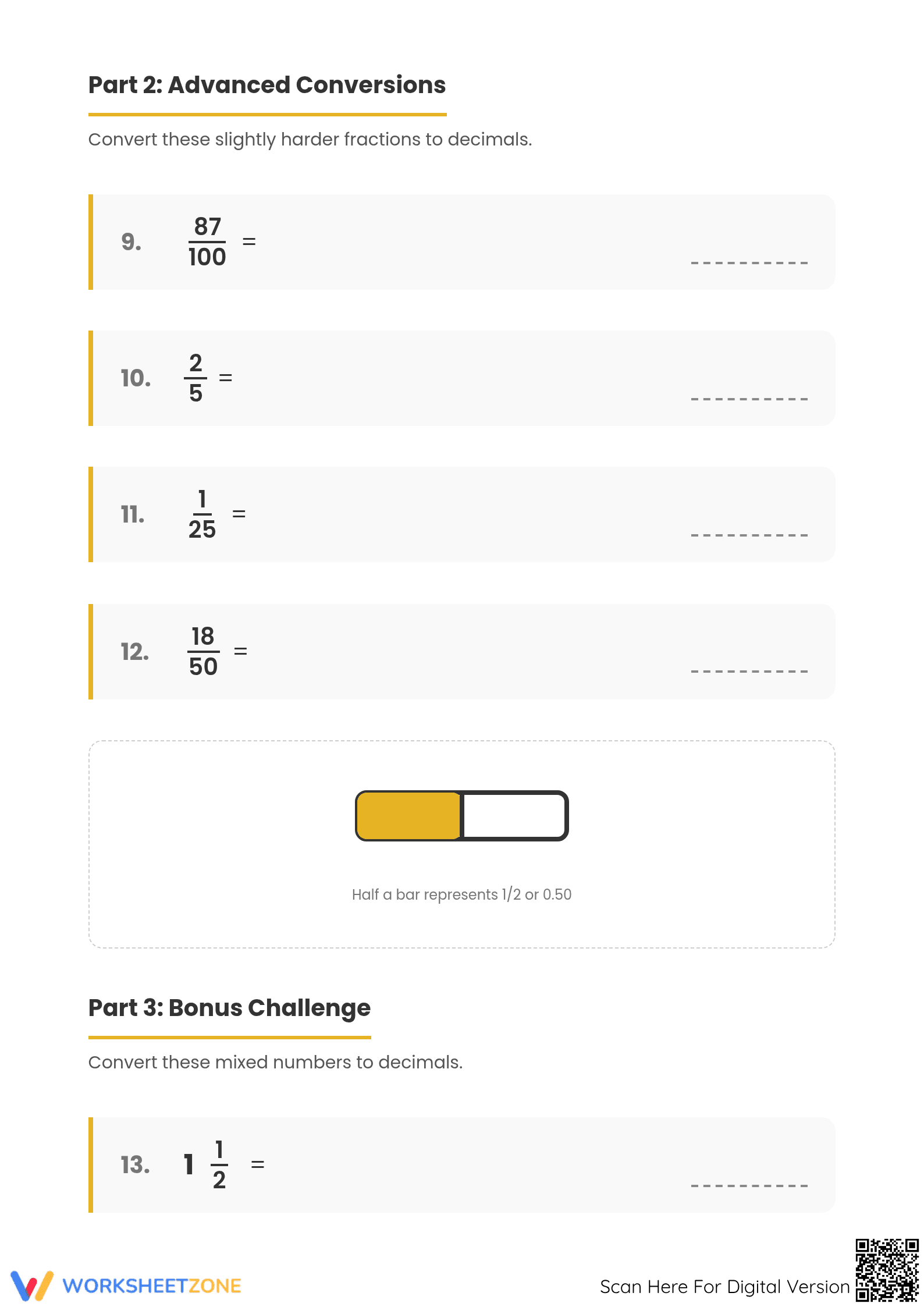
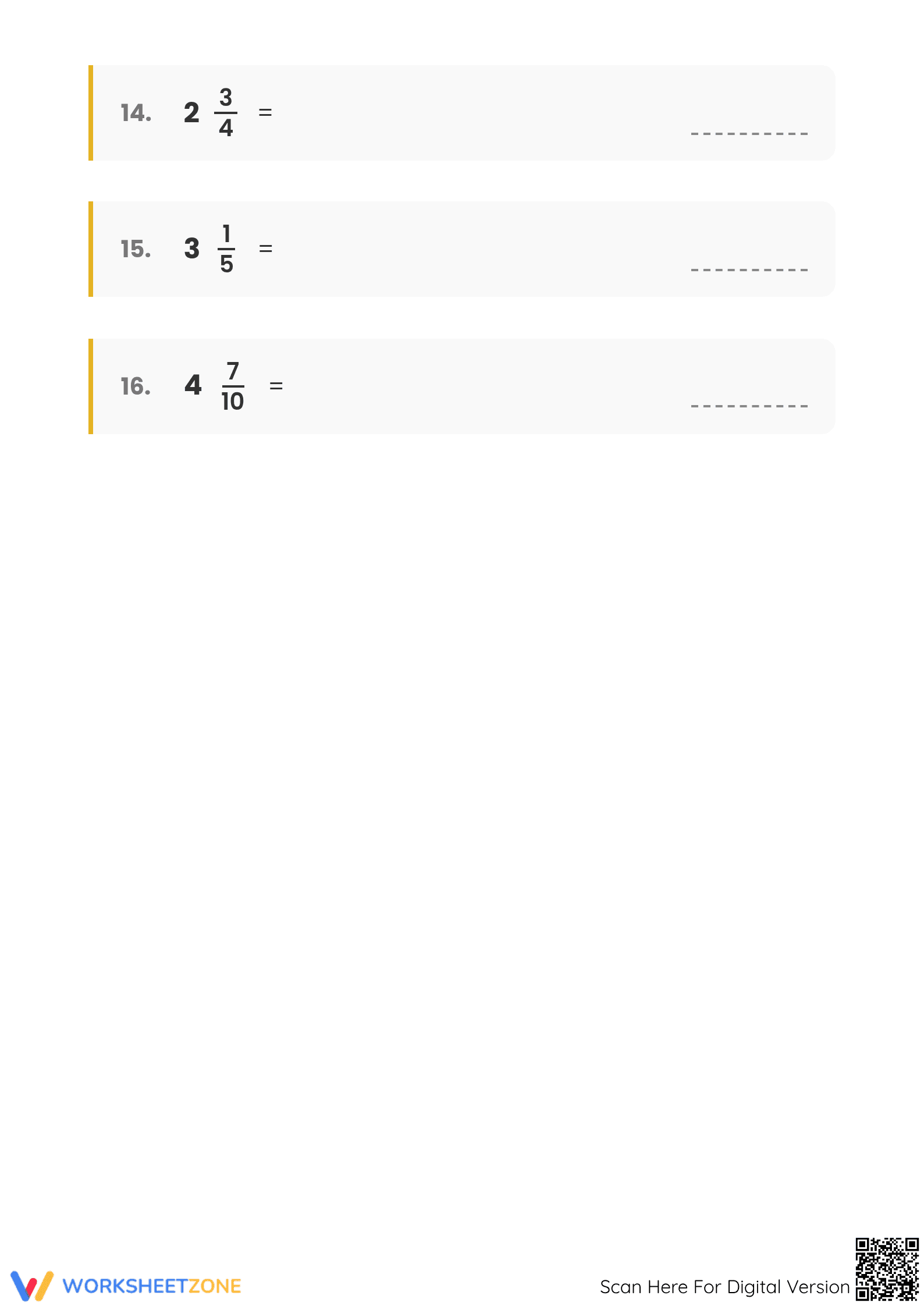
This four-page instructional packet features 16 carefully curated problems that guide students through the mechanics of converting fractions to decimals. The worksheet is organized into three progressive parts: basic conversions, advanced fractions, and a bonus challenge involving mixed numbers. Each problem includes dedicated workspace and a clear results line to ensure organized student work. A full answer key is included to facilitate quick grading and immediate student feedback.
Skill Progression
- Guided Practice: The initial section presents 8 fundamental fractions with denominators like 10, 25, and 100, allowing students to recognize patterns in place value.
- Supported Practice: Part 2 introduces 4 slightly more complex fractions, such as 18/50 and 1/25, requiring students to apply division or equivalent fraction strategies.
- Independent Practice: The final challenge features 4 mixed numbers, pushing students to integrate whole number concepts with fractional parts for a complete decimal solution.
This structure follows a gradual-release model, transitioning from I Do/We Do recognition to independent mastery of multi-step rational number conversions.
Standards Alignment
The primary focus is CCSS.MATH.CONTENT.7.NS.A.2.D, which requires students to convert a rational number to a decimal using division and identify terminating or repeating patterns. This worksheet specifically targets the computational aspect of this standard. This code can be copied directly into lesson plans, IEP goals, or district curriculum mapping tools to ensure instructional consistency across the middle school math sequence.
How to Use It
Use this worksheet as a targeted follow-up to direct instruction on the relationship between fractions and division. It serves as an excellent formative assessment tool; teachers should observe students during Part 2 to identify those struggling with denominator-to-decimal mental math. Expect students to complete the full 16-problem set within 30 minutes. It also functions perfectly as a homework assignment to solidify classroom learning.
Who It's For
This resource is ideal for Grade 6 and Grade 7 students working toward proficiency in the Number System domain. It provides necessary scaffolding for learners who benefit from a clean layout and progressive difficulty. Naturally pair this worksheet with a visual anchor chart displaying common fraction-decimal equivalents or a short introductory video on long division techniques for rational numbers.
According to a ScienceDirect TpT Analysis (2023), structured practice that bridges fractional and decimal representations is critical for developing the proportional reasoning necessary for high school algebra. This worksheet specifically addresses the computational fluency required by standard CCSS.MATH.CONTENT.7.NS.A.2.D. By isolating the skill of converting fractions to decimals, the resource minimizes cognitive load, allowing students to focus on the procedural accuracy of division and place value assignment. Research indicates that scaffolded mathematical tasks—moving from basic denominators to mixed numbers—significantly reduce math anxiety and improve long-term retention of rational number properties. Educational experts emphasize that mastering these conversions at the Grade 6 and 7 levels is a strong predictor of success in future statistics and geometry coursework. This printable PDF serves as a high-signal diagnostic tool for teachers to verify that students have moved beyond rote memorization into conceptual mastery of decimal equivalence.


