


























Views
Downloads
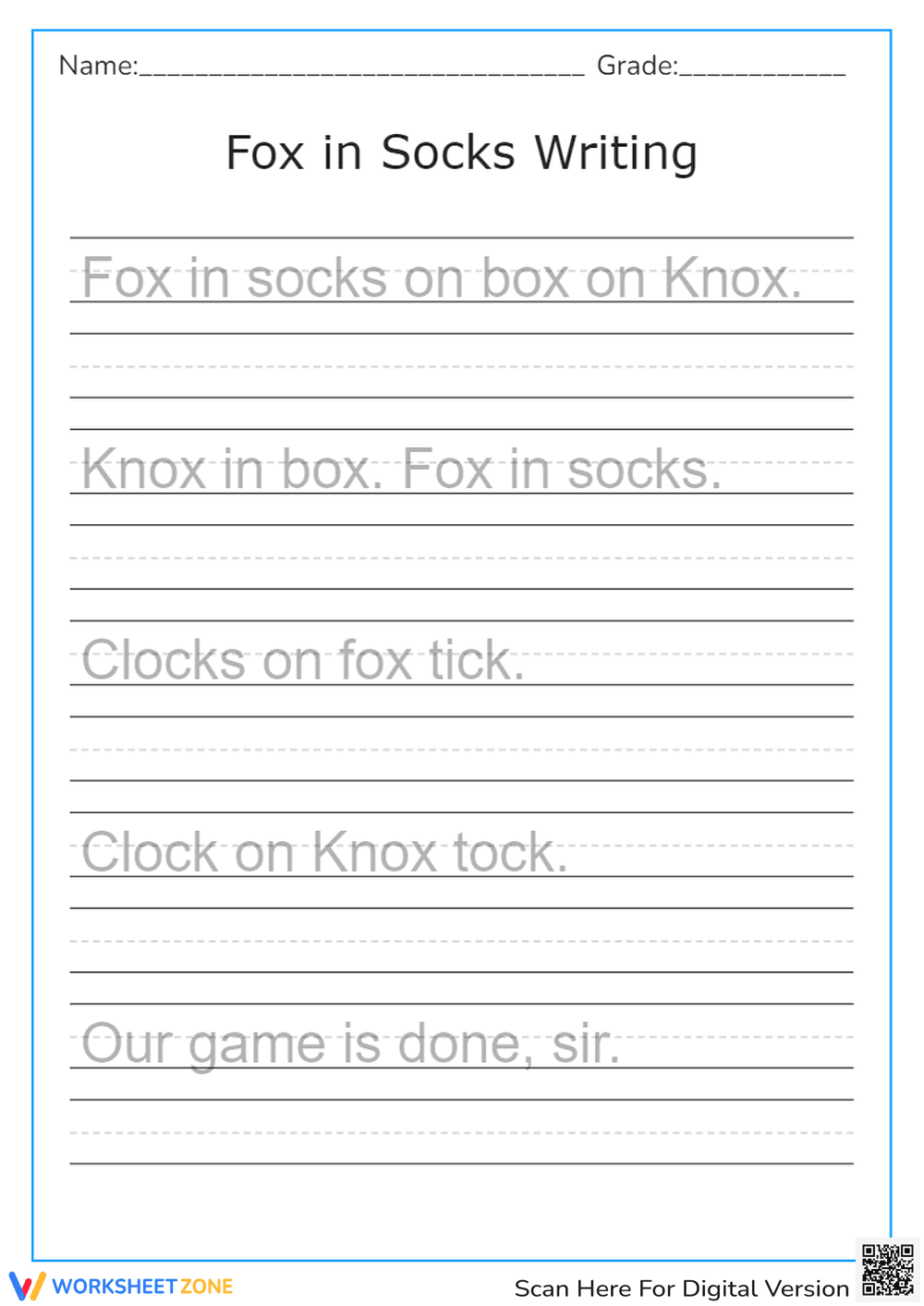

Fox in Socks Handwriting Practice | Essential Grade 1-2
Paste this activity's link or code into your existing LMS (Google Classroom, Canvas, Teams, Schoology, Moodle, etc.).
Students can open and work on the activity right away, with no student login required.
You'll still be able to track student progress and results from your teacher account.
This Grade 1 and Grade 2 handwriting worksheet helps students master letter formation and sentence spacing by copying whimsical lines from a classic text. By engaging with familiar literary content, learners develop the fine motor control necessary for legible penmanship while reinforcing basic reading fluency and punctuation rules.
At a Glance
- Grade: 1-2 · Subject: Handwriting
- Standard:
CCSS.ELA-LITERACY.L.1.1.A— Print all upper- and lowercase letters legibly and accurately- Skill Focus: Sentence copying and letter formation
- Format: 1 page · 5 sentences · Answer key included · PDF
- Best For: Morning work or literacy centers
- Time: 10–15 minutes
What's Inside
This single-page PDF features five distinct sentences inspired by "Fox in Socks." Each sentence is presented in a light grey tracing font on primary ruled lines, providing a clear visual guide for height and baseline placement. The layout includes ample white space to prevent visual overwhelm, ensuring students can focus on the mechanics of writing each character accurately.
Zero-Prep Workflow
- Print: Send the single-page PDF to your printer (30 seconds).
- Distribute: Hand out the sheets during your literacy block or as a transition activity (1 minute).
- Review: Quickly check completed work for proper letter slant and spacing (30 seconds per student).
Total teacher preparation time is under two minutes, making it an ideal choice for sub plans or unexpected schedule gaps.
Standards Alignment
The primary focus is `CCSS.ELA-LITERACY.L.1.1.A`, which requires students to print all upper- and lowercase letters. Additionally, it supports `CCSS.ELA-LITERACY.L.1.2`, focusing on the use of end punctuation and capitalization at the start of sentences. Both standard codes can be copied directly into lesson plans, IEP goals, or district curriculum mapping tools.
How to Use It
Use this worksheet during the independent practice phase of a handwriting lesson. After demonstrating proper grip and posture, assign the sentences as a quiet desk activity. For a formative assessment, observe how students handle the "k" in "Knox" or the "x" in "box," noting any difficulties with diagonal strokes. This task typically takes 10 to 15 minutes to complete.
Who It's For
This activity is tailored for first and second-grade students who are transitioning from individual letter practice to full sentence construction. It is particularly effective for English Language Learners (ELLs) who benefit from the repetitive, rhythmic nature of the text. Pair this with a read-aloud of the original book to increase student engagement and context.
Handwriting remains a foundational literacy skill, as research from Fisher & Frey (2014) emphasizes that the physical act of writing letters by hand supports orthographic mapping and long-term memory retention. This worksheet aligns with CCSS.ELA-LITERACY.L.1.1.A by providing structured opportunities for students to print all upper- and lowercase letters within a meaningful context. By copying 5 specific sentences, learners practice the fine motor coordination required for legible penmanship, which is a significant predictor of later writing fluency. According to the RAND AIRS 2024 report, consistent, short-burst practice sessions are more effective for motor skill acquisition than infrequent, long sessions. This resource provides that targeted practice, ensuring students develop the muscle memory needed for academic success across all subjects. The use of literary-themed content further bridges the gap between mechanical writing and reading comprehension.


