


























Views
Downloads
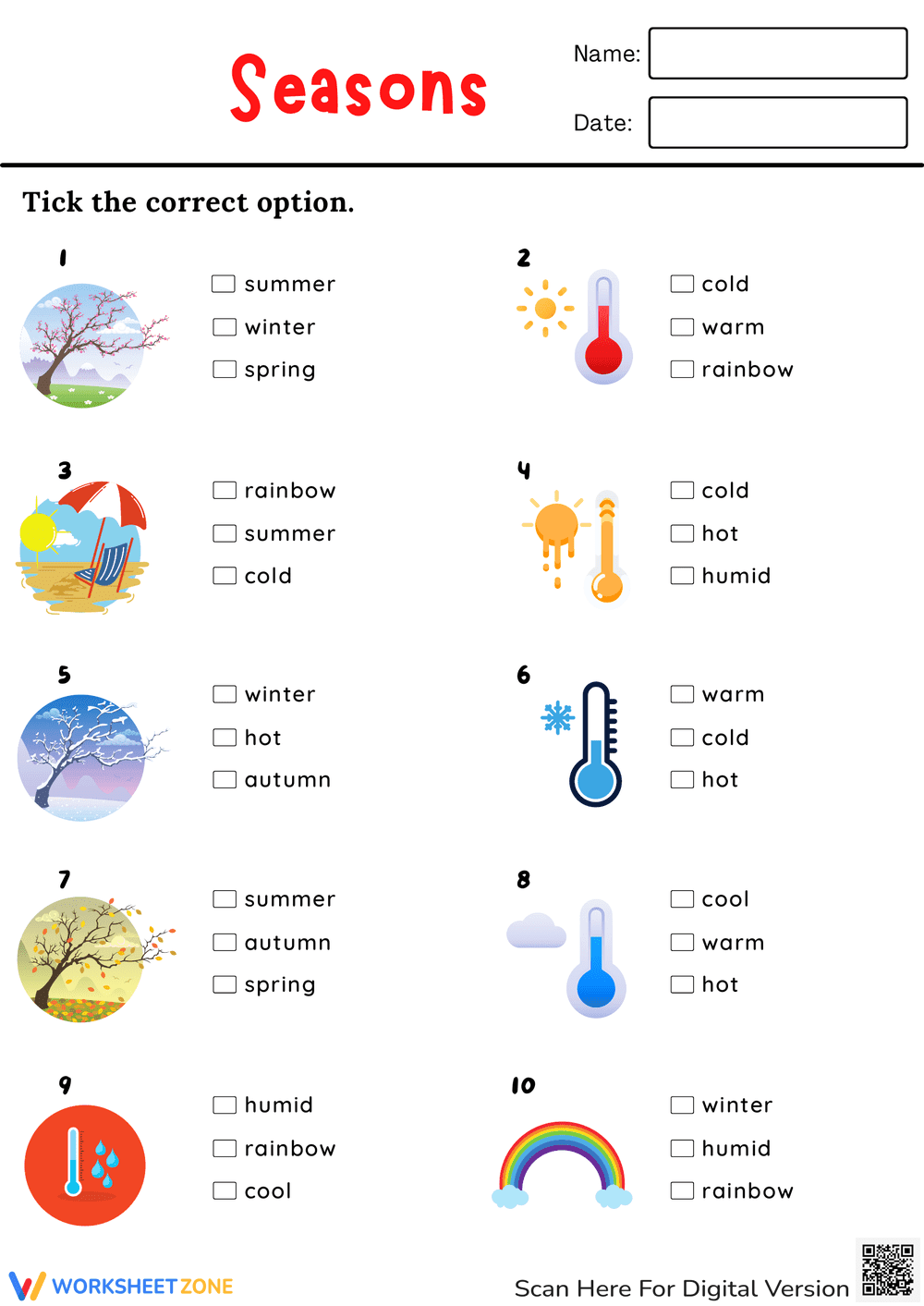

Four Seasons Quiz | Grade 1-3 Essential Science
Paste this activity's link or code into your existing LMS (Google Classroom, Canvas, Teams, Schoology, Moodle, etc.).
Students can open and work on the activity right away, with no student login required.
You'll still be able to track student progress and results from your teacher account.
This Grade 1-3 science worksheet helps students identify seasonal changes and weather patterns through visual cues. By matching images of trees, thermometers, and atmospheric conditions to the correct terms, learners build foundational Earth Science vocabulary. It provides a quick assessment of a student's ability to recognize environmental cycles and their associated characteristics.
At a Glance
- Grade: 1-3 · Subject: Science
- Standard:
K-ESS2-1— Use observations of local weather conditions to describe patterns over time- Skill Focus: Seasonal identification and weather vocabulary
- Format: 1 page · 10 problems · Answer key included · PDF
- Best For: Quick formative assessment or morning work
- Time: 10–15 minutes
The worksheet features 10 multiple-choice questions, each paired with a clear, colorful illustration. Students evaluate images ranging from blossoming spring trees to snowy winter landscapes and varying thermometer readings. The single-page layout is designed for clarity, featuring large tick boxes that are accessible for younger learners developing fine motor skills. A comprehensive answer key is provided for rapid grading.
The zero-prep workflow is designed for maximum efficiency in busy classrooms. First, print the single-page PDF (30 seconds). Second, distribute the sheets to students as a quiet transition activity or bell-ringer (1 minute). Third, review the answers as a whole group to reinforce vocabulary and clarify misconceptions (5 minutes). Total teacher preparation time is under 2 minutes, making this an ideal resource for substitute folders.
This resource aligns with `K-ESS2-1`, focusing on using observations to describe weather patterns. While listed for Grades 1-3, it supports the foundational understanding of Earth’s systems and the predictable changes that occur throughout the year. Both standard codes can be copied directly into lesson plans, IEP goals, or district curriculum mapping tools.
Use this worksheet during a unit on Earth's cycles as a mid-point check for understanding. It works best after direct instruction on the four seasons and their typical weather. For a formative assessment, observe if students can distinguish between cool, cold, and hot based on the thermometer visuals. Expect completion within 10 to 15 minutes.
This resource is for primary elementary students, including English Language Learners (ELL) who benefit from the strong visual-to-text associations. It pairs naturally with a classroom weather station or a seasonal anchor chart. The simple format ensures that students with diverse learning needs can demonstrate their knowledge of environmental patterns without heavy reading barriers.
According to the RAND AIRS 2024 report on elementary science instruction, the use of high-quality visual aids in formative assessments significantly improves retention of abstract concepts like seasonal cycles. This worksheet addresses the K-ESS2-1 standard by requiring students to observe and categorize weather patterns through 10 targeted visual prompts. Research from Fisher & Frey (2014) emphasizes that check for understanding tools with immediate feedback loops, such as this printable quiz, are essential for moving students toward mastery in Earth Science. By connecting specific environmental indicators—like thermometer levels and foliage changes—to seasonal vocabulary, the resource builds the cognitive scaffolding necessary for more complex climate studies in later grades. The inclusion of an answer key ensures that educators can provide the timely corrective feedback that NAEP identifies as a critical factor in student achievement across the primary grades.


